
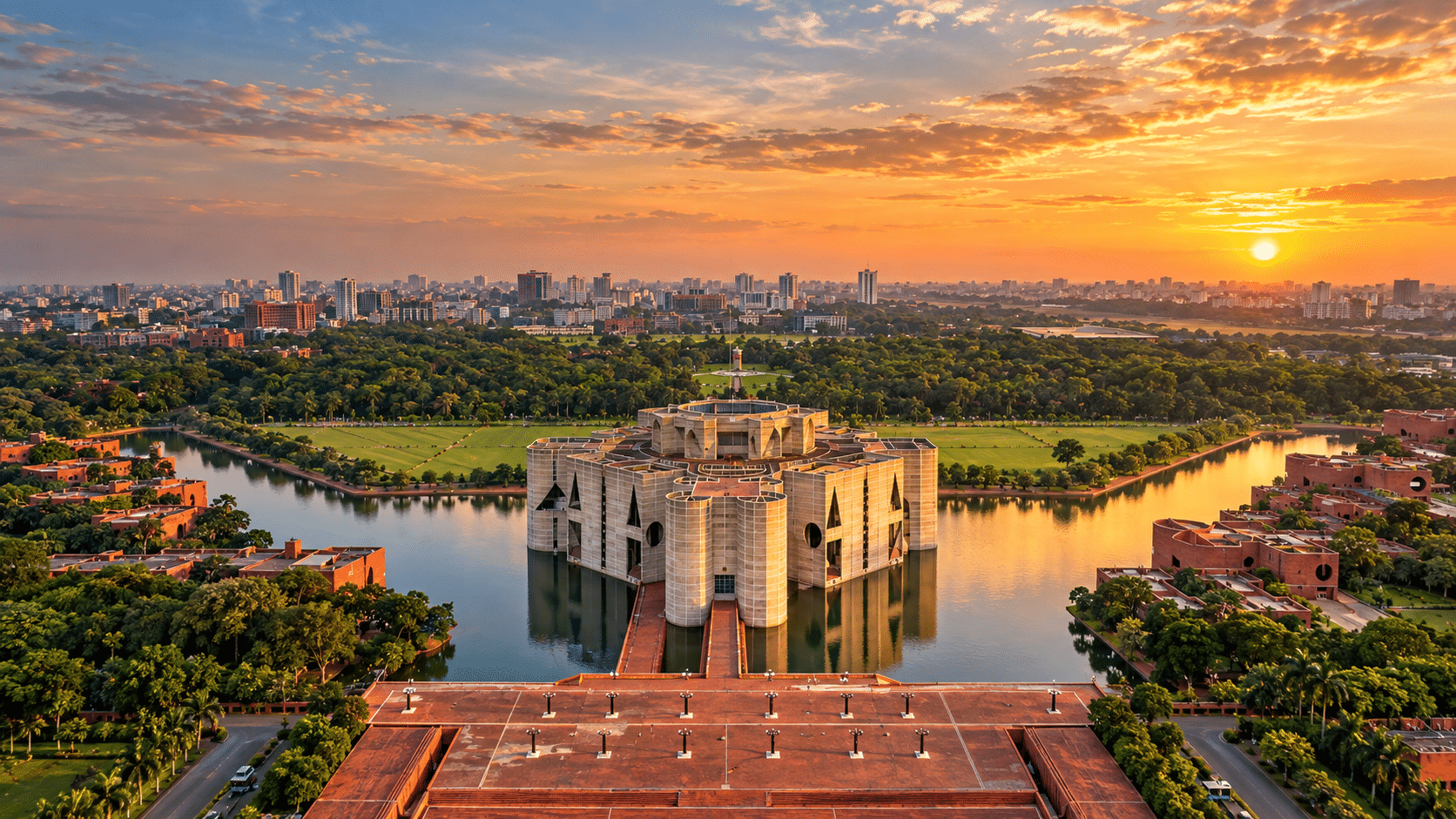
Jatiya Sangsad Bhaban is widely regarded as one of the twentieth century’s most significant works of architecture, and it’s easy to see why once you’re standing in front of it. American architect Louis Kahn designed the complex, an assembly of massive concrete cylinders and rectangular blocks sliced open with bold geometric apertures rather than conventional windows, and it took over two decades to complete. Construction began in 1961, when Bangladesh was still East Pakistan and the building was intended to make Dhaka a more prominent administrative capital. It wasn’t finished until 1982, more than a decade after Bangladesh’s independence, by which point it had become the seat of an entirely different nation’s parliament.
The scale is genuinely difficult to grasp from photographs alone. The complex spans roughly 200 acres, including artificial lakes, expansive lawns, and the main assembly building itself, eight peripheral blocks arranged around a central domed chamber. Kahn’s design plays constantly with natural light and water, and the way the concrete forms interact with the surrounding lakes has made the complex a genuine pilgrimage site for architects and architecture students from around the world.
Access, unfortunately, doesn’t match the building’s global reputation. The main chamber and interior are restricted to Members of Parliament, staff, and pre-arranged, security-screened guided tours booked well in advance through the parliamentary secretariat, visitors typically need passport copies and formal authorization, and same-day visits aren’t realistic. What’s freely and permanently open is the surrounding complex itself, the lakes, gardens, and exterior views of the building, which for most visitors is genuinely enough to appreciate Kahn’s achievement.
For architecture enthusiasts specifically, it’s worth planning ahead, but even a walk around the exterior grounds, ideally at golden hour when the concrete catches warm light against the water, delivers most of what makes this building famous.