
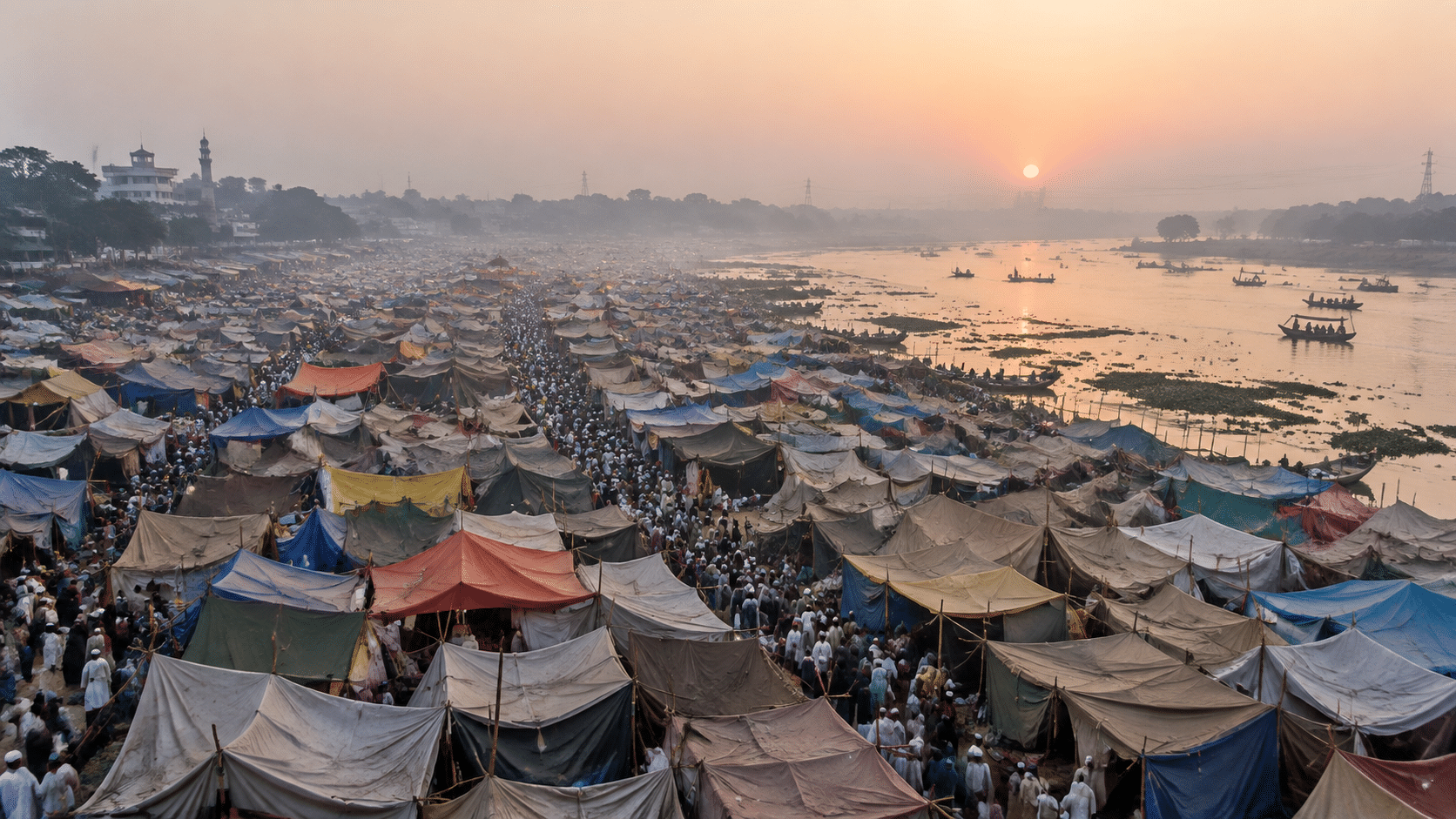
Every January, the industrial town of Tongi transforms into what press coverage routinely calls a “city of faith.” Bishwa Ijtema, held on the banks of the Turag River in Tongi, Gazipur, is widely described as the second largest congregation of Muslims in the world after the Hajj, drawing millions of devotees from Bangladesh and dozens of other countries to a single 160-acre ground.
What the event is
Organized by the Bangladeshi branch of the Tablighi Jamaat since 1969, the Ijtema functions as a demonstration of Muslim unity and a renewal of Islamic values, built around days of sermons, congregational prayer, and a final mass prayer known as the Akheri Munajat. In recent years the event has been held in two separate phases, each typically running three days, to accommodate the sheer number of attendees, with different factions of the organizing committee leading each phase.
Scale and impact
Reports have put attendance in the millions across both phases, with tens of thousands of foreign visitors from dozens of countries joining alongside Bangladeshi devotees from across the country. The scale is disruptive in a way few other events in Bangladesh are, the Dhaka-Mymensingh Highway sees vehicular movement come to a near-standstill during peak prayer times, and Dhaka’s own traffic patterns shift noticeably for the days surrounding each phase, given the ground’s proximity to Hazrat Shahjalal International Airport.
What visitors should know
This is not a tourist event in any conventional sense, it’s a religious congregation, and visitors without a specific reason to attend should expect a genuinely overwhelming crowd rather than a sightseeing opportunity. For those attending for religious purposes, expect significant transport disruption, limited facilities relative to the crowd size, and an atmosphere of intense, visible devotion. For anyone simply passing through Gazipur or Dhaka during the Ijtema dates, the practical takeaway is logistical: build in substantial extra travel time, particularly near the Dhaka-Mymensingh Highway and the airport corridor.
Exact dates shift from year to year, and the two-phase structure with separate organizing factions has occasionally led to schedule changes announced close to the event itself, always confirm current-year dates through recent local news before planning around it.