
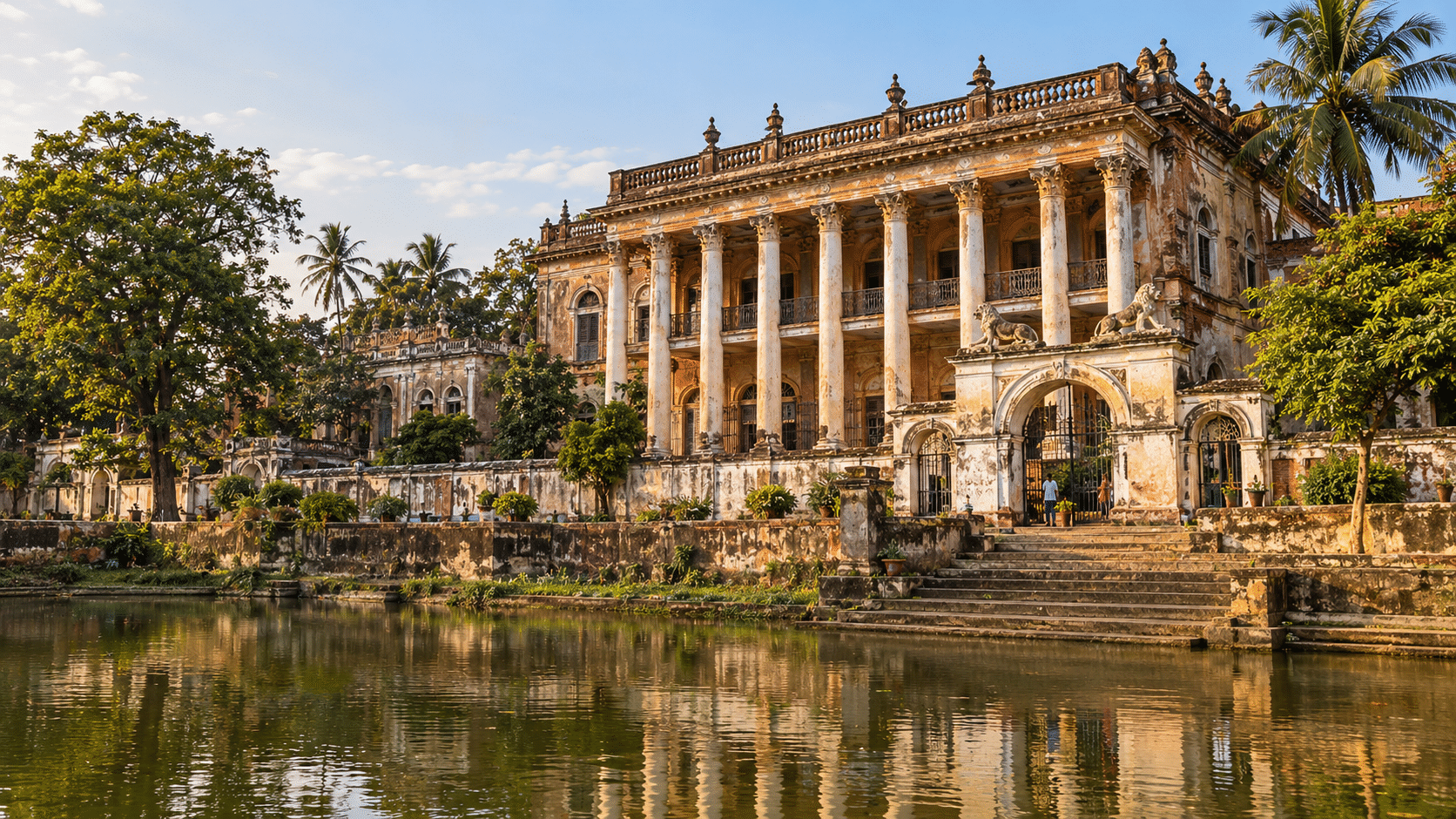
Baliati Zamindar Bari is the place to go when you want to see how a salt merchant’s money turned into a palace. Tucked into Baliati village in Saturia, Manikganj, this protected heritage house has long corridors, three lion topped gates and more than 200 rooms. If you are planning a visit, this page gives you the practical details first: tickets, timing, transport and what to look for once you are inside.
Baliati Zamindar Bari at a Glance
Baliati Zamindar Bari is also called Baliati Palace, and it is one of the best known zamindar houses close to Dhaka. Heritage records describe seven blocks inside a high boundary wall, on a compound of about 5.88 acres. The Department of Archaeology has protected the site since 1987, which is why the main buildings are still in good shape.
Who Built Baliati Zamindar Bari?
The founder was Govinda Ram Saha, a salt merchant of the mid 18th century. After him, his four sons, Dadhi Ram, Ananda Ram, Pandit Ram and Gopal Ram, are credited with raising the buildings you see today. That is why Baliati Zamindar Bari feels like a family project, with each block carrying a slightly different personality.
The family also left a mark in Dhaka. Babu Kishori Lal Roy Chowdhury of the Baliati family founded and supported the well known Jagannath College. So when you walk through Baliati Zamindar Bari, you are also walking through the early story of education in the region.
What to See Inside Baliati Zamindar Bari
The gates and the lion
Three matching gateways open into the compound, and a lion figure sits above them. Stop here for your first photo before you enter.
The main blocks
The southern front of Baliati Zamindar Bari stretches roughly 400 feet across its surviving blocks. Two central blocks are two storied, and the end blocks rise to three floors. Look for tall columns, deep verandas and arched windows that mix renaissance and Greek ideas.
Rong Mohal museum
On the upper floor of the central block you will find a decorative hall called Rong Mohal. It is now used as a small museum, with objects linked to the zamindar family. Give it time, because the details are easy to miss.
The tank and ghats
To the north is a large pond with masonry landings. In the late afternoon, this is the calmest corner of Baliati Zamindar Bari and a lovely place to sit.
Baliati Zamindar Bari Opening Hours and Ticket
Reports differ a little, so treat these as a guide and confirm locally. One report says Baliati Zamindar Bari opens from about 9 AM to 5 PM in winter and 10 AM to 6 PM in summer, with a short break at midday. Another says it is closed on Sunday and for half the day on Monday. During Ramadan it closes around 4 PM, and it stays shut on Eid day and the day before.
The ticket has been reported at BDT 20 per person. Carry small notes, and ask the gate staff about camera rules.
How to Reach Baliati Zamindar Bari
From Gabtoli bus terminal in Dhaka, take a bus to Saturia. A service called SB Link runs this route. From Saturia bus stand, Baliati Zamindar Bari is a 10 to 15 minute rickshaw or CNG ride. You can also get off at Golora on the Dhaka-Aricha highway and take a CNG, which takes about 20 to 25 minutes. With a private car, follow the Dhaka-Aricha highway through Savar and Dhamrai.
Tips for Visiting Baliati Zamindar Bari
- Go on a weekday morning for fewer crowds and softer light.
- Allow about two hours for the full compound.
- Wear comfortable shoes, because the courtyards are wide and uneven in places.
- Do not climb on walls or write on surfaces. Baliati Zamindar Bari is protected heritage.
- Add Dhamrai’s brass and pottery villages to turn the trip into a full day.
Is Baliati Zamindar Bari Worth Visiting?
Yes, especially if you enjoy history, architecture and photography. It is close to Dhaka, affordable and quiet. For the bigger picture of the area, read our guide to the Baliati Palace and Saturia Heritage Trail.