
Close Menu
Bangladesh Branding
  • Destinations
    • By Region
      • Dhaka
      • Chattogram
      • Sylhet
      • Rajshahi
      • Khulna
      • Barishal
      • Rangpur
      • Mymensingh
    • By Landscape
      • Beachs
      • Hills
      • Forests
      • Wetlands
      • Rivers
      • Historical Sites
      • Archaeological Sites
      • Religious Places
    • Popular Now
      • Cox’s Bazar
      • Sundarbans
      • Sajek
      • Bandarban
      • Sylhet
      • Srimangal
  • Experiences
  • Places to Visit
  • Festivals and Events
  • Plan Your Trip
  • Travel Stories
    • Travel Guide
      • Travel Tips
      • Hotels
      • Flights
      • Local Transport
      • Currency
    • News and Updates
      • News
      • Business and Brands
      • Buy Bangladeshi
    • Culture and Heritage
      • People
      • Culture
      • Food
      • Heritage Moshque
      • Arts and Crafts
  • Map
Facebook X (Twitter) Instagram YouTube
Facebook X (Twitter) Instagram
Bangladesh Branding
Subscribe
  • Destinations
    • By Division
      • Dhaka
      • Chattogram
      • Sylhet
      • Rajshahi
      • Khulna
      • Barishal
      • Rangpur
      • Mymensingh
    • By Landscape
      • Beachs
      • Hills
      • Forests
      • Wetlands
      • Rivers
      • Historical Sites
      • Archaeological Sites
      • Religious Places
    • Popular Now
      • Cox’s Bazar
      • Sundarbans
      • Sajek
      • Bandarban
      • Sylhet
      • Srimangal
    • Featured Destinations
  • Experiences
  • Places to Visit
  • Festivals and Events
  • Plan Your Trip
  • Travel Stories
    • Travel Guide
      • Travel Tips
      • Hotels
      • Flights
      • Local Transport
      • Currency
    • News and Updates
      • News
      • Business and Brands
      • Buy Bangladeshi
    • Culture and Heritage
      • People
      • Culture
      • Food
      • Heritage Moshque
      • Arts and Crafts
  • Map
Bangladesh Branding
Home » Crafts » Nakshi Kantha of Mymensingh

Nakshi Kantha of Mymensingh

November 5, 2026No Comments4 Mins Read
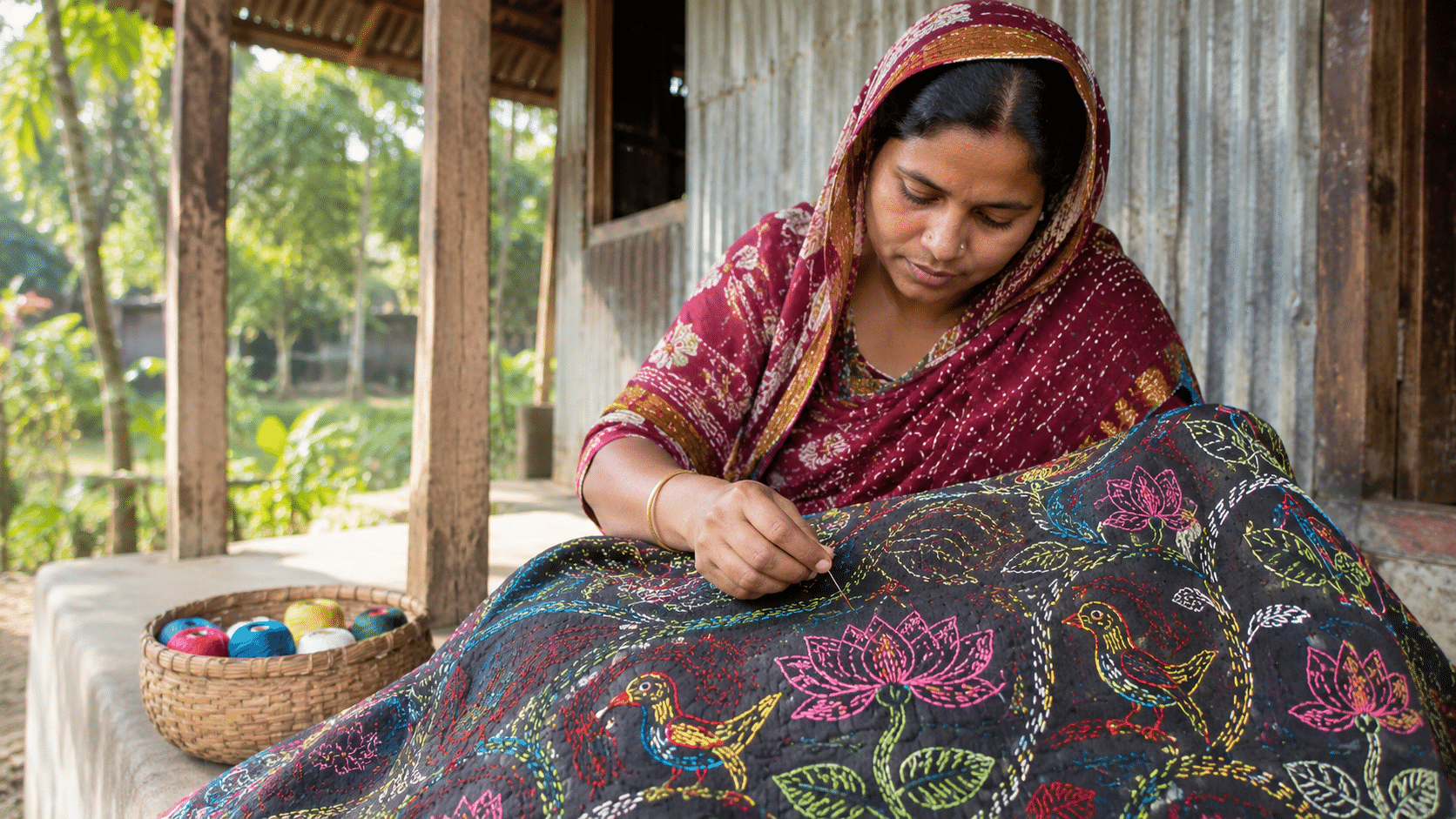
Mymensingh nakshi kantha
Share
Facebook Twitter LinkedIn WhatsApp Copy Link

Mymensingh Nakshi Kantha: The Stitched Stories of Rural Bengal

Mymensingh nakshi kantha is one of the most beautiful crafts of Bangladesh, and one of the easiest to fall in love with. It is a quilt, but it is also a diary, a poem and a family heirloom, all stitched by hand. Greater Mymensingh is counted among the most famous regions for this craft, alongside Jamalpur, Bogura, Rajshahi, Faridpur and Jessore.

This guide explains how Mymensingh nakshi kantha is made, what to look for when you buy, and how to support the women who stitch it.

Quick Facts

  • What it is: an embroidered quilt made from layered old cloth and thread
  • Who makes it: mostly rural women, often in their spare time
  • Time to make: from weeks to months, sometimes years, for a large piece
  • Good for: gifts, home decor, collectors and craft lovers

A Short History of Nakshi Kantha

Nakshi kantha began as a thrifty household skill. Women stacked old saris, lungis and dhotis, then stitched them together to make warm quilts. Over time they added patterns: flowers, birds, boats, village life and folk stories. The word “nakshi” means decorated. The poet Jasimuddin made the craft famous in 1929 with his poem “Nakshi Kanthar Math”.

The running stitch, known as the kantha stitch, was especially popular among women of greater Mymensingh. Because kantha making was not a full-time job, almost every household had an expert, and a large quilt could take months or even years to finish.

How Mymensingh Nakshi Kantha Is Made

  1. Layering the cloth. Several layers of old cloth are placed together and smoothed flat.
  2. Drawing the design. The artisan marks the pattern, often a central lotus with borders and scenes around it.
  3. Stitching. Rows of small running stitches hold the layers together and create the pattern. Other stitches, such as the arrowhead stitch, may be added.
  4. Finishing. The edges are neatened, and the piece is washed and folded.

Motifs You Will See

Traditional Mymensingh nakshi kantha often features lotus flowers, trees of life, fish, boats and scenes of daily village life. Each motif carries meaning for the family that made it. When you look closely, you are reading a story told in thread.

Where to Find Mymensingh Nakshi Kantha

Look for kantha at traditional fairs, especially on Pahela Boishakh, and at handicraft stalls in Mymensingh city. Some small firms and cooperatives in Sadar and Trishal have long employed local women to stitch kantha and related items such as shawls and cushion covers. Because the craft is also sold in Dhaka shops, always ask where and by whom a piece was made.

Tips for Buying Mymensingh Nakshi Kantha

  • Ask whether it is hand-stitched. Real nakshi kantha shows tiny, slightly uneven running stitches.
  • Check the back of the piece, since hand stitching looks similar on both sides.
  • Be wary of very cheap printed copies that only imitate the pattern.
  • Ask about the time taken and the artisan’s share, and pay a fair price.
  • Wash gently by hand and dry in the shade to protect the colours.

Why Mymensingh Nakshi Kantha Matters

Nakshi kantha gave rural women a way to express feelings and hopes, and it still provides income for thousands of families. Craft researchers warn that artisans face financial pressure and need better markets. Buying directly and fairly is the simplest way to help.

Frequently Asked Questions

Why is Mymensingh famous for nakshi kantha?

Greater Mymensingh has a long tradition of kantha stitching among rural women, and it is named among the most famous kantha regions in Bangladesh.

How long does a nakshi kantha take to make?

It depends on size and design, from weeks to months, and large traditional pieces could take years.

Can I visit artisans in Mymensingh?

Ask local guides, cooperatives or cultural groups before you go, and visit with respect and permission.

For more places and ideas in the district, browse our Places to Visit collection and look for kantha at Mymensingh’s fairs.

Search
Recent Post
  • Chandpur District: Where the Great Rivers Meet September 13, 2026
  • Noakhali District: Islands, Estuary, and Gandhian Heritage September 13, 2026
  • Feni District: Migratory Birds, Ancient Tanks, and the Hill-Plains Edge September 13, 2026
  • Khagrachari District: Cave Country, Tribal Heartland, and Hill Panoramas September 9, 2026
  • Cumilla District: Ancient Buddhism and the Highway City September 9, 2026
  • Rangamati District: The Lake District of Bangladesh September 8, 2026
  • Cox’s Bazar District: The World’s Longest Beach September 8, 2026
  • Chattogram District: Bangladesh’s Port City and Hill Country Gateway September 8, 2026
  • Jhenaidah District: Ancient Mosques and Riverine Landscapes September 7, 2026
  • Magura District: Quiet Rivers and Zamindari Remnants September 7, 2026
  • Narail District: Where Art Lives on the River September 5, 2026
  • Kushtia District: The Soul of Bangladesh’s Folk Tradition September 3, 2026
  • Jashore District: The Flower Capital of Bangladesh September 2, 2026
  • Khulna District: Gateway to the World’s Largest Mangrove Forest September 2, 2026
  • Panchagarh District: Where Bangladesh Meets the Himalayas September 2, 2026
Who We Are

Bangladesh Branding, your premier source for uncovering the treasures of Bangladesh, a land where vibrant culture meets breathtaking landscapes and warm hospitality.

Facebook X (Twitter) Instagram YouTube LinkedIn
Explore
  • Destinations
  • Places to Visit
  • Experiences
  • Travel Stories
  • Events
  • Crafts
Plan your trip
  • Trip Planner
  • Travel Guide
  • Best Time to Visit
  • How to Reach
  • Travel Tips
About
  • About Us
  • Contact Us
  • Partner With Us
  • Media / Press
  • Submit a Place
Search
Copyright © 2026 Bangladesh Branding | Developed by Business Brillianz.

Type above and press Enter to search. Press Esc to cancel.

imunify-bot-check