
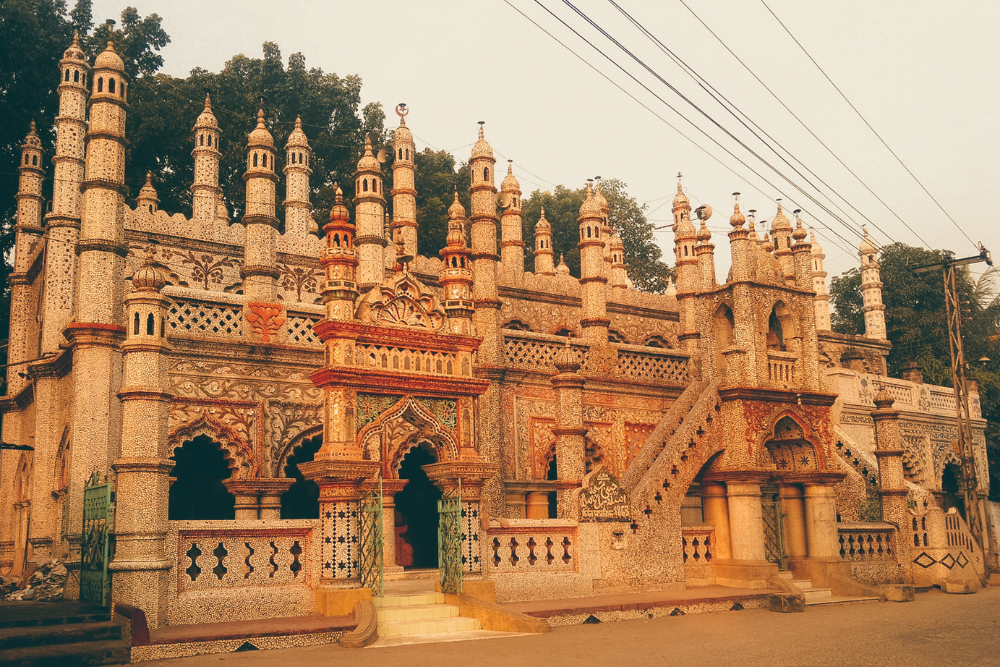
The Chini Mosque, also called the Glass Mosque, is a historic mosque in Saidpur, Nilphamari District, Bangladesh, about 20 km from Nilphamari town. It began as a small prayer house around 1863, and over the decades it grew into a showpiece covered in chini tikri, a mosaic of broken chinaware plates, glass and porcelain. It has three large domes, and reports count between 27 and 32 minarets, some of them never finished.
From the road, the Chini Mosque looks like a palace made of broken dishes and sunlight. Step closer and every wall flashes with tiny pieces of blue, green, gold and white, set in patterns of flowers, vases and stars. Nobody planned it in one go. Ordinary people, merchants and masons built it slowly, piece by piece, over a hundred years, and that shared effort is part of why Saidpur still treats it with pride.
The Chini Mosque at a Glance
- Also known as: Chini Masjid, Glass Mosque
- Location: Islambagh, Saidpur, Nilphamari District, Rangpur Division
- Began: Around 1863, as a small prayer house
- Major building phase: From 1920, with later additions
- Craft: Chini tikri mosaic of chinaware, glass and porcelain
- Features: Three large domes and many minarets (reports count 27 to 32)
- Distance: About 20 km from Nilphamari, and roughly 360 km northwest of Dhaka
The Chini Mosque: A Marvel of Aesthetic Architecture
The Chini Mosque stands in the town of Saidpur, about 20 km from Nilphamari, where it is celebrated for its eye-catching architecture. It sits in the Islambagh area at the northern end of town, beside the Nilphamari-Saidpur road, according to a Daily Star report. As Dhaka Tribune describes it, the mosque is famous for its aesthetic design, and it draws visitors from across the country.
The Origin of the Name: Sugar Grains or Porcelain?
In Bengali, “chini” means sugar, and it is also the word used for China and chinaware. That double meaning gives two explanations for the name.
- The porcelain explanation: The walls are covered in pieces of chinaware plates and glass, so people began calling it the Chini Mosque. Global Times tells the story this way.
- The sugar explanation: The tiny chips set in the walls shine like sugar grains, and the craft is sometimes described as “sugar-grain work”.
Some locals also say the Chini Mosque was made entirely of porcelain. That is a nice story, but the mosque is decorated with porcelain, not made of it. Either way, the name stuck.
Pioneers of Construction: How the Chini Mosque Was Built
Records differ on the first steps. Wikipedia and several news reports say Haji Bakir Ali Ahmed started the Chini Mosque around 1863 as a small prayer house, while one Dhaka Tribune account dates the first cane-and-bamboo building to 1883. Locals later rebuilt it with tin sheets. In 1920, businessman Haji Hafiz Abdul Karim led the first brick phase on the site, which the Daily Star measured at about 39 by 40 feet.
After that, Md Mokhtul and Nabi Baksha designed the grand mosque, which hundreds of skilled craftsmen and artists built. Wazir Ali Ahmed, a descendant of the founding family, then led the expansion and changes. Folklore also credits a Hindu mason named Shonku, which Dhaka Tribune calls a sign of communal harmony in the region.
In the middle of the 20th century, Wazir Ali Ahmed’s sons Mofizuddin Ahmed and Shafiuddin Ahmed, well-known cloth merchants, kept improving the Chini Mosque. In 1965, a southern section was added, according to the Daily Star report.
Chini Tikri: The Art of Mosaic Decoration
The Chini Mosque is famous for chini tikri, a mosaic technique that uses small chips of chinaware plates, colored and clear glass and porcelain. At the time of construction, there was no ceramic factory nearby, so the pieces were brought from Kolkata. The walls show vases, flowering shrubs, roses, crescent moons and stars, all assembled from tiny fragments.
If you love mosaic and tile work, see more in our guide to arts and crafts in Bangladesh.
Materials of Grandeur: Marble and Porcelain
The Chini Mosque used a large amount of imported material. Sources report about 243 marble stones from Kolkata, although Wikipedia says 283. About 25 tons of porcelain and glass pieces cover its walls, domes and minarets, though Wikipedia lists 23 tonnes. Locals say a gas factory in Bogura donated much of the porcelain, as Dhaka Tribune reports. The three large domes and the minarets are covered in this glittering skin.
Reports differ on the number of minarets. Wikipedia counts 27, of which five were never completed. Other accounts count 32 in total, including the unfinished ones. Please keep this in mind if you count the minarets of the Chini Mosque yourself.
Visiting the Chini Mosque
The Chini Mosque is an active place of worship, and it is also a draw for visitors. Dress modestly, remove your shoes and avoid prayer times. Opening times and rules can change, so check locally. Saidpur is about 360 km northwest of Dhaka, according to Xinhua via Global Times. For more mosques and heritage sites, see our heritage mosques, the Sixty Dome Mosque in Bagerhat and Bagha Mosque in Rajshahi. You can also browse our religious places and historical sites, and read our tips on local transport.
The Glass Mosque: A Distinctive Architectural Gem
The Chini Mosque is also called the Glass Mosque, because the walls glitter with glass. Dhaka Tribune notes that it shows strong Mughal influence in its style, although it was built in 1863 under British rule, not in the Mughal era. It is a good example of how an old design language can be reborn in a new century.
Frequently Asked Questions About the Chini Mosque
What is the Chini Mosque?
The Chini Mosque, also called the Glass Mosque, is a historic mosque in Saidpur, Nilphamari District, Bangladesh, decorated with a mosaic of chinaware and glass.
Why is it called the Chini Mosque?
“Chini” means sugar and also chinaware in Bengali. The mosque is named either for the porcelain pieces on its walls or for the sugar-like grains of its mosaic, and sources use both explanations.
When was the Chini Mosque built?
It began as a small prayer house around 1863, was rebuilt in brick from 1920, and was extended and decorated over later decades.
Where is the Chini Mosque located?
It is in the Islambagh area of Saidpur, Nilphamari District, about 20 km from Nilphamari town and roughly 360 km northwest of Dhaka.
How many minarets does the Chini Mosque have?
Reports differ. Wikipedia counts 27 minarets, five of them never completed, while other accounts count 32 including the unfinished ones.
What is chini tikri?
Chini tikri is a mosaic technique that uses small chips of chinaware, glass and porcelain to decorate walls with patterns such as flowers, vases and stars.
Why is it called the Glass Mosque?
It is called the Glass Mosque because its walls are covered with pieces of colored and clear glass along with chinaware, which makes the mosque sparkle in sunlight.
Final Thoughts on the Chini Mosque
The Chini Mosque proves that beauty can be built from fragments. Broken plates, scraps of glass and a century of community effort turned a small prayer house into one of Bangladesh’s most distinctive mosques. If you travel to the north, stop in Saidpur, look closely at the walls and let the light do the rest. For more ideas, explore our places to visit in Bangladesh, our Places to Visit stories and our travel experiences.