
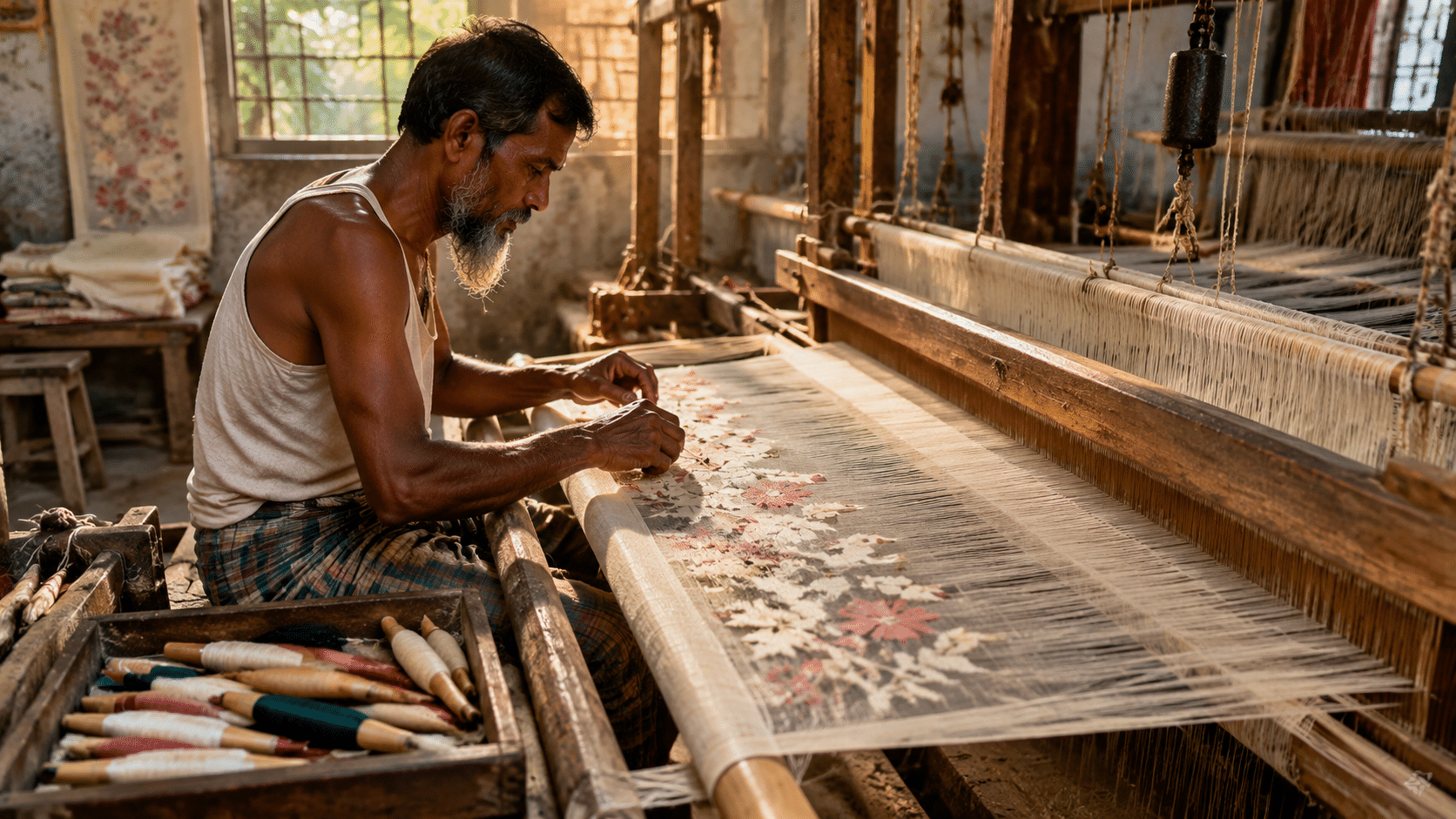
Five kilometres from Tongi’s Sataish area, in a neighbourhood called Gutia, a fading rhythm of bamboo looms still marks the day. This is one of Bangladesh’s lesser-known weaving clusters, where a shrinking community of artisans hand-weaves Jamdani and Benarasi sarees, the same prized textiles more commonly associated with Narayanganj’s Sonargaon and Rupganj, but produced here in Gazipur by weavers whose trade is genuinely at risk of disappearing.
What sets this cluster apart
Gutia’s weavers work in two distinct traditions under one roof. Jamdani is woven using a discontinuous weft technique, motifs added by hand during the weaving process itself, almost like embroidery on the loom, producing the sheer, floral-patterned muslin Bangladesh is internationally known for. Benarasi weaving, by contrast, uses heavier silk and brocade with gold or silver thread, a tradition that reached Bengal through Mughal-era trade and cultural exchange with Varanasi. Having both techniques practiced in the same small cluster is unusual, and it’s part of what makes Gutia worth knowing about even though it sits outside the more famous weaving belts.
A trade in decline
The scale of what’s been lost here is stark. At its peak, Gutia held more than 1,200 looms across roughly 200 factories, a genuinely industrial-scale weaving community. Today, reporting puts the number of active weavers at around 300, a steep fall driven by rising yarn prices, competition from imported Indian sarees, and the broader pull of Bangladesh’s garment industry, which offers steadier income than traditional handloom work. Industry figures have called for government support to keep the trade alive, without it, weavers and officials alike have warned the craft could disappear from the area entirely.
Where the sarees go
Sarees woven in Gutia don’t stay local, they’re sold on to markets across the country, including Dhaka’s Mirpur, itself a well-known retail hub for Jamdani and Benarasi sarees. This means a saree bought in central Dhaka may well have started its life on a loom in this quiet Gazipur neighbourhood, a connection most buyers never learn.
Visiting Gutia isn’t a polished tourist experience, there’s no formal gallery or shop set up for visitors, and access to working factories depends on the goodwill of individual weavers and owners. For anyone with a genuine interest in textile craft, arranging a visit through a local contact or guide, rather than showing up unannounced, is the respectful way to see the looms in action while they still are.