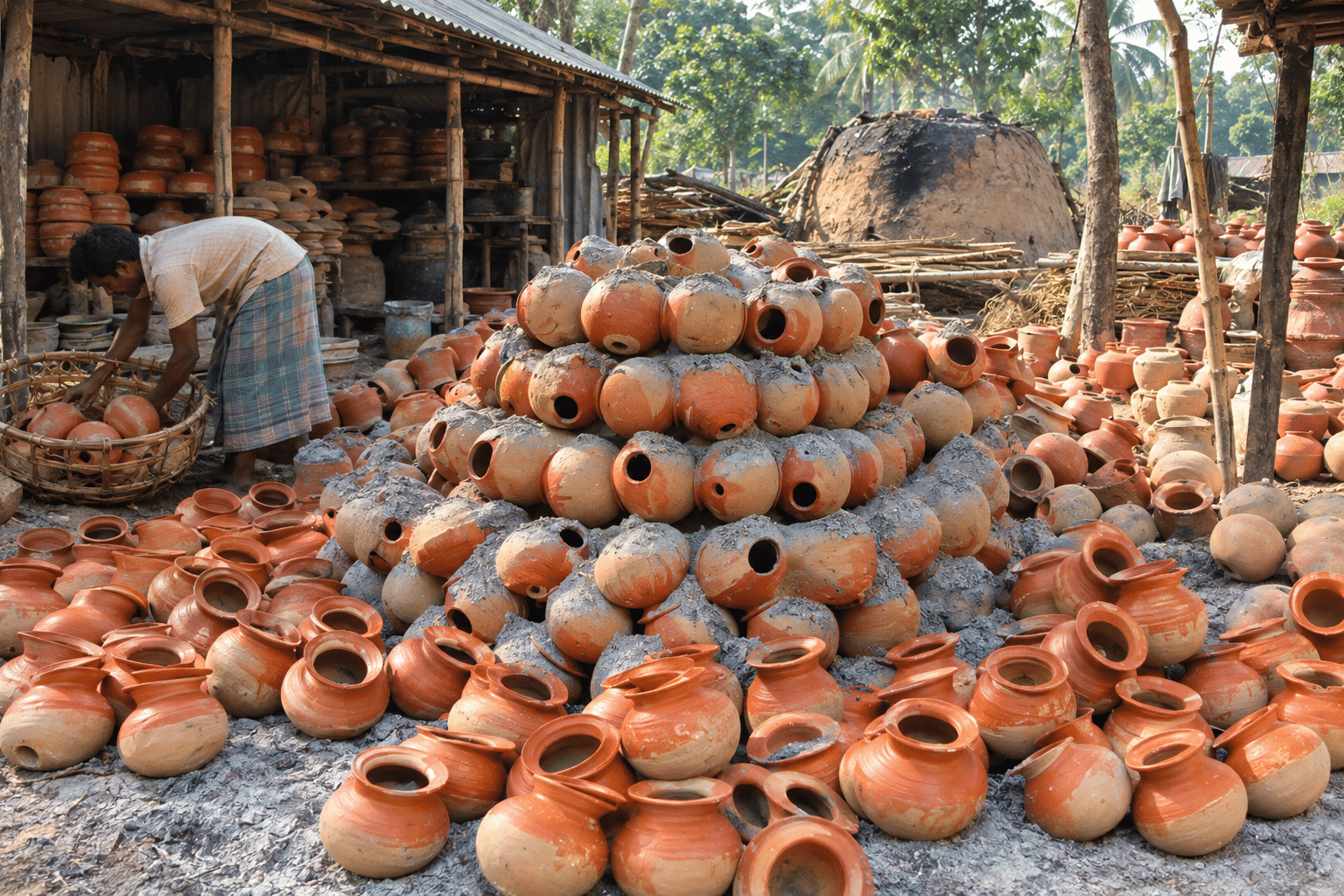
Munshiganj pottery is the most down-to-earth craft in the district. Every upazila in Munshiganj appears in Banglapedia’s list of places with potteries, from Sadar and Tongibari to Louhajang, Sreenagar, Sirajdikhan and Gazaria. If you enjoy simple clay pots, the smell of wet earth and the skill of hands on a wheel, Munshiganj pottery is a craft to look for on your next trip.
What Is Munshiganj Pottery?
Munshiganj pottery is the traditional making of clay pots, jars and household items in small family workshops. According to Banglapedia’s upazila records for Munshiganj Sadar and its neighbours, potteries are listed among the cottage industries of Sadar, Tongibari, Louhajang, Sreenagar, Sirajdikhan and Gazaria. In Bangla, the craft is called mritshilpo, which means the art of clay.
The Kumar and Pal Families
Banglapedia explains that the words kumar and pal both mean potters by profession, and that a potter’s neighbourhood is called a pada. Kumar is a caste name, and for a long time pottery was almost entirely in Hindu hands. Potters usually live in close-knit areas known as Kumarpara or Paulpara, where families share the craft across generations.
Banglapedia adds that the potter’s work is not only for the kitchen. It records ceremonial pots with names such as Dharmaghat, Shitalghat, Manasaghat, Muharramghat and Gazighat, which shows how clay vessels have served many faiths and festivals in Bengal.
How Munshiganj Pottery Is Made
- Clay is collected, cleaned and kneaded with sand until it is smooth and strong.
- The potter shapes the piece on a wheel, called a chak, turned by hand.
- The shaped pot is set aside and dried in the sun.
- It is fired in a kiln, called a panja, until hard and ready for use.
Banglapedia notes that in a traditional potter’s house, the kiln, the storeroom and the home often sit under the same thatched roof, with open ground in front for preparing the clay. Red and black earthenware use the same clay, and the black colour comes from covering the kiln at a certain stage.
What You Can Find in Munshiganj Pottery
- Pots and jars for water and kitchen use
- Plates, bowls and small dishes
- Flower pots and decorative pieces
- Ceremonial pots, which Banglapedia lists under names such as Dharmaghat and Mangalghat
The mix depends on the workshop. Some potters also make toys and small figures from clay.
Where to Find Munshiganj Pottery
Banglapedia lists potteries in Munshiganj Sadar, Tongibari, Louhajang, Sreenagar, Sirajdikhan and Gazaria. Markets noted for Tongibari include Tongibari Hat, Betka Hat, Subochoni Hat and Dighir Para Hat, and for Louhajang include Gaodia Bazar, Kalma Bazar, Dighali Hat and Kanaksar Hat. Banglapedia does not name individual potters’ villages, so ask in the local hats for a Kumarpara or Paulpara nearby.
Why Munshiganj Pottery Still Matters
A clay pot is a simple thing, but it holds a lot of history. Banglapedia notes that a national survey in 1985 by the Bangladesh Small and Cottage Industries Corporation counted 666 pottery villages in the country, home to about 18,000 families. Munshiganj pottery belongs to that wider story, and each pot you buy helps one more family keep the wheel turning.
Tips for Buying Munshiganj Pottery
- Tap the pot gently. A clear sound suggests it is well fired.
- Look for even walls and a flat base.
- Avoid pieces with cracks or chips if you plan to use them for water.
- Wrap pots carefully for the journey home.
- Ask whether the piece is for display only or for everyday use, since Munshiganj pottery varies by workshop.
Why Munshiganj Pottery Needs Support
Potters across Bangladesh face real challenges. A Ceramic Bangladesh Magazine report from another part of the country described potters struggling with a shortage of clay, firewood and funds, with the number of local potter families dropping sharply. Buying handmade pots helps keep that skill from fading.
Frequently Asked Questions
Where can you find Munshiganj pottery?
Banglapedia lists potteries in Sadar, Tongibari, Louhajang, Sreenagar, Sirajdikhan and Gazaria upazilas.
What is a Kumarpara?
It is a neighbourhood where families of potters live and work, also called Paulpara.
What does mritshilpo mean?
It means the art of clay, the Bangla name for pottery.