
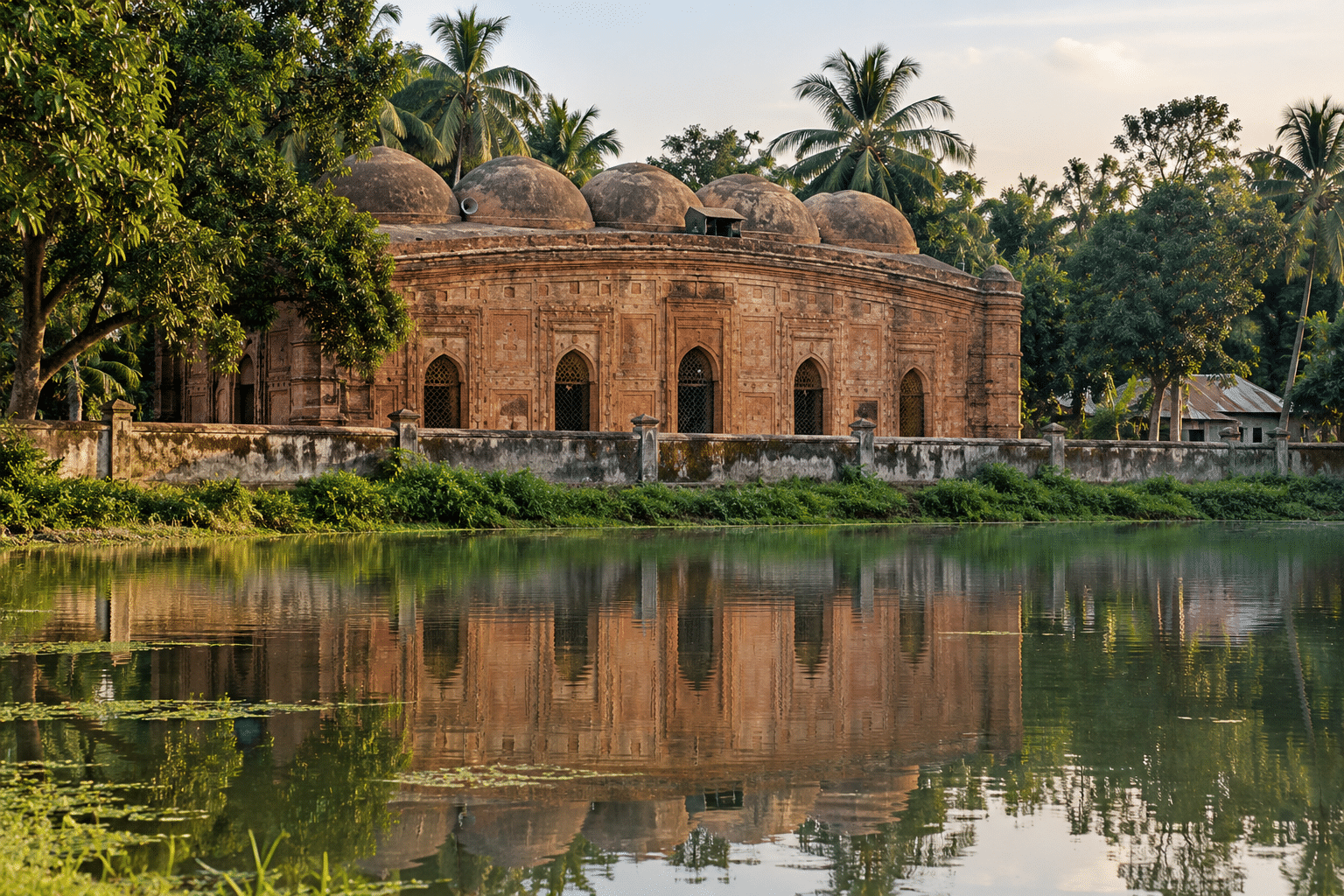
Most people know Faridpur for jute fields and the Padma. Fewer know that this district holds some of the oldest brick and terracotta monuments in central Bangladesh. Long before it was called Faridpur, the area was known as Fatehabad, and Sultan Jalaluddin Muhammad Shah ran a mint here. The Faridpur heritage trail connects that forgotten past through three standout stops: a ten-domed Sultani mosque beside a giant dighi, a centuries-old mosque in Boalmari, and a twelve-sided terracotta tower that has no real twin anywhere in Bangladesh.
Stop 1: Pathrail Mosque (Majlis Aulia Mosque), Bhanga
In Pathrail village of Bhanga upazila, a low brick wall encloses a mosque and a mazar on the western bank of a huge tank. Locals link the complex to the saint Majlis Abdullah Khan, better known as Majlis Aulia, and his grave lies south of the mosque.
What Makes It Special
- Ten domes of equal height cover the prayer hall, carried on arches and pillars.
- Five arched doorways on the east face five mihrabs on the west wall.
- Terracotta ornament once covered the walls, and traces still survive.
- Pathrail Dighi, a vast tank dug in the same period, sits right beside it.
Historians disagree on the date. Some sources place it in the reign of Ghiyasuddin Azam Shah, while Banglapedia compares its plan and decoration with Rajshahi’s Bagha Mosque and suggests the early 16th century Husain Shahi period. Either way, this is one of the oldest stops on any Faridpur heritage trail.
Stop 2: Satoir Mosque, Boalmari
Near Satoir Bazar in Boalmari upazila stands another Sultani-era mosque, traditionally linked to the Husain Shahi rulers, often described as the golden age of the Bengal Sultanate. Heavy renovation over the years has changed much of its original look, so come for the history and the village setting rather than untouched ancient brickwork.
Stop 3: Mathurapur Deul, Madhukhali
This is the showpiece of the Faridpur heritage trail. Rising from open fields in Mathurapur village, the deul is a twelve-sided rekha-style tower that tapers gracefully toward the sky. Its walls are covered with terracotta panels showing flowers, gods and goddesses, dancing figures, galloping horses and scenes from the Ramayana and Mahabharata, with Hanuman appearing in several places.
The Mystery of Who Built It
No inscription has been found, so the story is still open. One local legend credits Raja Man Singh, Emperor Akbar’s general, who is said to have built it after defeating Raja Pratapaditya. Another account links it to Sangram Singh, a Mughal-era official who settled in Mathurapur. Most historians place it in the 16th to 17th century.
Visit With Care
The tower is now around 21 metres tall, and recent news reports describe missing bricks and widening cracks after heavy rain. Please do not climb, lean on or touch the terracotta panels. Responsible visits and public attention are part of what can save it. The Faridpur Sugar Mill, which allows visitors, sits close by if you want to add a modern industrial stop.
Bonus Stop: Gerda Mosque, Faridpur Sadar
Closer to town, the Mughal-era mosque at Gerda (dated 1013 AH) is a short detour for anyone who wants one more old monument on the Faridpur heritage trail without a long drive.
How to Plan the Faridpur Heritage Trail
- Coming from Dhaka? You pass Bhanga first on the expressway, so stop at Pathrail Mosque on the way in.
- Day two: head west from Faridpur town to Satoir in Boalmari and Mathurapur Deul in Madhukhali, then return to town.
- Short on time? Pick Mathurapur Deul alone. It is the most unique site and worth a half day.
Hire a CNG or car for the whole day. Local transport to these villages is irregular, and having your own ride lets you catch the late afternoon light on the terracotta.
Travel Tips
- Pathrail and Satoir are active mosques. Dress modestly, remove shoes where required and avoid prayer times.
- Carry water and snacks, since village shops near the sites are basic.
- Winter mornings can be foggy on rural roads, so start a little later and drive carefully.
- Respect the Department of Archaeology signs and fencing at every protected monument.
Why This Trail Deserves More Visitors
Bangladesh’s heritage story is often told through Bagerhat, Puthia or Sonargaon. Yet the Faridpur heritage trail packs Sultani mosques, Mughal-era brickwork and rare temple architecture into a single district now just a few hours from Dhaka thanks to the Padma Bridge. For history lovers, photographers and students of Bengal’s past, these Faridpur historical places offer the same sense of discovery as the famous sites, with far fewer crowds.
Quick FAQ
Which site should I not miss on the Faridpur heritage trail?
Mathurapur Deul. Its twelve-sided terracotta tower is unlike anything else in the country.
Can I cover all the stops in one day?
It is possible with an early start and a private vehicle, but two relaxed half-days work better, since Pathrail lies in the southeast and the Madhukhali and Boalmari sites lie to the west.