
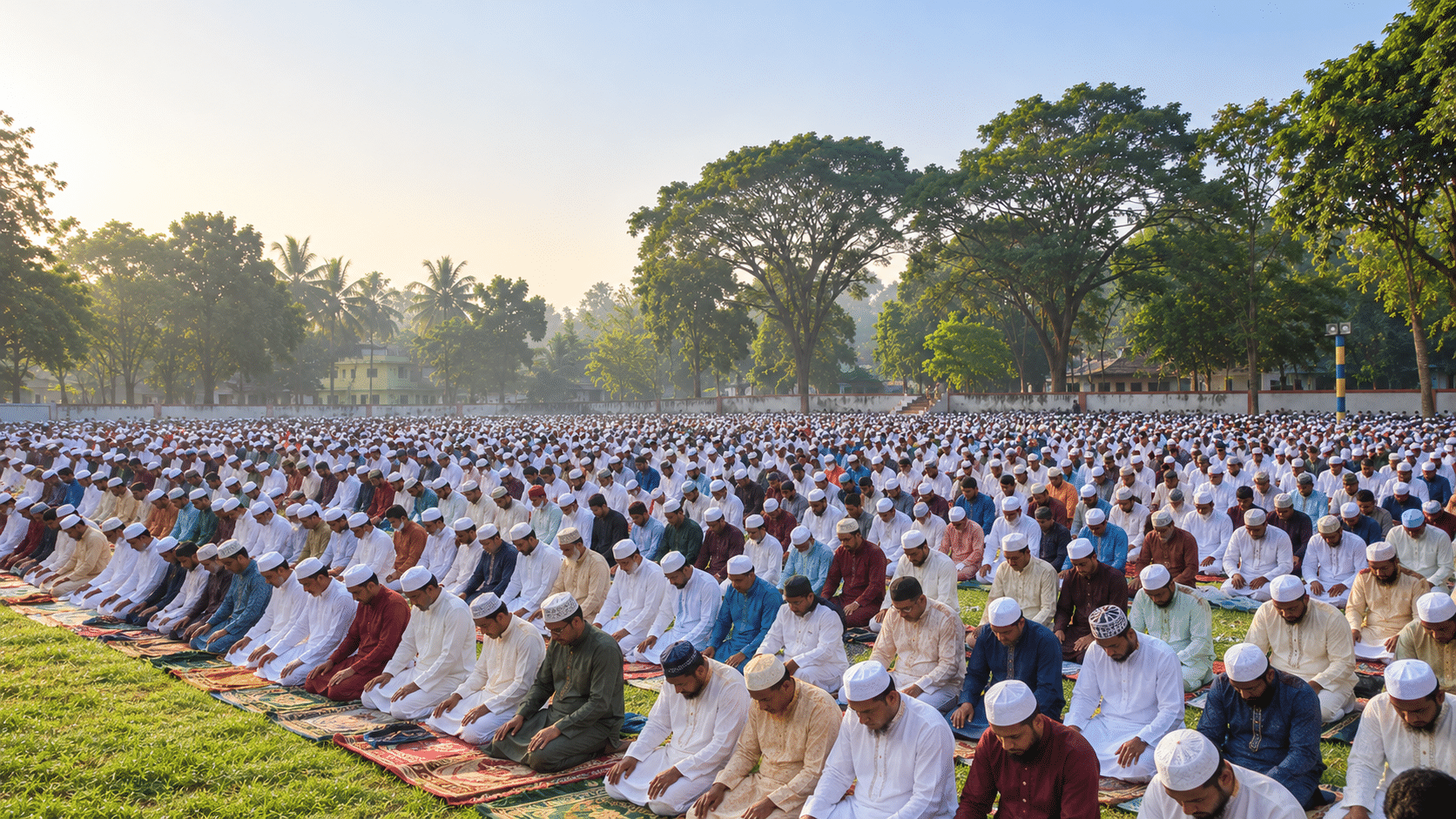
Every Kishoreganj story begins in the town itself, and the best place to start is Sholakia Eidgah. Standing on 6.61 acres on the eastern side of the town, Sholakia Eidgah is often called the largest Eidgah in Asia. On a normal day it is a calm green field with a boundary wall. On Eid morning it becomes a sea of people, and that contrast is what makes it so special.
The Story Behind Sholakia Eidgah
The name has a lovely local story. According to the district portal, there was a time when about 1.25 lakh worshippers gathered here for Eid-ul-Fitr. In Bangla, that number is called “sawa lakh”, and over time the place became known as Sholakia. Whether you take it as history or tradition, the story shows how deeply this ground is tied to the people of Kishoreganj.
On Eid day the road from the town centre to Sholakia Eidgah, around one kilometre long, fills with people walking in new clothes. After the prayer, fairs spring up around the Eidgah, and the whole neighbourhood turns into a festival.
Pagla Mosque and the Old Town Mood
A short rickshaw or auto-rickshaw ride from the Gaital bus stand takes you to the historic Pagla Mosque, one of the best-known religious landmarks in Kishoreganj. Visiting it after the Eidgah gives you a full picture of the town’s faith and architecture in a single morning.
Chandravati Shiv Mandir and Literary Roots
Kishoreganj is also a district of words and stories. It is the home of Chandrabati, regarded as the first female poet of Bengali literature, and the Chandravati Shiv Mandir at Katcharipara, about 8 km from the town, is a reminder of that heritage. The temple dates back to the late 16th century and is linked to Dwija Bangshi Das, the poet and father of Chandrabati. Its artistic craftsmanship still draws visitors today.
The Ray Chowdhury family, famous for children’s literature, also has roots in this district, and leaders like Syed Nazrul Islam and Zillur Rahman were born here. Walking around the town, you start to feel that Kishoreganj has given Bangladesh more than its size suggests.
Why This Town Deserves a Slow Visit
Many travellers pass through Kishoreganj on the way to the haors and never stop. That is a loss. The town is compact, friendly and full of small details: busy markets, tea stalls where people argue happily about cricket and politics, and well-known colleges that shape its character. A slow morning here gives you the cultural background that makes the haor and fort trips make more sense.
Because the main sites are close to each other, you can see them by rickshaw or auto-rickshaw without a big budget. It is a good choice for students, families and anyone who prefers stories over adventure.
A Simple Heritage Circuit
- Begin at Sholakia Eidgah and walk around the large open ground
- Visit the historic Pagla Mosque
- Go to the Chandravati Shiv Mandir at Katcharipara
- Walk past the well-known Gurudayal Government College area
- Taste local sweets and snacks before heading back
Visiting Tips
Eid-time crowds are huge and traffic near the ground becomes slow, so for a relaxed visit choose a normal winter day. Wear modest clothes at religious sites and ask before photographing worshippers.
Quick Answers About Sholakia Eidgah
Where is Sholakia Eidgah?
It is on the eastern side of Kishoreganj town, in Kishoreganj Sadar Upazila.
Why is it called Sholakia?
Local tradition says the name comes from “sawa lakh”, the 1.25 lakh people who once gathered for Eid prayers.
How do I reach Sholakia Eidgah from the railway station?
It is a short rickshaw ride from Kishoreganj town, and any local can point the way.