
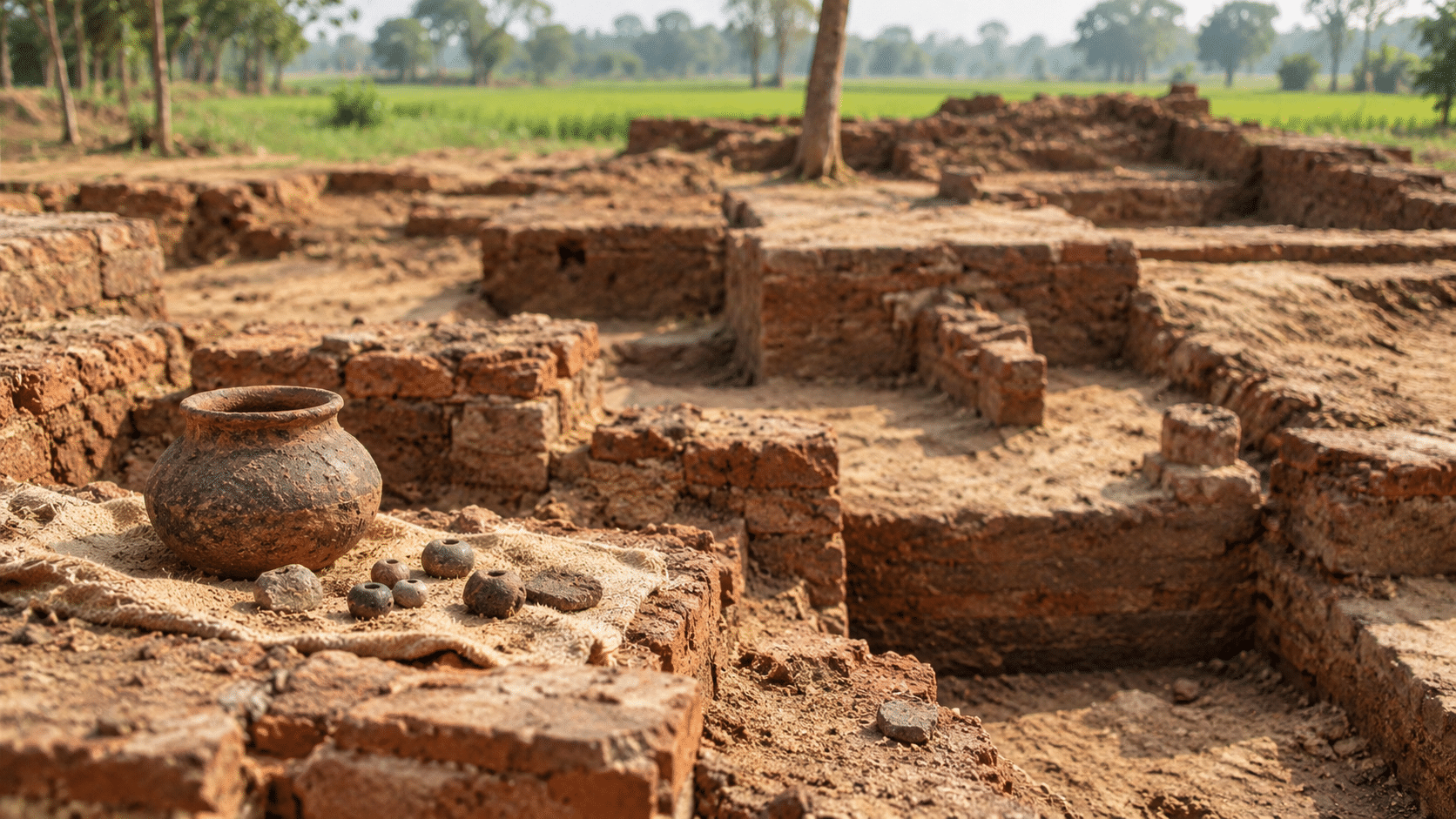
Wari Bateshwar is the kind of place that quietly rewrites what you thought you knew about Bangladesh. Tucked inside Belabo upazila of Narsingdi, about 75 km from Dhaka, this pair of villages holds the remains of an ancient fort city and trading centre. Many estimates place it around 2,500 years in the past. Long before Dhaka grew into a capital, people at Wari Bateshwar were shaping stone beads, minting silver coins and trading across the region.
The Story Behind Wari Bateshwar
The discovery did not begin with a big expedition. It began with a village schoolteacher. In the 1930s, Hanif Pathan noticed that farmers kept turning up old silver coins while digging, and he started collecting them. His son, Habibullah Pathan, carried the work forward and wrote a book on the finds in 1989. For decades, the story of Wari Bateshwar lived mostly with these local enthusiasts.
Proper excavation started only in 2000, led by archaeologist Sufi Mostafizur Rahman and his team from Jahangirnagar University. Since then, each season of digging has added a new piece to the puzzle.
Why Wari Bateshwar Matters
The site has produced silver punch-marked coins, semi-precious stone beads, iron objects and several types of ancient pottery. Together, these point to an organised economy with real craftsmen and real trade. Researchers also found signs of a bead-making workshop, and some studies suggest links with Southeast Asia and even the Roman world.
Some scholars believe Wari Bateshwar is the place the Greek writer Ptolemy called Sounagoura. This is still debated, but it shows how seriously historians take the site.
For a modern traveller, the real thrill is simple. You are standing on ground where traders once met, bargained and sent goods along the old river routes. Wari Bateshwar gives Narsingdi a past that few districts in South Asia can match, and it deserves a proper visit rather than a quick photo stop.
What You Will See at Wari Bateshwar
The Excavation Area
Wari Bateshwar is not a polished monument, and that is part of its charm. You walk beside open excavation pits and old brick structures that archaeologists believe include religious buildings. An ancient road has also been uncovered here. Standing next to walls laid down some 2,000 years ago is an experience no textbook can give you.
The Local Museum Collection
The Pathan family started a small local museum to keep their collection of coins and beads, and photographs and finds from the digs are displayed nearby. Opening arrangements can change, so ask around in Belabo before you go.
Plan Your Wari Bateshwar Visit
- Where: about 3 km west of Belabo, Narsingdi.
- Time needed: two to three hours is enough for the site and the nearby village paths.
- Pack: comfortable shoes, water, a hat and a charged phone for photos.
- Tip: talk to local villagers. Many of them grew up hearing stories of coins turning up in the fields.
Go in the dry winter months. In the monsoon, the paths turn muddy and parts of the area can be hard to reach.
Wari Bateshwar Through a Traveller’s Eyes
Do not expect ticket counters, cafes or neat signboards. Wari Bateshwar rewards curious people. Bring a notebook, read about the coins before you arrive, and let the villagers point you to the spots where finds have been made. A slow, quiet visit leaves a far stronger memory than a rushed one.
Pair Wari Bateshwar With Other Narsingdi Stops
Most travellers give Wari Bateshwar half a day and then return to Narsingdi town. From there, you can continue to the Sultanate-era mosques on our Narsingdi historical places trail, or finish with a shopping stop at the Madhabdi textile belt.
Wari Bateshwar FAQs
Where is Wari Bateshwar located?
Wari Bateshwar is in Belabo upazila of Narsingdi district, about 75 km from Dhaka.
How old is Wari Bateshwar?
Many estimates date the settlement to around 450 BCE or earlier, which makes it one of the oldest known urban sites in Bangladesh.
What is the best time to visit Wari Bateshwar?
November to February, when the weather is dry and walking around the site is easy.