
A Buddhist pilgrimage near Dhaka does not have to mean a long journey. In Munshiganj, the old land of Bikrampur, you can trace the story of one of Asia’s great Buddhist teachers in a single quiet day. This guide walks you through a calm Buddhist pilgrimage near Dhaka, from the birthplace of Atish Dipankar Srijnan to the buried monastery city that surrounded his world.
Why Bikrampur Is a Place for a Buddhist Pilgrimage Near Dhaka
Atish Dipankar Srijnan lived from about 980 to 1054 and is closely tied to Bikrampur. He later travelled to Tibet, where he helped revive Buddhism. According to Wikipedia, in his time the region was a centre of Buddhist learning, and some 8,000 students and teachers are said to have come from as far as China, Tibet, Nepal and Thailand.
Stop One on the Buddhist Pilgrimage Near Dhaka: Atish Dipankar Memorial
Begin at the memorial in Bajrayogini village, on Sukhbashpur Road. It marks the traditional birthplace of the scholar, known locally as Nastik Panditer Bhita. The grounds have a central monument, a prayer room and a small library, and many Buddhist visitors come here to pray. This is the best place to slow down and set the mood for the day. A pilgrimage does not need long rituals. Sitting quietly here for ten minutes is a good start to a Buddhist pilgrimage near Dhaka.
Stop Two on the Buddhist Pilgrimage Near Dhaka: Nateshwar Buddhist Bihar
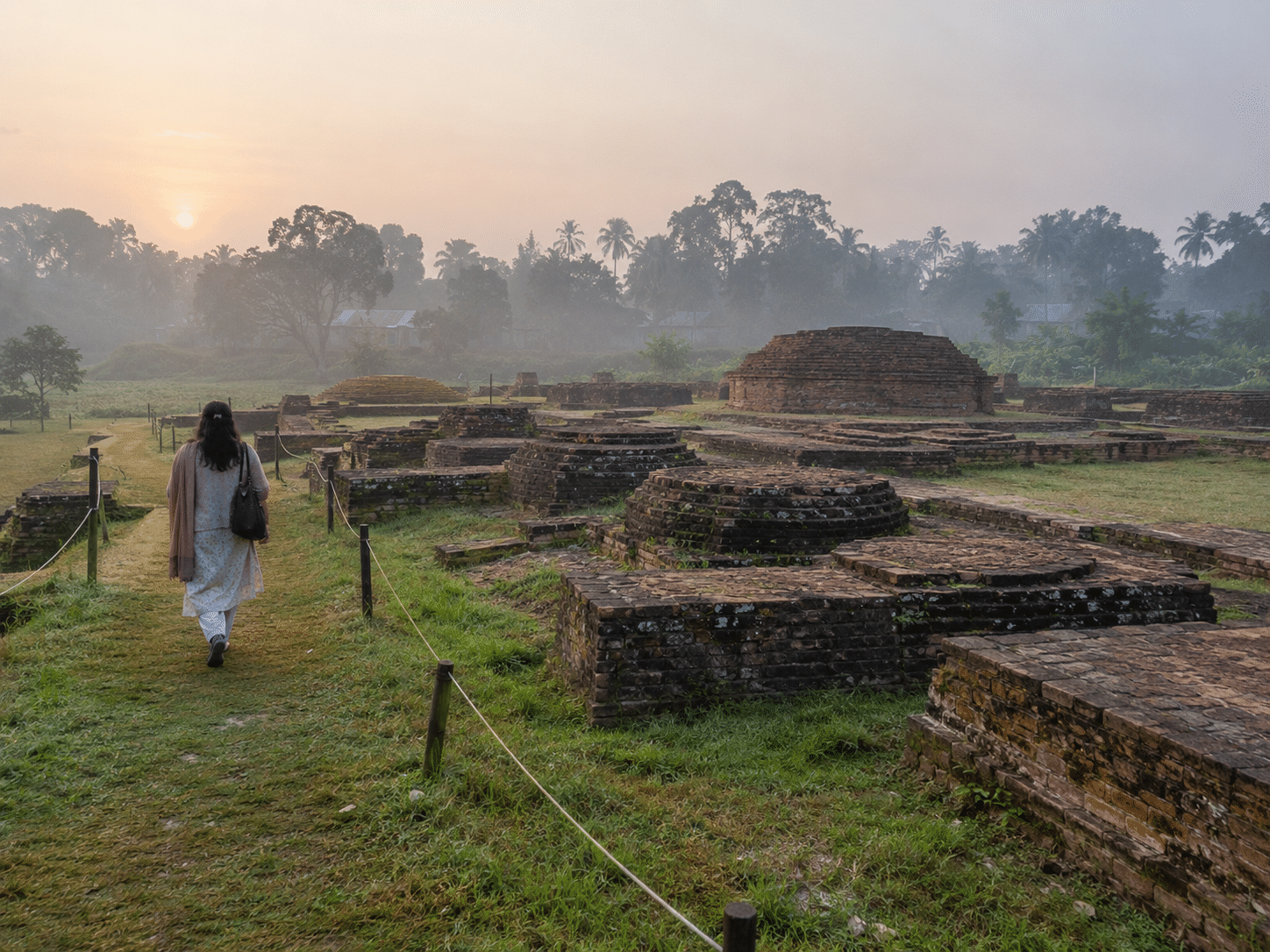
Nateshwar is the buried monastery city found by archaeologists in Tongibari. Carbon dating places the settlement between about 780 and 1223 CE, and the digs have revealed octagonal stupas, brick roads and a large pyramid-shaped stupa. Walking its grounds gives a real sense of the Buddhist world that surrounded Atish Dipankar. Parts of the site may be fenced off, so ask the caretaker before you enter.
Stop Three on the Buddhist Pilgrimage Near Dhaka: Bikrampur Vihara
The Bikrampur Vihara at Raghurampur in Munshiganj Sadar is a Buddhist monastery whose discovery was announced on 23 March 2013 after years of excavation. Later studies dated it to about 990 to 1050 CE. It is still an archaeological site, so ask locally whether visitors are allowed on the day you go.
How to Plan Your Buddhist Pilgrimage Near Dhaka
- Take an early bus from Gulistan to Munshiganj town, and hire a reserved auto-rickshaw for the day.
- Visit the Atish Dipankar Memorial first, when it is quiet.
- Continue to Nateshwar in Tongibari and walk the excavated grounds.
- Add the Bikrampur Vihara at Raghurampur if access is possible.
- Finish with a quiet moment before heading back to Dhaka from Muktarpur.
The Sonarang Twin Temples in Tongibari are Hindu, not Buddhist, but they lie close to Nateshwar and make a lovely detour if you want to see the wider heritage of the area.
Best Time for a Buddhist Pilgrimage Near Dhaka
For a Buddhist pilgrimage near Dhaka, November to February is best, with dry weather and gentle sun. Mornings are quiet, and paths are firmer than in the monsoon. If you wish to join a community event, ask local Buddhist groups about festival dates, since crowds and rules can change.
Respectful Behaviour on a Buddhist Pilgrimage
- Dress modestly and speak softly, especially near the prayer room.
- Remove your shoes where signs or worshippers ask you to.
- Ask before photographing worshippers or monks.
- Do not climb on the stupas or lean on the old brick walls.
- Carry your rubbish out with you, and keep the sites clean.
Why a One-Day Buddhist Pilgrimage Near Dhaka Works
Most Buddhist sites in Bangladesh are far from the capital, so a Buddhist pilgrimage near Dhaka in Munshiganj is a rare chance to combine faith, history and a short journey. The stops are close together, the roads are simple, and the story of Atish Dipankar ties them into one clear path. Even a short visit can leave you with a deeper feeling for Bengal’s Buddhist past.
Frequently Asked Questions
Where can you go on a Buddhist pilgrimage near Dhaka?
Munshiganj is the closest region, with the Atish Dipankar Memorial and the Nateshwar Buddhist Bihar site.
How long does a Buddhist pilgrimage near Dhaka take?
One full day is enough for two or three stops, starting early from Dhaka.
Is the Buddhist pilgrimage near Dhaka open to non-Buddhists?
Yes. Visitors of all faiths are welcome, as long as they behave respectfully.
What is the best time for a Buddhist pilgrimage near Dhaka?
November to February is best, with dry weather and calm mornings.