
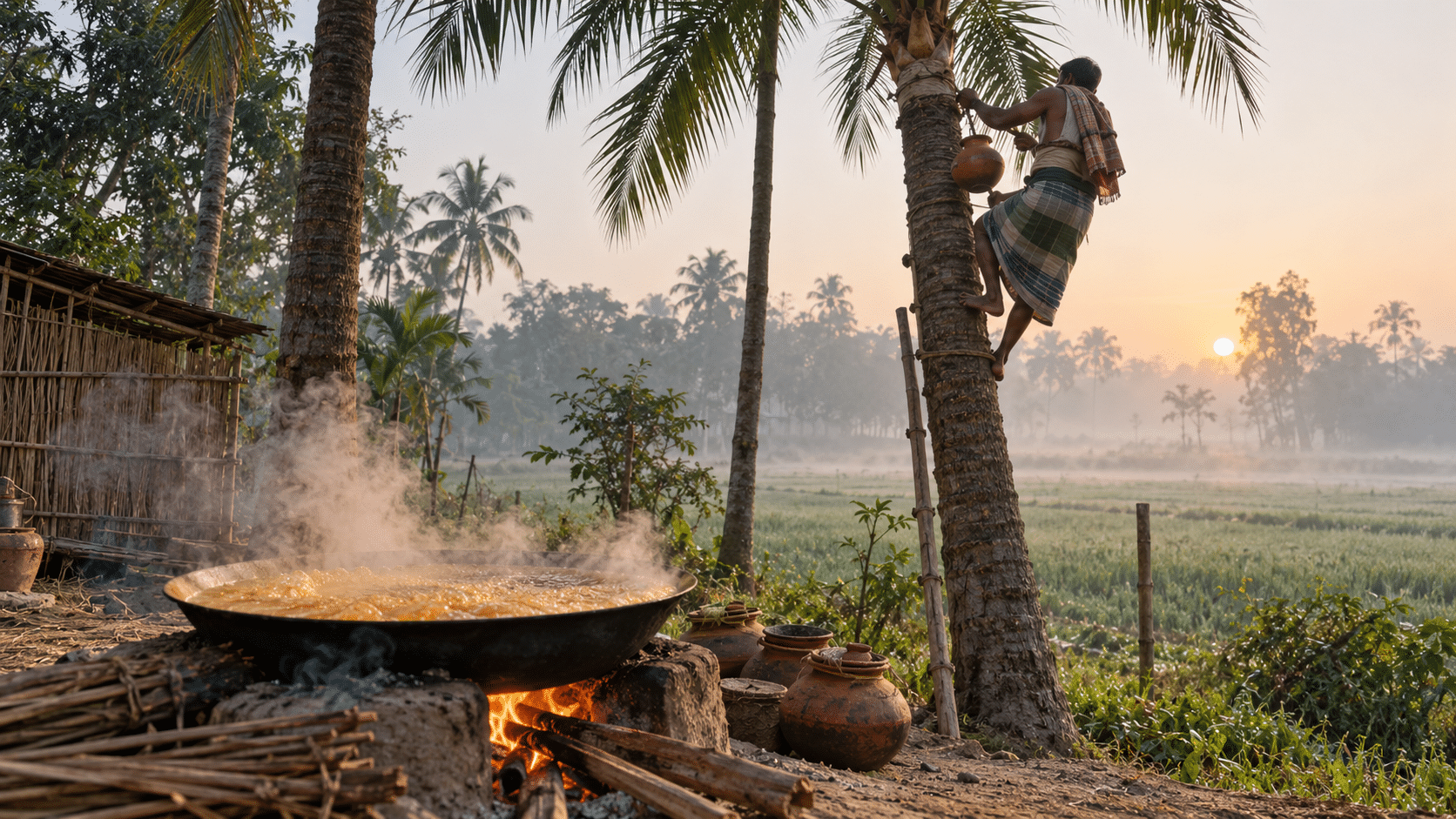
Before the sun is fully up on a winter morning, a gachi (sap collector) in a Faridpur village climbs a date palm, swaps a full earthen pot for an empty one and sets off a chain of work that ends in one of Bengal’s favourite sweets. The Faridpur khejur gur season is short, deeply seasonal and, honestly, getting harder to find in its pure form. That is exactly what makes it one of the most rewarding food experiences in the district.
Why Faridpur Is Famous for Khejur Gur
Faridpur, which sits between the Padma and Arial Khan rivers, has been linked with date palm jaggery for generations, alongside Jessore. In the past, almost every farming family had a few date palms at home. Winter meant sweet sap in the morning and pitha and payesh made with fresh gur in the afternoon. That memory is still strong here, and it is why the Faridpur khejur gur season matters to locals as more than just a sweetener.
How Faridpur Khejur Gur Is Made
- Cut: the gachi trims the bark near the top of the palm and fixes a small spout.
- Collect: sap drips into an earthen pot overnight and is collected at dawn.
- Boil: the sap is cooked in large pans for hours until it thickens and turns deep golden brown.
- Set: it is poured out and cooled. Thick, solid blocks are called patali gur, while the runny version is jhola or nolen gur.
Because the sap only flows well in the coldest months, the whole season for Faridpur khejur gur lasts roughly two months, from December to February.
What You Can Do
Watch the Dawn Sap Collection
If a local contact can introduce you to a gachi, ask whether you can watch the early-morning round. It takes only a short time, but seeing a collector balance on a tall palm with bare hands and a curved knife makes you respect every spoonful of gur.
See the Boiling Pans
In village courtyards, the sap is boiled in wide pans over a wood fire. The smell is smoky and caramel-like, and it is the real heart of the Faridpur khejur gur experience.
Taste It the Traditional Way
Try fresh gur in pitha, payesh or simply on its own. The flavour is nutty, smoky and far more complex than plain sugar.
Safety: Do Not Drink Raw Sap
In Bangladesh, drinking raw date palm sap has been linked to Nipah virus, which can spread when bats contaminate the collection pots. Drink sap only if it has been properly boiled, and when in doubt, skip it and taste the finished gur instead.
How to Buy Pure Gur
This is the biggest challenge for any visitor. Faridpur’s safe food inspector has warned that some producers whiten gur with sulphur, red dye, lime, molasses or saccharin, and that some gur is made with no date sap at all. To protect yourself:
- Buy directly from a gachi or a producer you can see boiling sap.
- Be wary of gur that looks unusually white, bright red or perfectly uniform.
- Be suspicious of very low prices during peak season.
- Smell it. Real Faridpur khejur gur has a rich, smoky aroma, not a chemical or sugary one.
How to Plan the Experience
- Best time: December to February, ideally during the coldest weeks.
- Base: Faridpur town, then travel to nearby villages in the early morning.
- Local help: go with a local friend, driver or guide. Villages rarely have signs for visitors.
- Manners: ask before photographing people at work, pay for anything you taste or buy, and thank the family.
Combine your morning with the Pallikabi Jasimuddin heritage area in Ambikapur or an evening on the Padma at Dholar Mor.
Why It Matters
Date palms are disappearing from many Faridpur villages, partly because trees are cut for brick kiln fuel and fewer people want to work as sap collectors. Local officials say lakhs of palms have been planted in recent years to bring the tradition back. Choosing real Faridpur khejur gur from a trusted source is a small way to help it survive.
Quick FAQ
When is Faridpur khejur gur available?
Mainly from December to February, when the sap flows best.
What is the difference between nolen gur and patali gur?
Nolen or jhola gur is the liquid form, while patali gur is the solid, set form.
Can anyone watch the gur-making?
Usually yes, if you ask politely through a local contact. Be respectful and do not get in the way of the work.