
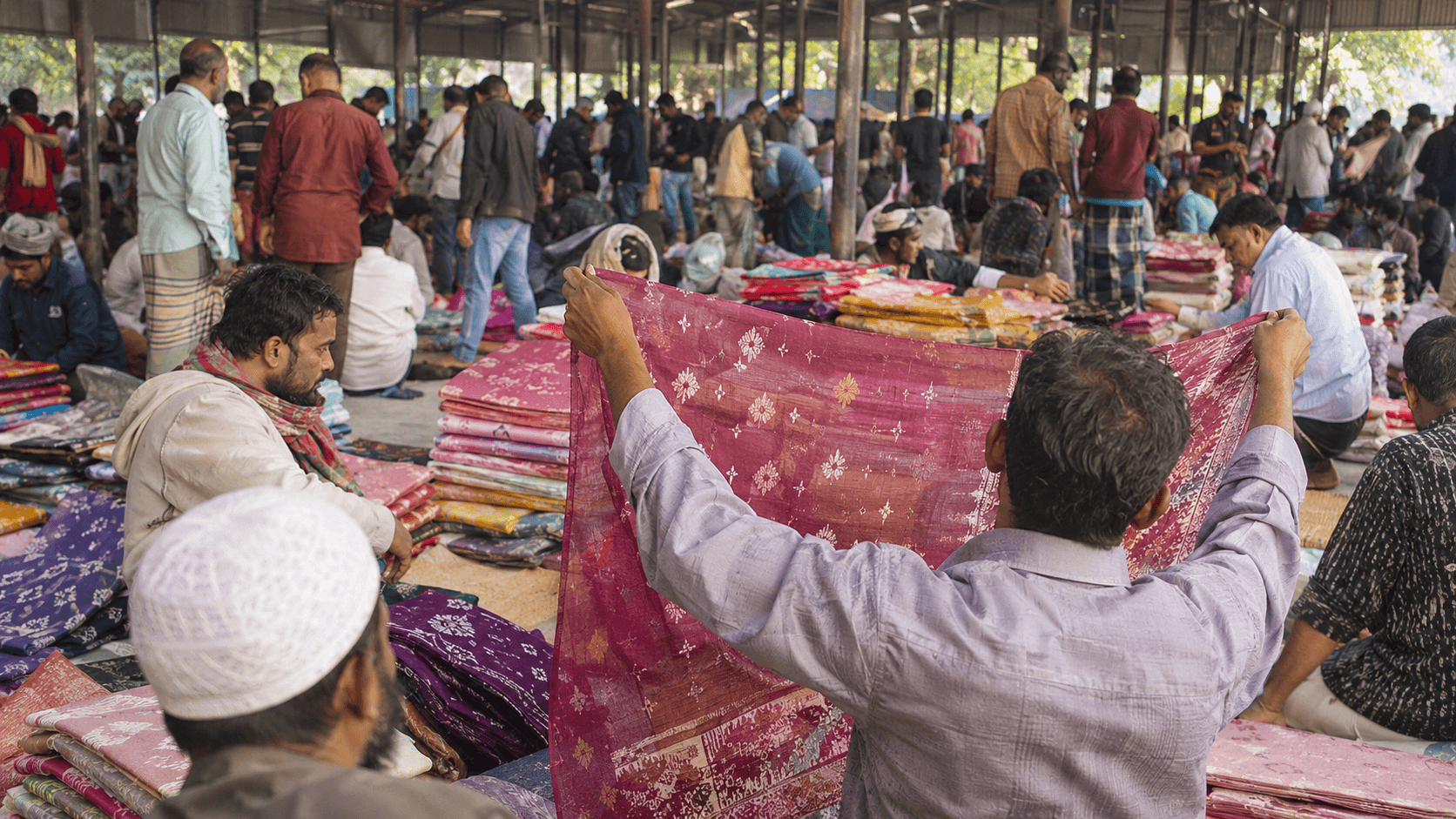
The Friday Jamdani haat is a loud, colourful and fascinating wholesale market where weavers, traders and buyers meet to trade hand-woven saris. If you want to see how Jamdani moves from the loom to the shop, the Friday Jamdani haat in Rupganj is the best place near Dhaka. Go early, keep your eyes open and enjoy a market that feels like a living piece of heritage.
What Is the Friday Jamdani Haat?
A haat is a traditional weekly market. At the BSCIC Jamdani Palli in Noapara, Rupganj, a weekly haat is organised on Fridays, and buyers and traders gather soon after the early morning prayer. It is mainly a wholesale market, so you will see weavers carrying saris, traders checking the quality, and buyers bargaining over price. There are also older Jamdani haats in the Demra area, which have long served weavers from Rupganj, Sonargaon and Siddhirganj.
What Happens at the Friday Jamdani Haat
The Friday Jamdani haat is busy and fast. Many people have more than one role, because a person can be a weaver, a financier and a seller at the same time. A typical scene looks like this:
- Weavers arrive early: Many bring finished saris wrapped in cloth, straight from their looms.
- Traders inspect each piece: They check the motifs, thread and any damage before paying.
- Buyers compare and bargain: Wedding shoppers and shop owners look for good designs at wholesale rates.
- Deals close quickly: The buyer checks the sari, pays the weaver, and the pieces are wrapped for transport.
It can feel like a whirlwind, but that energy is exactly what makes the Friday Jamdani haat special.
Is the Friday Jamdani Haat Good for Visitors?
Yes, if you like crowded, real-life markets. It is not a polished tourist event. It is a working market, so prepare for noise, quick decisions and little personal space. If you only want to watch, stand near the edges and take your time. If you want to buy, go with patience and a clear idea of what you like. Wholesale buyers may prefer larger orders, so ask politely if single pieces are available.
Best Time for the Friday Jamdani Haat
Go very early on a Friday morning. Trading begins shortly after dawn, and the busiest hours are before late morning. Winter months from October to March are the most comfortable for the Friday Jamdani haat, and the weeks before Eid and the wedding season bring the biggest crowds. Weekdays are better for seeing looms, while Friday is for the market.
How to Reach the Friday Jamdani Haat
The Jamdani Palli haat is at Noapara in Tarabo, Rupganj, about three kilometres north of Kanchpur Bridge on the Dhaka to Sylhet highway. From Dhaka, take a bus toward Rupganj or Narsingdi, get down near Noapara or Tarabo, and use a CNG auto-rickshaw or rickshaw for the last stretch. By private car, cross Kanchpur Bridge and follow the signs. Leave very early, because traffic and the crowd both build up quickly.
Tips for the Friday Jamdani Haat
- Carry cash in small notes and keep valuables safe.
- Wear comfortable shoes and light clothes.
- Ask before photographing people or their saris.
- Check each sari carefully for tears, loose threads and uneven motifs.
- Bargain politely, and remember that fair pay keeps the craft alive.
How to Spot Real Handloom Jamdani
Handwoven motifs look neat but slightly irregular, and you can feel the pattern in the fabric. Printed designs look flat and perfect. Ask how many days or weeks the piece took, and compare two or three weavers before buying. If something looks too cheap, it may not be handloom.
Plan Your Day Around the Friday Jamdani Haat
A good plan is to visit the Friday Jamdani haat early, then continue to a quieter weaving home, and finish at Zinda Park in the afternoon. For the place behind this experience, read our Jamdani Palli guide, and for the wider area, read our Rupganj Jamdani Village and Eco Retreat Belt destination guide.