
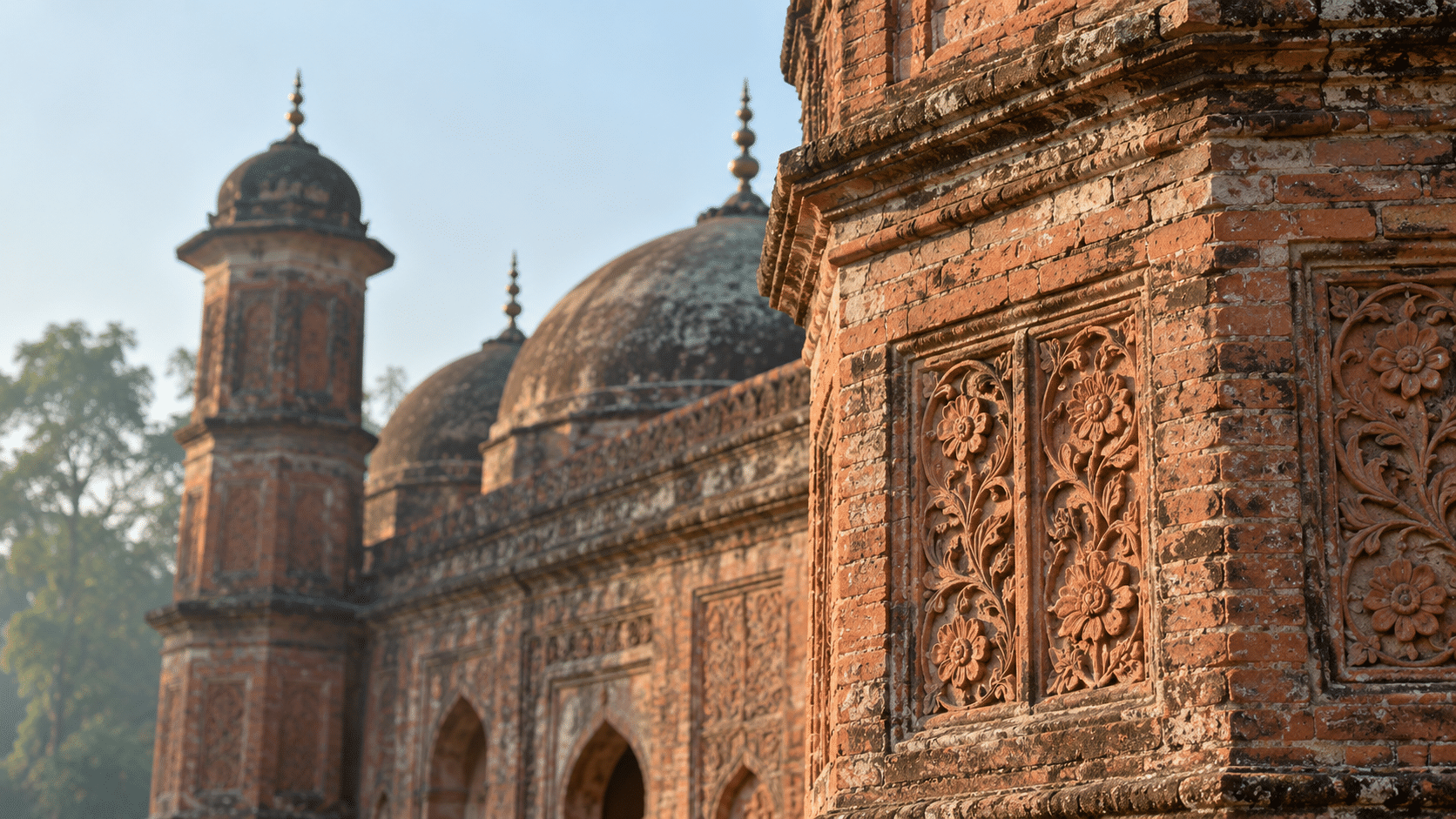
A Kishoreganj mosque trail is a lovely way to see how mosque design in Bengal changed over centuries. Within one district you can find a five-domed Sultanate mosque, a Mughal-era mosque decorated with terracotta, and a large modern-style mosque on the river bank. Walking this Kishoreganj mosque trail turns a religious journey into an architecture lesson as well.
Stop One: Kutub Shah Mosque in Austagram
The Kutub Shah Mosque is probably from the later part of the 16th century. It has a large central dome with four smaller domes, four octagonal corner towers, a curved cornice and terracotta panels with floral designs. Experts note that it marks the start of a special five-domed style in Bengal. A tomb beside it is believed to belong to the saint it is named after. It stands beside a lake in Austagram, about 60 km south of Kishoreganj town.
Stop Two: Shah Mahmud Mosque in Egarasindur
The Shah Mahmud Mosque was built in 1664, during the time of Subedar Shaista Khan, by a local businessman. It is square in shape, with a boundary wall, a small gatehouse called the balakhana and four octagonal corner structures. Three doors open on the east side, and the middle one is larger. Terracotta designs on the walls give it a warm, handmade look. It is the best place on the trail to study Mughal-era decoration.
Stop Three: Sheikh Sadi Mosque
About 250 metres away from the Shah Mahmud Mosque stands the Sheikh Sadi Mosque, another Mughal-era mosque in Egarasindur. Visiting both on the same walk shows how a village could hold two historic mosques side by side.
Stop Four: Pagla Mosque in Harua
The Pagla Mosque on the Narsunda river bank is described as a modern-style building. It has three storeys, tall minarets and three domes, and it belongs to a larger Islamic complex. It is famous for its legends and for its donation boxes. Seeing it after the older mosques helps you notice how scale, materials and purpose changed over time.
What to Compare Along the Way
Look at the domes first, from one large dome in the older mosques to three in the Pagla Mosque. Then look at the surface: terracotta panels in the older mosques, plastered and painted walls in the modern one. Also compare setting: lake, fort ground and river bank. These small differences are what make the Kishoreganj mosque trail worth doing in order.
How to Plan the Kishoreganj Mosque Trail
Austagram is far from the other stops, so treat it as a separate day or combine it with a haor trip. The Egarasindur mosques and the Pagla Mosque fit easily into one day starting early from Kishoreganj town. Use CNG auto-rickshaws, and ask locals for current routes, especially toward Austagram.
Mosque Etiquette
- Dress modestly and cover your head if asked
- Remove shoes where requested and speak softly
- Avoid visiting during prayer times, unless you are there to pray
- Ask permission before photographing worshippers
- Do not climb walls or domes of protected sites
Best Time
November to February is the most comfortable season, with dry paths and cool air. Early morning gives the softest light for photographs of brick and terracotta.
Quick Answers About the Kishoreganj Mosque Trail
Which mosque is the oldest on the trail?
The Kutub Shah Mosque is believed to be the oldest, probably from the later part of the 16th century.
Can I do the whole trail in one day?
The Egarasindur mosques and the Pagla Mosque fit in one day. Austagram is better as a separate trip.
Can visitors who do not pray enter?
Rules can differ from site to site, so ask locally first, dress modestly and behave respectfully.