
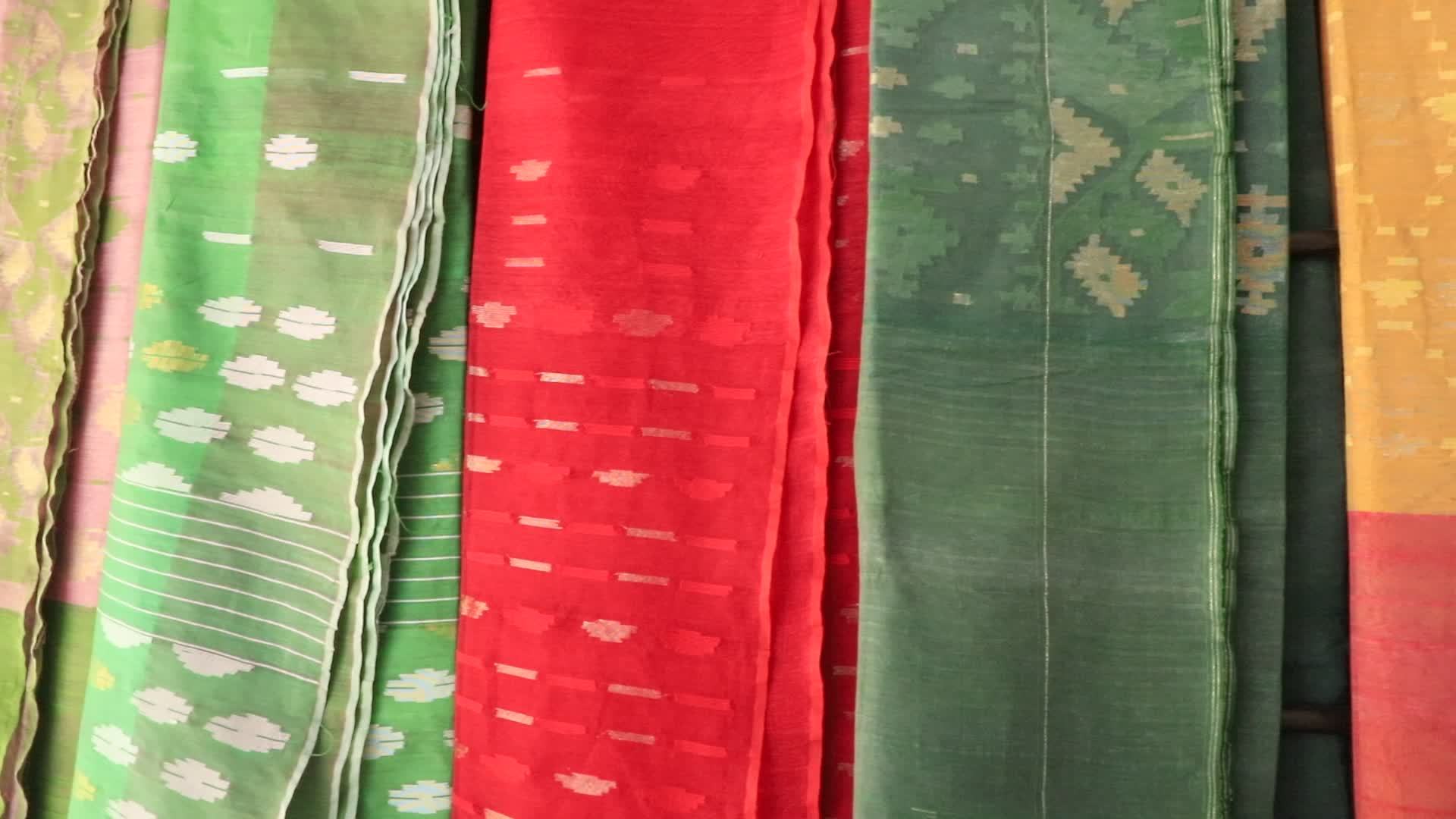
Jamdani, also called Dhakai Jamdani, is a fine, hand-woven cotton textile from the Narayanganj area near Dhaka, Bangladesh. Weavers make its flower and geometric patterns by adding extra weft threads by hand, often with two weavers at one loom. UNESCO inscribed the traditional art of Jamdani weaving on its Intangible Cultural Heritage list in 2013, and Bangladesh received Geographical Indication (GI) status for the Jamdani sari in 2016. Today the craft depends on fair pay for weavers, protection of traditional designs and new markets.
A Jamdani sari looks calm from a distance. Up close, every flower is a tiny puzzle, set into the cloth thread by thread. At a bamboo loom in Rupshi village, two weavers sit side by side with a pit under their feet, counting and placing each motif by hand. A fine piece can take months to finish. This is the story of how a craft that was once almost lost found its way back, and what it needs now to survive.
Jamdani at a Glance
- Also known as: Dhakai Jamdani, Dhakai
- Where it is woven: Sonargaon, Rupganj and Siddhirganj in Narayanganj District, near Dhaka, with Rupshi village often called the “Jamdani village”
- Technique: Handloom weaving with extra, discontinuous weft threads that form the motifs
- Material: Fine cotton, sometimes with gold or silver-colored thread
- UNESCO listing: 2013, Representative List of the Intangible Cultural Heritage of Humanity
- GI status: 2016 (the first GI product of Bangladesh)
Jamdani: A Fine Muslin Textile with a Long History
Jamdani is a type of muslin that has been woven near Dhaka for centuries. It is popularly known as Dhakai Jamdani, or just Dhakai, after the city, as Wikipedia notes. For many Bengali women, a Jamdani sari is more than clothing. It is worn at weddings, festivals and family occasions, and it is passed down as an heirloom. The usual six-yard sari carries a sense of elegance and tradition, and weavers also make dress material and scarves.
Historical Roots of Jamdani
The word “Jamdani” is commonly explained as Persian, from “jam” (flower) and “dani” (a container or vase), which fits the flower patterns on the cloth. Fine cotton cloth from Bengal is much older than the name. Early writings, including the Periplus of the Erythraean Sea and the accounts of Arab, Chinese and Italian travelers, praise the muslin of the region, and some historians link it to the fine textiles of ancient Vanga mentioned in the Arthashastra. The art flourished under the Mughals, when villages around Dhaka became weaving centers. European, Iranian, Armenian and later American traders sought out Bengal muslin. Wikipedia notes that a piece was priced at 56 livres in 1776, which shows how valuable Jamdani was.
The craft fell on hard times as the muslin trade declined and after the Partition of 1947. Weavers received little help, and by the 1970s many families had stopped weaving. A BRAC survey in 1978 in Demra found that families who had woven Jamdani for generations had given up the craft, according to BRAC’s blog. Aarong then began working with weavers, and in 1981 it held what it calls the first Jamdani exhibition in Bangladesh at Shilpakala Academy.
The Intricate Weaving Process
Jamdani is a handloom weave known for its rich motifs. In the main technique, extra weft threads are added by hand, thread by thread, to the base cloth, so the pattern appears to float on the surface. The weavers do not use a drawn pattern. They often create the design in their minds as they work. In many workshops, two weavers sit at the same loom and count and place the design threads, and a third weaver may join for very fine work, according to an excerpt on ThePrint.
The work is slow. A fine sari can take many months, and more complex pieces can take far longer, depending on the design. A 2005 report in The Daily Star found that most adult weavers in the Jamdani village worked very long days, and that many suffered from back pain. The knowledge is passed from parent to child and from master to apprentice, which is why UNESCO notes that master weavers pass the traditional motifs and skills to their disciples.
Challenges Facing Jamdani Weavers
- Low and uncertain income. Weaving is slow, and pay can be irregular. The goal for the craft is a steady, fair income for weavers and the trades around them.
- Middlemen. Intermediaries connect weavers to markets, but some offer very low prices. Direct links, such as the Jamdani Palli (production centre) near Dhaka, are meant to reduce this problem, as reported by The Daily Star.
- Loss of authenticity. Designers worry about enlarged motifs, copied patterns and cheaper imitations. Ruby Ghuznavi of Aranya warned in 2005 that enlarging and changing the traditional designs is a danger to the heritage.
- Keeping young people interested. The craft needs designs that appeal to young buyers, while staying true to its roots.
- Rising costs and market pressure. Weavers have often had to simplify designs because of price limits.
Possible Solutions to Protect Jamdani
People who work on the craft suggest several steps:
- Support for weavers’ centers and direct links to markets, so that weavers earn more.
- Fair trade practices and honest labeling, backed by the GI protection won in 2016.
- Help with raw materials, such as duty relief on specific yarns.
- New products such as panjabis, dress material and home items, without changing the traditional motifs.
- Training for young weavers and designers, in partnership with design schools.
Aarong, Aranya (led by Ruby Ghuznavi), Tangail Saree Kutir (led by Monira Emdad) and Kumudini are named by The Daily Star among the people and brands that worked to revive Jamdani. For more handmade crafts, see our guide to arts and crafts in Bangladesh.
Efforts and Recognition
UNESCO inscribed the “Traditional art of Jamdani weaving” on its Representative List of the Intangible Cultural Heritage of Humanity in 2013, based on a nomination from Bangladesh. The Goethe-Institut Bangladesh notes that Bangladesh obtained GI status for Jamdani in 2016, and that the craft is still woven in Sonargaon, Rupganj and Siddhirganj. Jamdani was the first product of Bangladesh to get a GI, as we explain in our post on GI products from Rajshahi.
Recognition helps, but it does not fill the loom. What keeps Jamdani alive is demand for real, hand-woven cloth, and a fair price for the people who make it.
General Tips for Buying Real Jamdani
- Ask whether the sari is hand-woven on a loom, and who made it.
- Look at the back of the cloth, where the motifs of hand-woven Jamdani are neat and the extra threads are cut cleanly.
- Buy from trusted shops, cooperatives or directly from weavers’ centers.
- Expect a high price for fine work, since it takes weeks or months to make.
For more ways to support local makers, browse our Buy Bangladeshi and culture stories.
Frequently Asked Questions About Jamdani
What is Jamdani?
Jamdani is a fine, hand-woven cotton muslin from the Dhaka region of Bangladesh, known for its flower and geometric motifs made with extra weft threads.
Where is Jamdani woven?
Jamdani is woven in Sonargaon, Rupganj and Siddhirganj in Narayanganj District, with Rupshi village known as the “Jamdani village”.
What does the word Jamdani mean?
It is commonly explained as a Persian word made of “jam” (flower) and “dani” (a vase or container).
Is Jamdani recognized by UNESCO?
Yes. UNESCO inscribed the traditional art of Jamdani weaving on its Representative List of the Intangible Cultural Heritage of Humanity in 2013.
Does Jamdani have a GI tag?
Yes. Bangladesh received Geographical Indication status for the Jamdani sari in 2016.
How long does it take to weave a Jamdani sari?
A fine sari can take many months, and the most complex designs take longer, depending on the motifs and the number of weavers.
How can I tell real Jamdani from imitations?
Ask whether it is hand-woven on a loom, check that the motifs are woven into the cloth and not printed or embroidered, and buy from trusted sellers.
Final Thoughts on Jamdani
Jamdani is proof that a craft can come back from the edge, but only if buyers, designers and institutions keep choosing it. Recognition from UNESCO and the GI tag give it protection on paper. The real protection is a weaver who earns a fair living and a young person who wants to learn the loom. For more ideas, explore our places to visit in Bangladesh and travel experiences.