
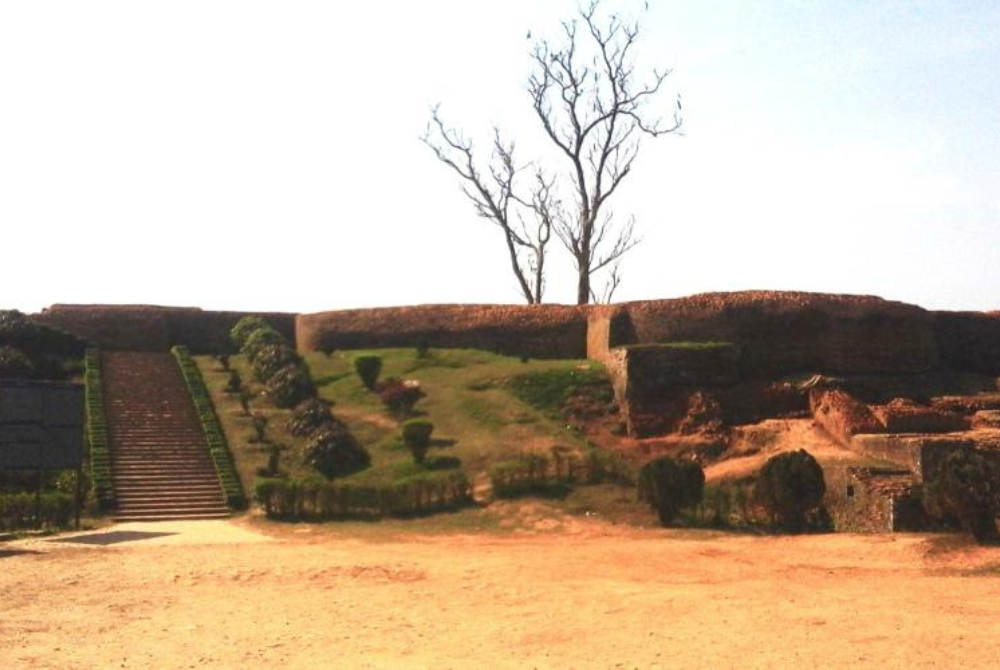
Mahasthangarh is an ancient fortified city in Bogura District, Bangladesh, and one of the oldest known city sites in the country. Also called Pundranagara, it dates back to the 3rd century BCE, as a Brahmi inscription found here in 1931 shows. Today you can walk its ramparts, see old temple bases and visit a site museum about 12 km north of Bogura town.
Picture a quiet green mound in northern Bangladesh. Cows graze nearby, and a small stream trickles past. Now imagine that the same ground once held the busy capital of Pundravardhana, when the Maurya Empire ruled much of South Asia. That is the surprise of Mahasthangarh. It does not look like a famous city, but every step here sits on layers of history that stretch back more than 2,000 years.
Mahasthangarh at a Glance
- Also known as: Pundranagara, Paundravardhanapura
- Location: Mahasthan village, Shibganj, Bogura District, Rajshahi Division
- Age: From the 3rd century BCE
- Citadel size: About 185 hectares
- Distance: About 12 km north of Bogura town, on the Bogura-Rangpur highway
- Status: On Bangladesh’s UNESCO World Heritage Tentative List
- Best time to visit: Winter, from November to February
Where Is Mahasthangarh? Geography and Location
Mahasthangarh, the ancient capital of Pundravardhana, lies about 12 km north of Bogura (also spelled Bogra) along the Bogura-Rangpur highway. A feeder road runs along the eastern side of the citadel’s ramparts for 1.5 km and leads to Jahajghata and the site museum. Accommodation is easy to find in Bogura town, so most visitors stay there and visit Mahasthangarh as a day trip. You can compare options in our hotel guides.
How to Reach Mahasthangarh from Dhaka
Buses run from Dhaka to Bogura and take around 4 to 5 hours, crossing the Jamuna River over the Bangabandhu Jamuna Bridge. From Bogura, you can take a local bus to Mahasthangarh. Inside the area, local rickshaws are handy for short hops between the sites. You can also hire a private vehicle from Dhaka or Bogura. For more help on getting around, read our tips on local transport in Bangladesh.
Why the Ancient City Was Built Here
Two things made this spot a smart choice. First, Mahasthangarh sits on the red soil of the Barind Tract, a slightly raised area inside a mostly flat river plain. The land here rises about 15 to 25 meters above its surroundings, which gives natural protection from floods.
Second, the Karatoya River flowed right beside it. In its prime, the Karatoya was a mighty river that carried trade and people. Today it is a small stream on the eastern side of the citadel, but its old path still explains why a great city grew here. You can see more such waterways in our list of rivers in Bangladesh.
Discovery and the Citadel of Mahasthangarh
Many people helped bring Mahasthangarh back into the light. In 1808, Francis Buchanan Hamilton became the first to locate and visit the site. C.J. O’Donnell, E.V. Westmacott and Beveridge followed. Alexander Cunningham, who visited in 1879, was the first to recognize Mahasthangarh as the capital of Pundravardhana.
The site has also faced pressure. On April 19, 2004, The Daily Star reported that local residents were looting bricks and valuable items, and that some were building homes on the site against government rules. It is a reminder that places like this survive only when visitors and locals care for them.
The heart of the ancient city is the citadel. It is rectangular, about 1.523 km long from north to south and 1.371 km wide from east to west, and covers roughly 185 hectares. High, wide ramparts protect it on all sides. Before excavations began in the 1920s, the inside of the citadel stood over 4 meters higher than the land around it, and the rampart rose 11 to 13 meters above the surrounding ground, covered in jungle. At the southeastern corner stood a mazhar (holy tomb) and a mosque built in 1718-19.
Today, the citadel holds several mounds and ruins, each with its own story:
- Jiat Kunda: a pond believed to have life-giving properties
- Mankalir Dhap: a mound dedicated to Mankali
- Parasuramer Basgriha: a palace linked with King Parasuram
- Bairagir Bhita: a palace for a female anchorite
- Khodar Pathar Bhita: a place with a stone said to be a gift from God
- Munir Ghon: a bastion
- Govinda Bhita: a temple to Govinda on the bank of the Karatoya, near the site museum and a rest house
The citadel also has four gateways: Kata Duar (north), Dorab Shah Toran (east), Burir Fatak (south) and Tamra Dawaza (west). At the northeast corner, a flight of steps called Jahajghata leads toward the old riverbank.
Mahasthangarh Excavations Overview
Systematic digging at Mahasthangarh began in 1928-29, led by K.N. Dikshit of the Archaeological Survey of India. The first work covered Jahajghata, Munir Ghon and Bairagir Bhita. In 1934-36, teams dug at Bairagir Bhita and Govinda Bhita. In the 1960s, work moved to the Mazhar, Parasuramer Prasad, Mankalir Dhap and Jiat Kunda, with some digging along the northern rampart.
Later phases included on-and-off work on the east and north ramparts, and the final report is still pending. Between 1992 and 1998, a Bangla-Franco joint project dug the area between Bairagir Bhita and a gateway found in 1991. Learn more about this partnership on the Franco-Bangladeshi archaeological mission page. That project, now in its second phase, includes digging around the mazhar on the western side of the citadel.
Discoveries and Movable Antiquities
The digs at Mahasthangarh have turned up a rich set of finds:
- Inscriptions: The most famous is a small limestone slab, about 4.4 cm by 5.7 cm, with six lines of Prakrit written in the Brahmi script. It was found by chance in 1931. It reads like an official order from the Mauryan era, and it dates Mahasthangarh to the 3rd century BCE. The site also gave an Arabic slab from 1300-1301, which mentions a tomb for Numar Khan, a naval fleet lieutenant, and a Persian slab from 1718-19, which records a mosque built during the rule of Mughal Emperor Farrukhsiyar.
- Coins: Silver punch-marked coins from the 4th century BCE to the 1st or 2nd century CE, some uninscribed copper cast coins, two Gupta-period coins from nearby Vamanpara village, and coins from the sultans of the 14th and 15th centuries and the British East India Company.
- Ceramics: Mostly pottery shards, which help experts date each layer of the city.
- Sculpture: A 5th-century Buddha stone sculpture from Vasu Vihara, a Lokesvara sculpture showing traits of both Vishnu and Avalokitesvara, sandstone door-frames, pillars and lintels from the 5th to 12th centuries, many bronze Buddha figures from the 10th and 11th centuries, and a terracotta Surya from Mankalir Bhita.
- Terracotta plaques: Many plaques that show scenes and figures from daily and religious life.
For a wider view of the site’s history, see the Banglapedia entry on Mahasthan, which describes it as the earliest and largest archaeological site in Bangladesh.
Mahasthangarh Site Museum: Timings and Visitor Tips
These finds are now on display in the Mahasthangarh site museum. The museum is open Sunday to Thursday. In summer (April 1 to September 30), it runs from 10 am to 6 pm. In winter (October 1 to March 30), it runs from 9 am to 5 pm. The lunch recess is from 1 pm to 2 pm.
On Fridays, the recess is from 12:30 pm to 2:30 pm, and the museum opens at 9 am in summer, with the other timings the same. Timings can change, and the museum may close on public holidays, so confirm with the museum or the Department of Archaeology before you go.
At the ticket counter, you can buy books on Mahasthangarh and other archaeological sites in Bangladesh, in both Bengali and English. If you love old places, also explore our archaeological sites in Bangladesh and historical sites. For another story of ancient Buddhist heritage, read our guide to Cumilla District.
Frequently Asked Questions About Mahasthangarh
What is Mahasthangarh?
Mahasthangarh is the remains of an ancient fortified city in Bogura District, Bangladesh. It was known in the past as Pundranagara or Paundravardhanapura, the capital of Pundravardhana.
How old is Mahasthangarh?
Mahasthangarh dates back to at least the 3rd century BCE. A Brahmi inscription on a limestone slab, found in 1931, is the key proof.
Where is Mahasthangarh located?
Mahasthangarh is in Mahasthan village, about 12 km north of Bogura town, along the Bogura-Rangpur highway.
How can I go to Mahasthangarh from Dhaka?
Take a bus from Dhaka to Bogura, which takes around 4 to 5 hours over the Bangabandhu Jamuna Bridge. From Bogura, take a local bus or hire a vehicle to reach Mahasthangarh.
What are the Mahasthangarh museum opening hours?
The museum is open Sunday to Thursday, from 10 am to 6 pm in summer and 9 am to 5 pm in winter, with a recess from 1 pm to 2 pm. Friday timings differ, so check before you visit.
Is Mahasthangarh a UNESCO World Heritage Site?
Not yet. Mahasthangarh is on Bangladesh’s UNESCO Tentative List, listed as the Cultural Landscape of Mahasthan and Karatoya River. You can read the entry on the UNESCO tentative list page.
Who discovered Mahasthangarh?
Francis Buchanan Hamilton was the first to locate and visit the site, in 1808. Alexander Cunningham later identified it as the capital of Pundravardhana.
Final Thoughts on Mahasthangarh
Mahasthangarh is not a place of grand towers or crowds. Its power is quieter. Standing on its old ramparts, you can feel more than 2,000 years of Bangladesh’s story under your feet, from Mauryan officials to Gupta coins to Mughal-era mosques. Visit in winter, start with the museum, and then walk the citadel slowly. For more trip ideas, explore our places to visit in Bangladesh and travel experiences.