
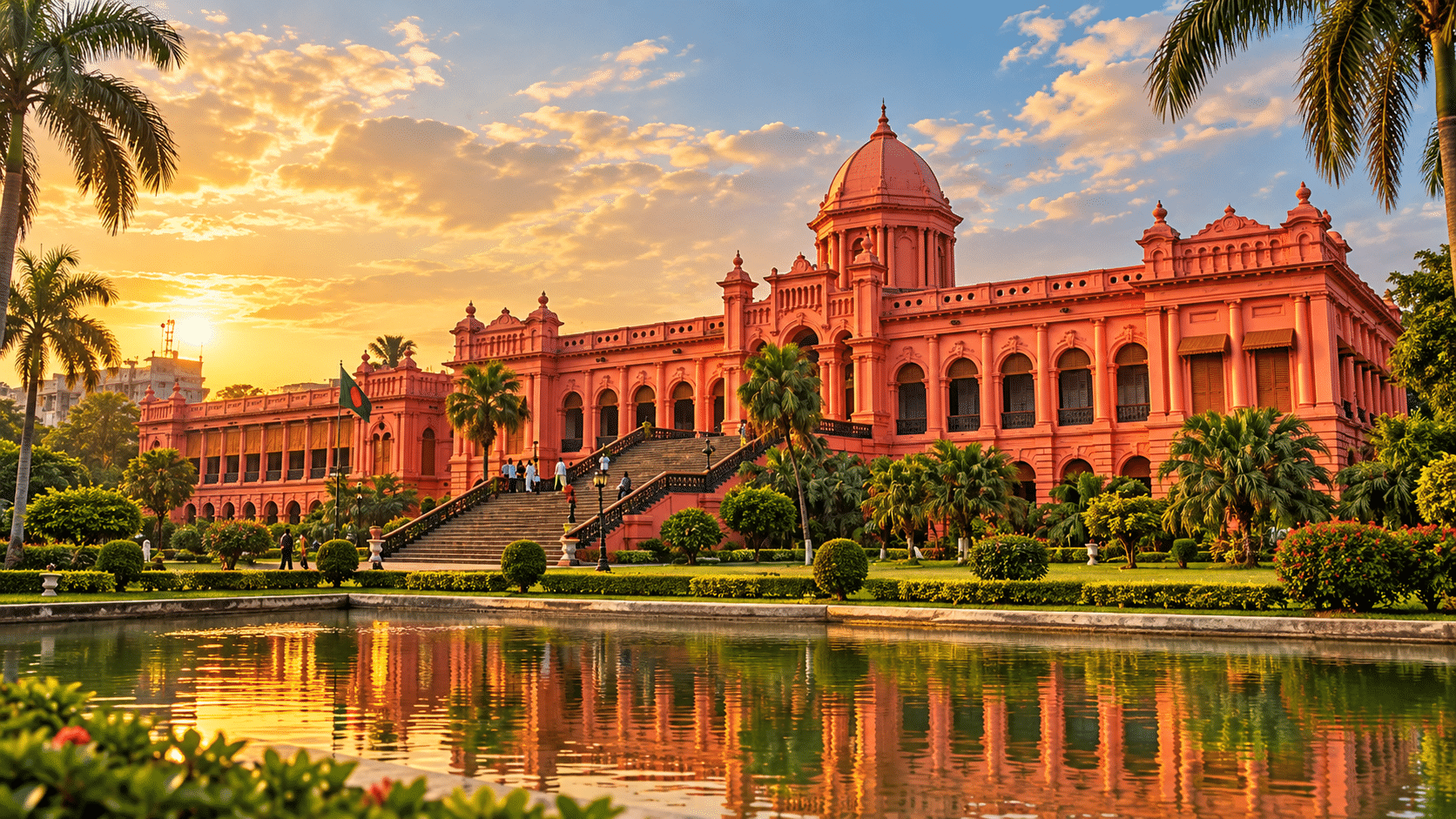
Everyone in Dhaka calls it the Pink Palace, and one look at its rose-colored facade against the Buriganga River explains why. Ahsan Manzil was the residence of the Nawabs of Dhaka, the city’s most powerful landholding family during British colonial rule, and for nearly a century it functioned as the real seat of social and political power in the region, a place where decisions affecting the whole of eastern Bengal were quietly made over tea on the veranda.
Construction began in 1859 and finished in 1872, commissioned by Nawab Abdul Ghani, who named the finished palace after his son Khwaja Ahsanullah. A devastating cyclone tore through the building in April 1887, damaging it badly enough that a full renovation followed, along with the addition of a dome that still crowns the structure today. The architecture blends Indo-Saracenic style with clear European influences, tall arched windows, a grand staircase, and formal reception rooms designed to impress visiting British officials as much as local subjects.
The palace declined along with the Nawab family’s fortunes after the end of British rule, and by the 1980s it had fallen into serious disrepair before the government stepped in, restoring it and converting it into a museum, formally brought under the Bangladesh National Museum’s management in 1992. Today its 23 rooms display period furniture, portraits of the Nawab family, ceremonial weapons, and household objects that offer a genuinely intimate look at 19th-century aristocratic life in Bengal, closer to a lived-in home than a formal exhibition hall.
Sitting directly on the Buriganga waterfront, Ahsan Manzil pairs naturally with a walk to nearby Sadarghat, where the river traffic that once brought the Nawabs their wealth still moves past just a few minutes away.