
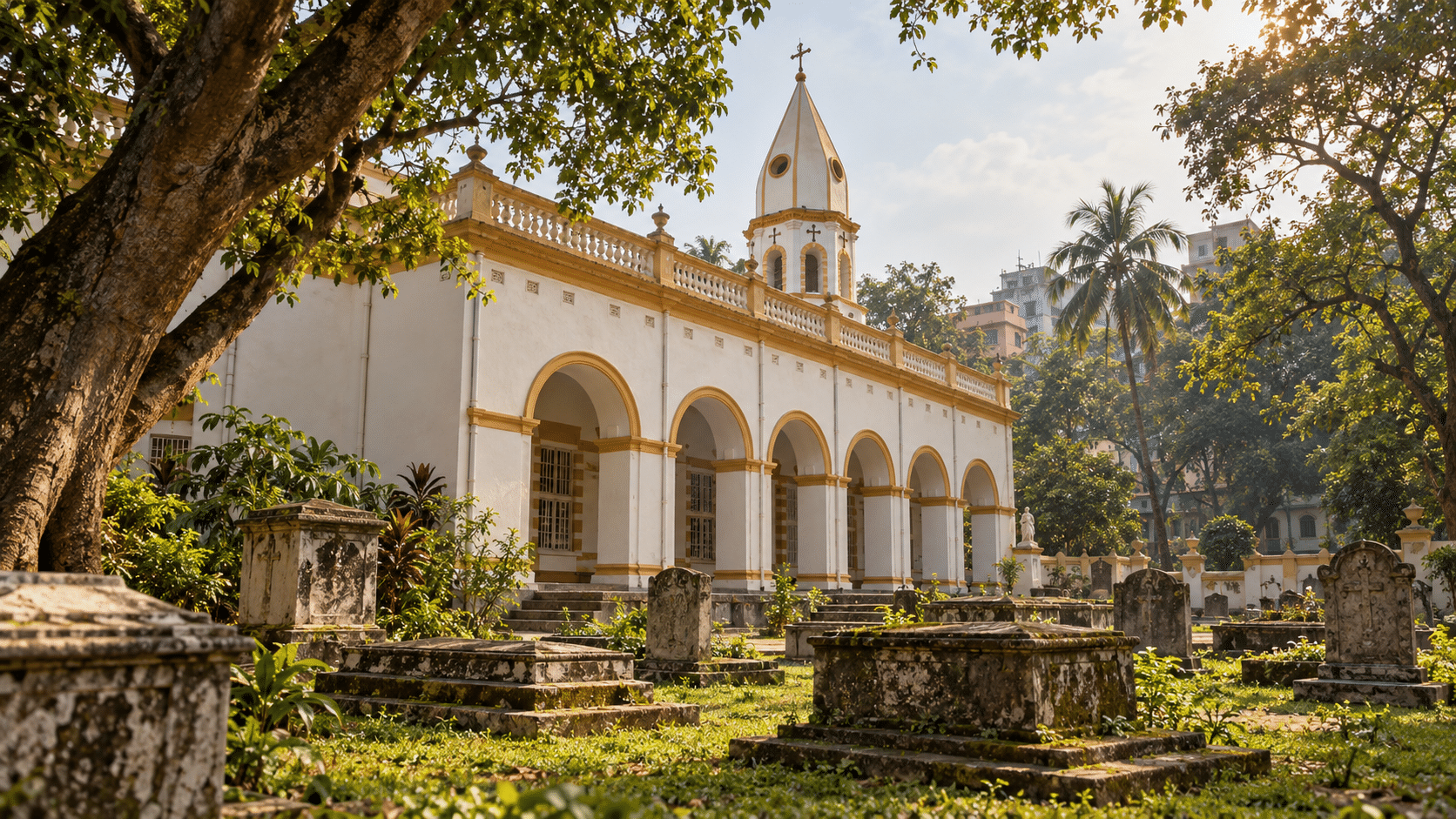
The Armenian Church of the Holy Resurrection is the last physical trace of a community that shaped Old Dhaka’s commerce far more than its modest size ever suggested. Armenian merchants arrived in Dhaka from the early 17th century, many originally deported from Armenia by Persian rulers before making their way east along trade routes. In Dhaka they built fortunes in jute, leather, and silk, wealthy enough that by 1781 the community could commission a permanent church of its own.
The building’s origin has a genuinely moving backstory. An Armenian businessman named Agaminus Catachik donated the land, previously used as the community’s graveyard, in memory of his wife Sofy, who died in 1768. The church that rose on that burial ground still stands atop layers of Armenian tombstones, some still legible, that chronicle a community now almost entirely vanished from the city.
A clock tower once stood on the church’s western side, its bell reportedly audible up to four miles away, locals set their watches by it until it stopped working in 1880 and an 1897 earthquake finished it off. What survives today is the white, two-story European-style church itself, along with its quiet garden and the historic cemetery, now cared for as much by the memory of the community as by any active congregation. Services still happen here, though led today by Coptic and other Christian clergy rather than Armenian priests, since the last Armenians left Dhaka decades ago.
For visitors, Armenian Church offers something genuinely different from Old Dhaka’s Mughal and Hindu heritage sites, a window into the city’s forgotten cosmopolitan past, when Armenian traders introduced horse-drawn carriages and helped popularize tea culture across Bengal.