
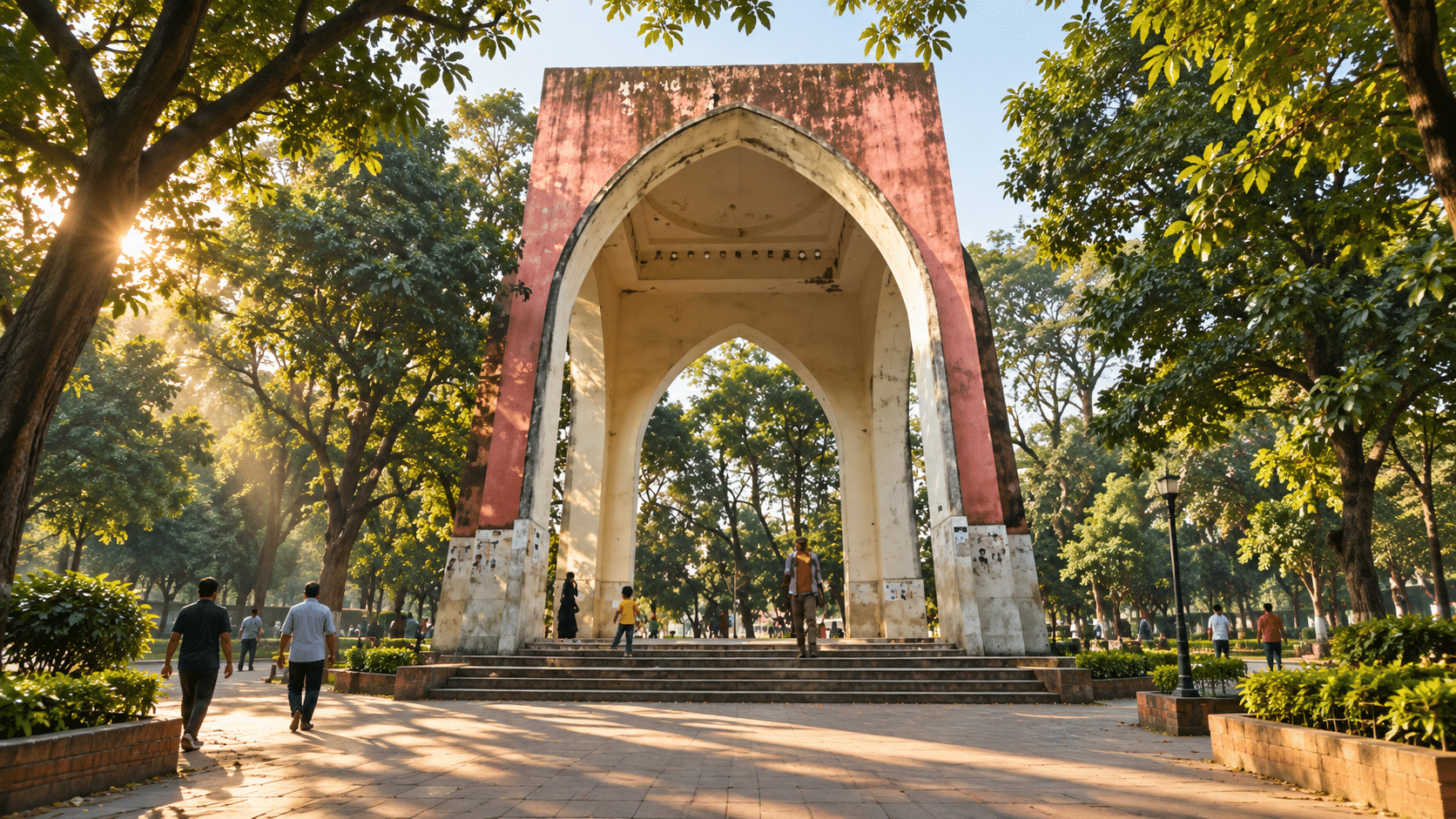
Bahadur Shah Park carries one of Old Dhaka’s darker histories inside what today looks like an ordinary neighborhood park. Established in the first half of the 19th century by Nawab Khwaja Abdul Ghani, the site began as Antaghar Maidan, a field beside a billiards club the local Armenian community ran. Its transformation into a place of genuine historical weight came in 1857.
That year, local sepoys rose up against British colonial rule as part of the wider Indian Rebellion. When the uprising failed, eleven defeated fighters were publicly hanged at this exact spot, their bodies left displayed as a warning to the local population. The following year, in 1858, the Commissioner of Dhaka Division used the same ground to publicly announce Queen Victoria’s direct rule over India, and the park was named Victoria Park in her honor, a name it carried for nearly a century.
In 1957, on the centenary of the rebellion, the park was renamed after Bahadur Shah II, the last Mughal emperor and a symbolic figurehead of the 1857 uprising, reclaiming the site’s association with resistance rather than colonial authority. Two monuments now stand inside the park’s iron railings: a tall memorial on the eastern side honoring the executed sepoys, and a separate obelisk commemorating Khwaja Hafizullah, eldest son of Nawab Khwaja Ahsanullah.
Today the park functions primarily as a neighborhood green space, popular with morning walkers and locals looking for a break from Old Dhaka’s density, its historical weight is easy to miss without knowing the story, which makes it a worthwhile stop for visitors who want Old Dhaka’s colonial history in a quieter register than Lalbagh Fort or Ahsan Manzil offer.