
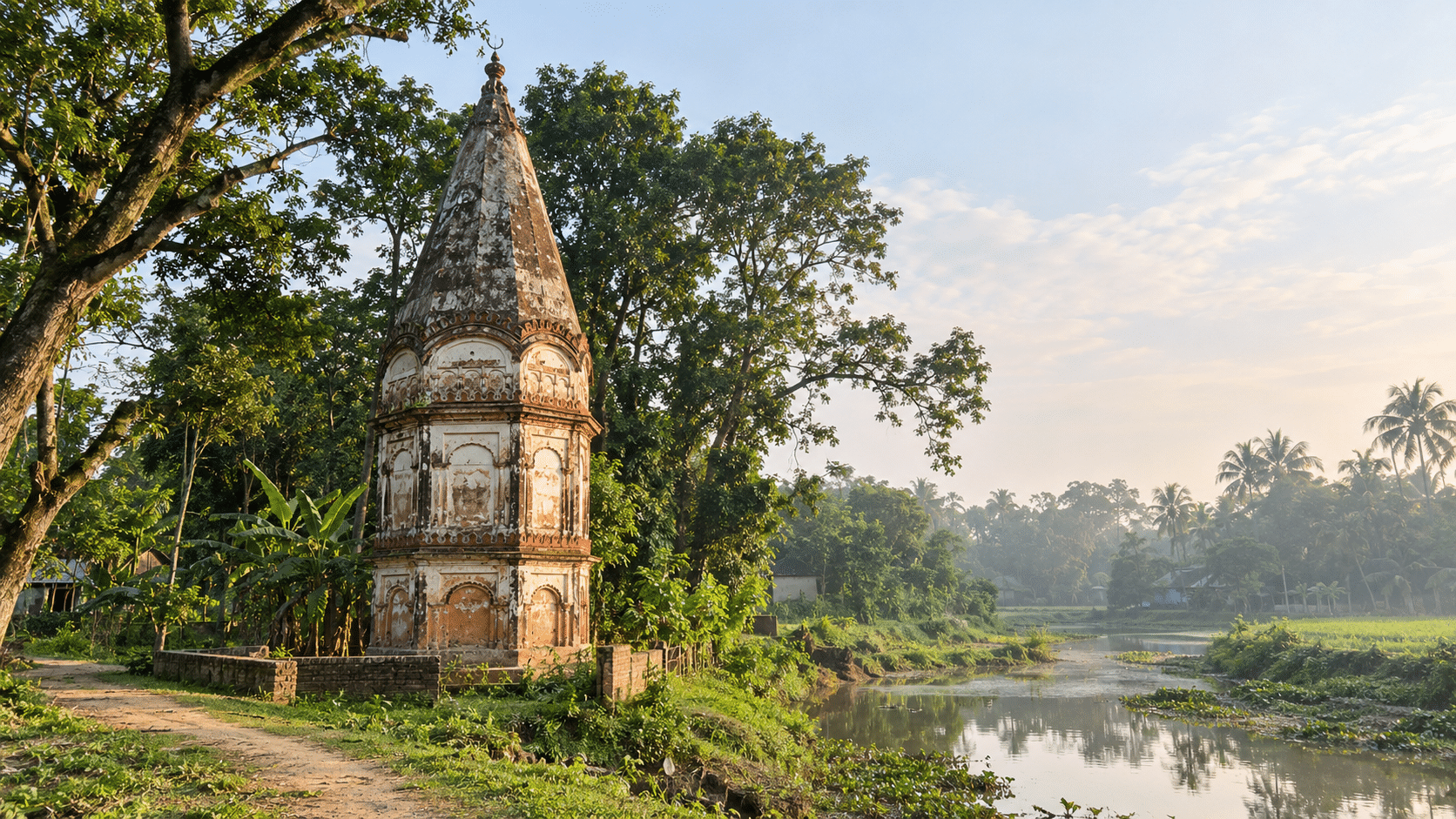
The Chandravati Shiv Mandir at Kacharipara is one of the most touching heritage sites in Kishoreganj, because it is tied to a woman who changed Bengali literature. Standing quietly on the bank of the Fuleswari river, the Chandravati Shiv Mandir is a reminder of Chandravati, the first known female poet of the Bengali language.
Who Was Chandravati?
Chandravati was born around 1550 in Patuyari village on the Fuleswari river in Kishoreganj. Her father, Dwija Bangshi Das, was a poet who composed the Manasa ballads. She grew up surrounded by verses, and later wrote her own version of the Ramayana. Instead of celebrating male heroes, her telling looks at the story through a woman’s eyes and the suffering of women caught up in the ego of men. That fresh voice is why she is still remembered today.
The Temple at Kacharipara
The Chandravati Shiv Mandir is in Kacharipara village, Maizkhapon Union, Kishoreganj Sadar, about 6 km from the town. According to the district administration, the temple is octagonal in shape and around 32 feet high, and it is listed as an archaeological site by the Department of Archaeology. Local tradition says her father built a Shiva temple next to his own Manasa temple so that she could pray in peace, and the two temples are known as part of her heritage.
A Story Told on the Temple Wall
A famous legend adds a sad chapter. It says that Joychandra, a young man she was once close to, came to the temple while she was praying behind closed doors. Since she did not open the door, he wrote a message on the wall with red malati flowers. When she finally opened it, it was too late. The story ends in sorrow, and it is part of why many visitors come not only to see a monument but to feel a story.
Visiting the Chandravati Shiv Mandir
From the front of the Shahidi Mosque in Kishoreganj Sadar, you can take a CNG or auto-rickshaw to the temple. It is also reachable by tempo or rickshaw. The river that once flowed beside the temple has shrunk over time, but the setting is still green and peaceful. A short visit takes about an hour, so it fits nicely with the Pagla Mosque and Sholakia Eidgah on one town day.
Why Chandravati Still Matters
In a time when almost all known writers were men, Chandravati wrote in her own voice. Standing by the river where she lived and prayed gives that fact a human size. You do not need to be a literature expert to feel it. Bring a short poem or a story about her, read it quietly, and let the place do the rest.
The best time to visit is winter, from November to February, when roads are dry and the air is cool. Monsoon visits can be muddy on village lanes, though the greenery is lovely.
What to Notice
- The octagonal shape of the temple
- The riverside setting at Kacharipara
- The nearby heritage structures connected to Dwija Bangshi Das
- The quiet village around it, where Chandravati’s story is still told
Visit With Respect
This is both a heritage site and a place of worship. Remove your shoes where asked, dress modestly and ask permission before photographing devotees or the shrine. Please do not touch carvings or sacred objects.
Quick Answers About the Chandravati Shiv Mandir
Where is the Chandravati Shiv Mandir?
It is in Kacharipara village, Maizkhapon Union, Kishoreganj Sadar, on the Fuleswari river bank.
How far is it from Kishoreganj town?
The district administration gives the distance as about 6 km.
Why is it important?
It is linked with Chandravati, the first known female poet of Bengali literature.