
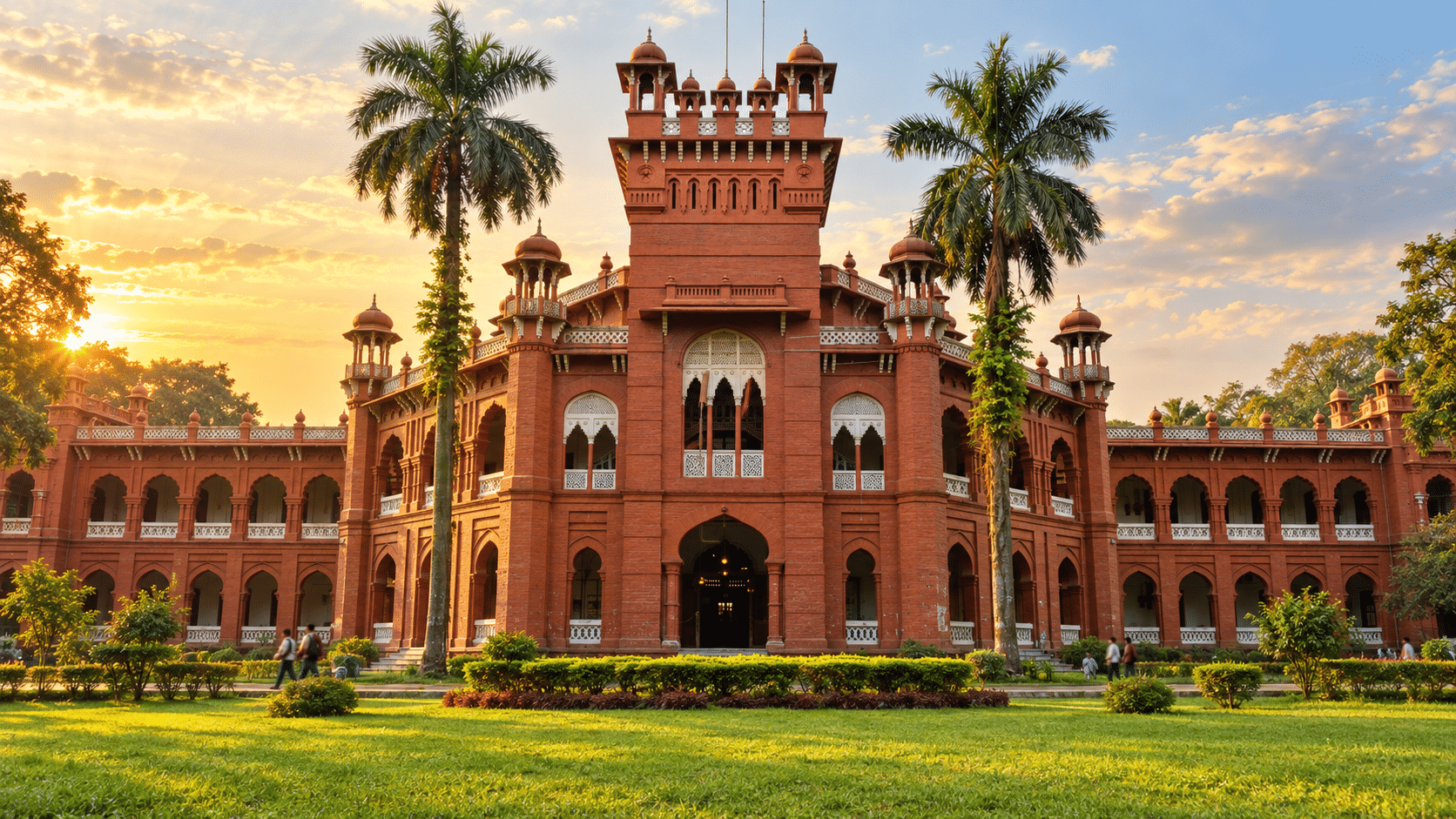
Curzon Hall was never meant to become part of a university. Lord Curzon, Viceroy of India, laid its foundation stone in 1904 with plans for a grand town hall, and the building’s foundation stone-laying itself was meant as a statement of British architectural ambition in Bengal. History had other plans. The 1905 Partition of Bengal changed the region’s administrative needs, and by 1911 the still-new building had become the campus of Dhaka College instead. When Dhaka University was established in 1921, Curzon Hall was absorbed into the new institution as its Faculty of Science building, a role it still holds today.
Architecturally, it’s one of Dhaka’s most distinctive buildings, an Indo-Saracenic design blending Mughal domes, horseshoe and cusped arches, and ornate turrets with British structural sensibilities, all rendered in a deep burgundy-red brick that makes it instantly recognizable against the campus’s green lawns. The building’s grounds, a botanical garden, playing fields, and a historic pond, add to its appeal as a place to simply sit and take in the architecture.
Curzon Hall’s significance extends well beyond design. It was a center of protest during the Bengali Language Movement of the 1950s, and it was here, in March 1948, that Pakistan’s Governor-General Muhammad Ali Jinnah declared Urdu the sole state language, a moment that triggered loud protests from the assembled students and intellectuals and helped set in motion the language movement that would eventually reshape the nation’s identity.
Visiting Curzon Hall costs nothing and takes about half an hour, and it pairs naturally with a walk to the nearby Shaheed Minar, itself a direct legacy of the movement that found some of its earliest voice on these grounds.