
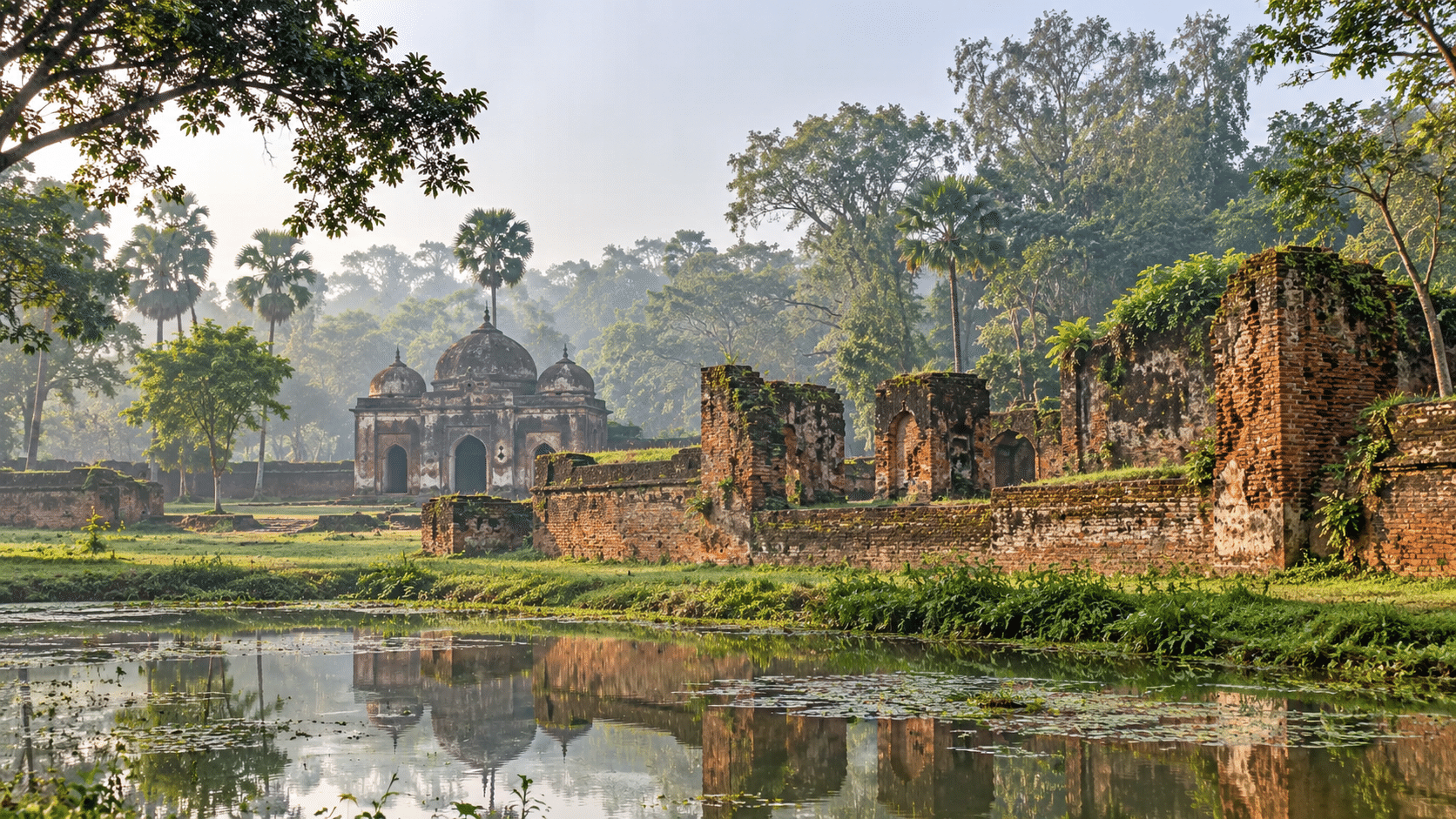
Jangalbari Fort in Karimganj is where the story of Isha Khan continues after Egarasindur. Known as his second capital, Jangalbari Fort sits on an old island-like site surrounded by moat traces and green fields. What remains today is modest, but the old walls, the pond, the mosque and a small museum make it one of the most meaningful heritage stops in Kishoreganj.
The Story of Jangalbari Fort
According to the district administration, Isha Khan took the fort from the Koch rulers of the area, and then strengthened it. He is said to have dug moats and linked them with the Narasunda river, giving the fort the shape of a round island. Accounts differ on the exact year, with dates in the 1580s and 1590s mentioned in different sources, so it is best to treat the timeline as a story told in different ways.
Banglapedia adds an interesting detail. Bricks and pottery pieces found around the site suggest the place may be older than Isha Khan, and that it was once the centre of a busy settlement. Isha Khan is still credited with building several structures inside it. After his son Musa Khan accepted Mughal rule, the family moved from Sonargaon to Jangalbari and became local landlords.
What You Can See at Jangalbari Fort Today
Parts of the old boundary wall, a pond in front of the main house, and a mosque with three domes still stand. A wall known as the Prasad Prachir divides the fort into northern and southern open spaces, and there is an arch on the south side. The old darbar house was renovated and opened in 2005 as the Isha Khan Memorial Museum and library, which keeps the memory of the Baro-Bhuyan leader alive.
Older reports describe the site as surrounded by deep waterways that needed a boat crossing, even in the dry season. Conditions may have changed, so ask locally how to reach the fort on the day you go.
Descendants Still Live Here
One of the most touching parts of a visit is learning that descendants of Isha Khan still live in the village of Jangalbari. A Daily Star feature in 2005 even met a 14th-generation descendant, Dewan Amin Dau Khan. That living link makes Jangalbari Fort feel less like a ruin and more like a family home with a very long memory.
Plan Your Visit
Jangalbari is a short ride from Kishoreganj town, around 6 km by the district’s description, and you can use a CNG, rickshaw or easybike from the Ekrampur crossing. Combine Jangalbari Fort with Egarasindur and the Chandravati temple for a full heritage day around the district.
November to February is the most comfortable time to go, with dry paths and cool air. In the monsoon the surroundings turn green and the waterways fill up, which is beautiful but can make access slower, so leave extra time.
What to Look For
- The old boundary wall and traces of the moat
- The pond in front of the main house
- The three-domed mosque inside the fort area
- The Isha Khan Memorial Museum in the renovated darbar house
- Village life around the fort and the Narasunda river nearby
Visit With Respect
Some parts of the fort area are family property and local homes, so ask before entering, avoid loud noise and do not climb old walls.
Quick Answers About Jangalbari Fort
Where is Jangalbari Fort?
It is in Jangalbari village, Kadirjangal Union, Karimganj Upazila, Kishoreganj.
Why is it important?
It is known as the second capital of Isha Khan, the leader of the Baro-Bhuyans.
Is there a museum?
Yes. The renovated darbar house works as the Isha Khan Memorial Museum and library, opened in 2005.