
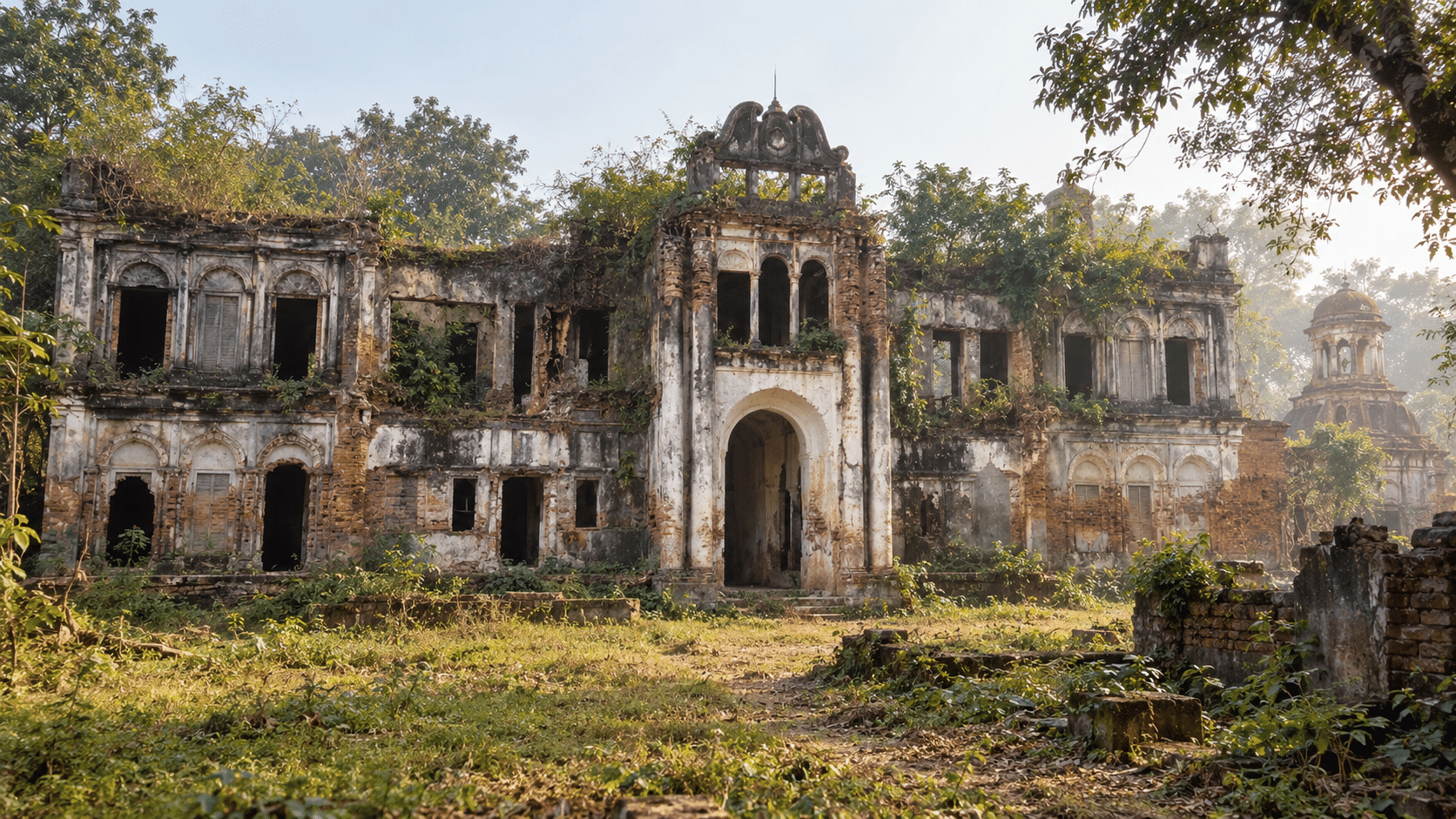
Some zamindar houses survive as museums. Kanaipur Shikdar Bari survives as a ruin, and somehow that makes it more moving. On the bank of the Kumar River in Kanaipur village, cracked walls, old temples and quiet courtyards still tell the story of one of Faridpur’s most powerful landlord families, and of the widow who ran it. If you like heritage that feels honest and unrestored, Kanaipur Shikdar Bari deserves a few hours of your day.
Who Were the Shikdars of Kanaipur?
The zamindars of Faridpur played a big role in the district’s history, and the Shikdars were among the most prominent. Their family rose to strength under Rani Bhabatarini, a widow who took over the estate and ran it with skill. She managed the zamindari and its trade, working with the support of her only son, Satish Chandra Shikder, and a trusted employee. Under her, the family expanded its estate across the area.
About Kanaipur Shikdar Bari
Kanaipur Shikdar Bari stands in Kanaipur village in Faridpur Sadar upazila, near the Kumar River. According to The Independent, Rani Bhabatarini built the palatial house in the second half of the 19th century. Some local accounts claim the estate is around 400 years old, so treat the date with care. What is clear is that the compound is large, layered and old, and that it reflects the final years of feudal Bengal.
What to See at Kanaipur Shikdar Bari
The Main Mansion Ruins
Most of the buildings are now in a ruinous state, with broken plaster, open arches and trees growing through the walls. Even in decay, you can read the scale of the house, with its rooms, verandas and old brickwork.
The Durga Temple
Among the structures on the grounds is a Durga temple that is still in use. It appears to have been built a few years after the main buildings, and it gives the compound a quiet, living feeling that most ruins do not have.
Other Temples and Outbuildings
Several buildings and temples around the compound still carry the traces of the family’s luxurious life. Walk slowly and notice the small details: carved cornices, old doorframes and faded colours.
The Kumar Riverbank
The setting beside the Kumar River adds a lot to the visit. A short walk along the water gives you a view of village life and an easy break between sites.
Visit With Care
This is a fragile, unprotected-feeling site, so please be a careful visitor.
- Do not climb on unstable walls, roofs or staircases.
- Never take bricks or fragments as souvenirs.
- Respect the working Durga temple and any worshippers there.
- Take your rubbish with you, and avoid graffiti or marking the walls.
Photography Tips
Kanaipur Shikdar Bari looks best in the soft light of morning or late afternoon, when long shadows bring out the texture of the old brick. In winter, light mist over the river adds a quiet, moody backdrop.
Plan Your Visit
From Faridpur town, take a bus toward Kanaipur Bazar, then walk about 7 to 8 minutes or take a van to the house. Allow an hour or two. It is about 9 km from the town centre, so it pairs easily with the Jasimuddin House and a sunset at Dholar Mor.
Why Kanaipur Shikdar Bari Matters
Bangladesh has fewer well-kept zamindar houses than people expect, and many are disappearing. Kanaipur Shikdar Bari is a reminder of how much local history can vanish quietly. Visiting respectfully, photographing it and talking about it online are small ways to keep it from being forgotten.
Quick FAQ
Is there an entry fee for Kanaipur Shikdar Bari?
There is no official ticket counter that we know of. It is generally free to visit, though local rules can change.
Is Kanaipur Shikdar Bari safe to walk around?
Mostly, yes, but many buildings are unstable. Stay on open paths and do not enter damaged rooms.
Who built Kanaipur Shikdar Bari?
Sources credit Rani Bhabatarini, a widowed zamindar, who built the palatial house in the second half of the 19th century.