
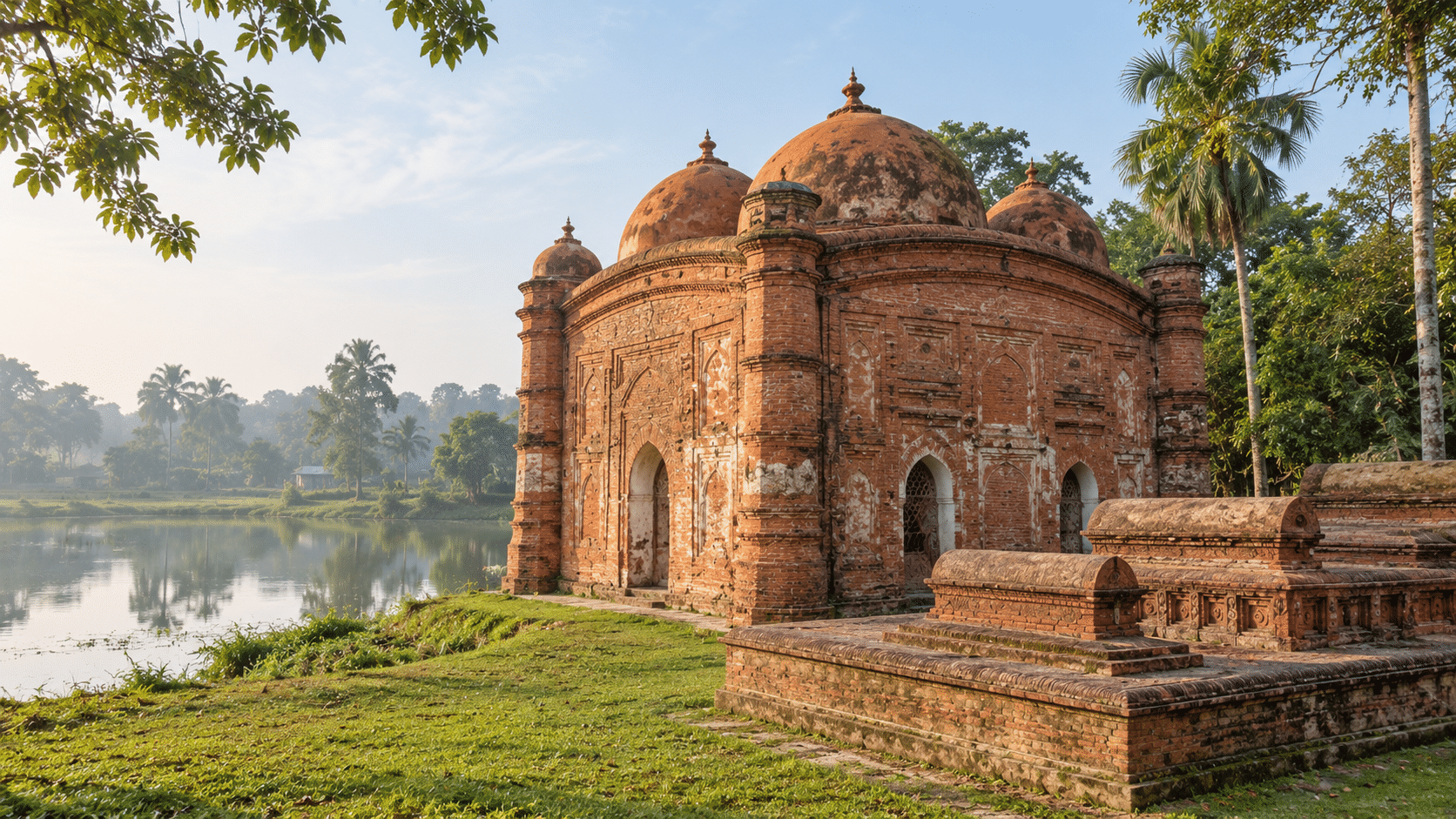
The Kutub Shah Mosque in Austagram is one of the oldest surviving mosques in the greater Mymensingh region, and it stands in a part of Kishoreganj that most visitors never reach. Surrounded by haor country and standing beside a large lake, it has five domes, curved cornices and a quiet confidence that comes from centuries of standing in the same spot.
A Mosque With Five Domes
This is a medium-sized mosque, longer from north to south, with a large dome in the centre and four smaller domes around it. Four octagonal towers stand at the corners, with ring-like patterns on them. The roof edge, called the cornice, curves gently, which makes the building look different from other Sultanate-era mosques. Experts at Banglapedia note that this design marks the beginning of a special type of five-domed mosque in Bengal.
Inside, there is a single oblong hall, cleverly divided into five square bays, and three mihrabs along the west wall. Outside, you can see panel work and terracotta tiles with floral designs. Three entrances open on the east side, with one more on the north and one on the south.
How Old Is the Kutub Shah Mosque?
No inscription has been found on the walls, so nobody can give an exact date. Based on the building materials and decoration, experts believe the Kutub Shah Mosque was built in the Sultanate period, probably in the later part of the 16th century. It is often described as the oldest surviving Muslim architectural remains in greater Mymensingh. The district administration notes that the then archaeology department listed it as a protected site in 1909.
Who Was Kutub Shah?
Local tradition links the mosque to a saint called Hazrat Kutub Shah, who is said to be one of the 360 saints who came with Hazrat Shah Jalal to this region. A tomb beside the mosque is believed to be his, and the mosque is named after him. Because the exact history is not written in stone, visitors enjoy it as both a monument and a living legend.
Visiting the Kutub Shah Mosque
Austagram lies about 60 km south of Kishoreganj town, and the area is almost surrounded by water. The district administration describes an older route that goes by CNG or auto-rickshaw to the Balikhola embankment, then by trawler to Mithamain, and finally by auto-rickshaw or motorbike to Austagram. Today the all-weather road across Nikli Haor also links Mithamain and Austagram by land, so ask locals for the best route on the day of your trip.
It makes sense to combine the mosque with a haor trip. In the monsoon you travel across a wide sheet of water, and in the dry season you pass golden paddy fields, so the journey itself becomes part of the story.
Why Austagram Is Worth the Journey
Many travellers stop at the haor and never go further. That is a pity, because Austagram gives the trip a second layer. After the open water and the wide sky, you step into a quiet compound where old brick, terracotta and a lake make a very different mood. It is the kind of contrast that makes a day trip feel complete.
What to Notice
- The large central dome and the four smaller domes
- The octagonal corner towers with ring-like patterns
- The curved cornice that makes the roofline special
- Terracotta tiles and panel work on the outer walls
- The tomb beside the mosque and the lake nearby
Visit With Respect
This is a protected heritage site and an active place of faith. Dress modestly, speak softly, avoid prayer times and do not climb on old walls or domes.
Quick Answers About the Kutub Shah Mosque
Where is the Kutub Shah Mosque?
It is in Austagram Upazila Sadar, Kishoreganj district, about 60 km south of Kishoreganj town.
How many domes does it have?
It has five domes: one large central dome and four smaller ones.
When was it built?
There is no inscription, but experts believe it dates to the later part of the 16th century.