
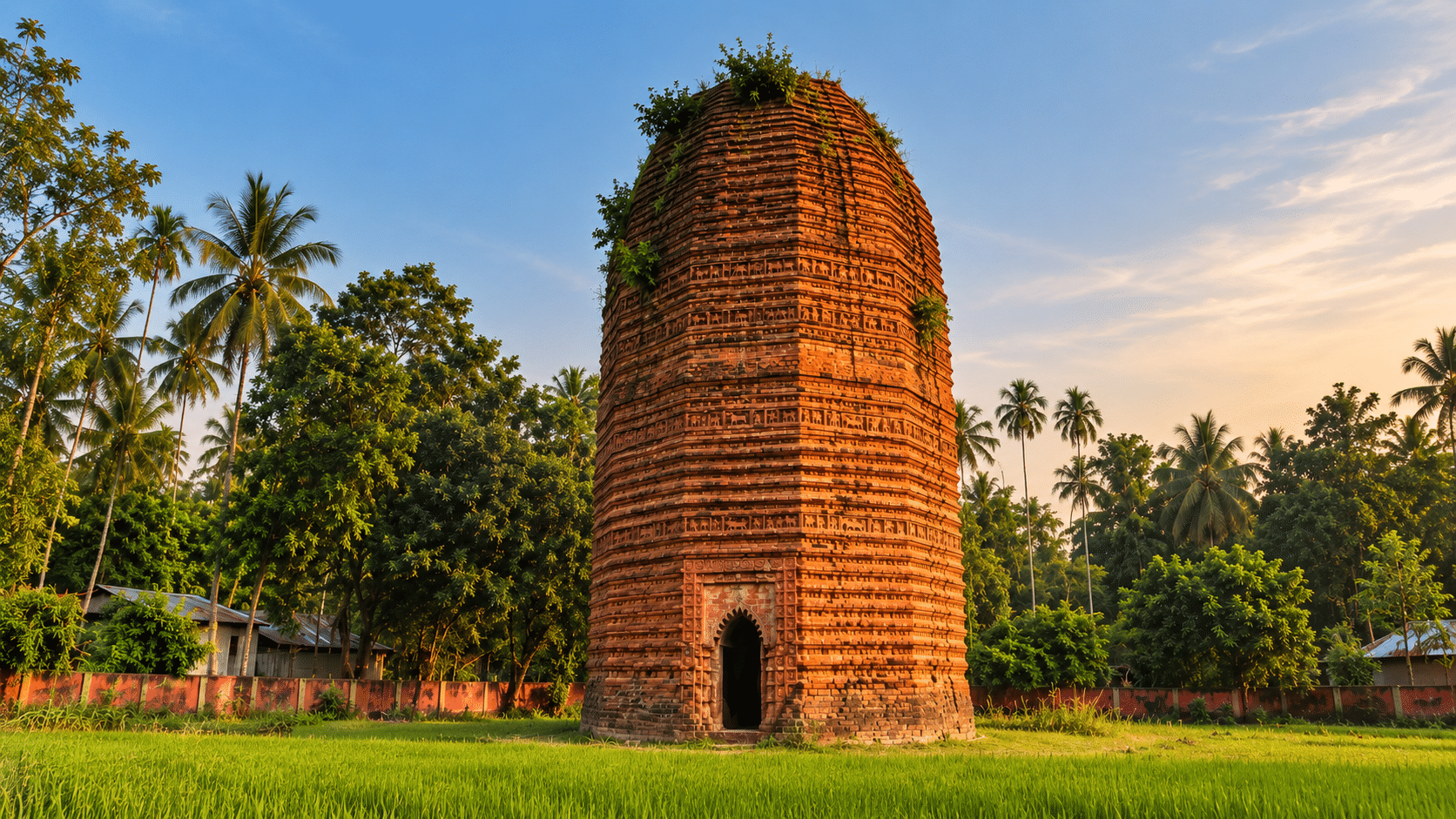
Drive west from Faridpur town through flat green fields, and a strange shape slowly rises over the paddy: a tall, twelve-sided brick tower covered in carvings. This is Mathurapur Deul in Madhukhali upazila, one of the most unusual monuments in Bangladesh and the highlight of the Faridpur heritage trail. Nobody knows for certain who built it, and that mystery is half its charm.
What Is Mathurapur Deul?
A deul is a tower-style temple, and Mathurapur Deul follows the rekha form, rising straight and then gently curving inward toward the top. What makes it rare is its plan: twelve sides, which is very unusual in Bengal temple architecture. It stands in Mathurapur village under Gazna union, around 36 km west of Faridpur town, and is protected by the Department of Archaeology.
The Terracotta Story Wall
Look closely and the walls of Mathurapur Deul start talking. Terracotta panels show flowers and foliage, gods and goddesses, dancing figures, galloping horses and scenes from the Ramayana and Mahabharata. Hanuman appears in several panels, often in a lively, almost joyful pose. Walk slowly around all twelve sides, because each face has something different.
Inside, there is a small chamber reached through a low arched entrance on the southern side. It is simple and dark, a sharp contrast to the busy outer walls.
Who Built Mathurapur Deul?
No inscription has ever been found, so history here is a mix of records and local memory:
- The victory legend: locals often say Raja Man Singh, Emperor Akbar’s general, built it after defeating Raja Pratapaditya.
- The Sangram Singh account: another version links it to Sangram Singh, a Mughal-era official who gained power in the Bhushana area and settled in Mathurapur.
- The style evidence: scholars generally date Mathurapur Deul to the 16th to 17th century based on its architecture and ornament.
When you visit, ask the caretaker or older villagers for their version. You will often hear a story that is not in any book.
Its Condition Today
Older sources describe Mathurapur Deul as around 80 feet tall. Today it stands about 21 metres, and recent reports describe missing bricks on the northern wall and cracks widening after heavy rain. This is a monument that needs care, not just admiration.
- Do not climb the tower or lean on the walls.
- Never touch, scratch or pull at the terracotta panels.
- Stay outside any fencing or marked area.
Respectful visits and good photographs shared online help keep public attention on its conservation.
Photography Tips
Mathurapur Deul looks best in the soft light of late afternoon, when the terracotta glows warm orange against green fields. In winter, early mist can add a dreamy feel. A wide lens captures the whole tower with its rural setting, while a short zoom picks out individual panels without you needing to touch anything.
Combine It With
- Faridpur Sugar Mill: an active mill close by that allows visitors.
- Satoir Mosque, Boalmari: a Sultani-era mosque on the same western side of the district.
- Pathrail Mosque, Bhanga: the other major stop on the Faridpur heritage trail, best visited on your way in from Dhaka.
Quick FAQ
Is there an entry fee for Mathurapur Deul?
It is an open-air protected site and is generally free to visit, though local rules can change.
How long should I spend at Mathurapur Deul?
About an hour is enough to walk around all twelve sides, study the terracotta and take photos.