
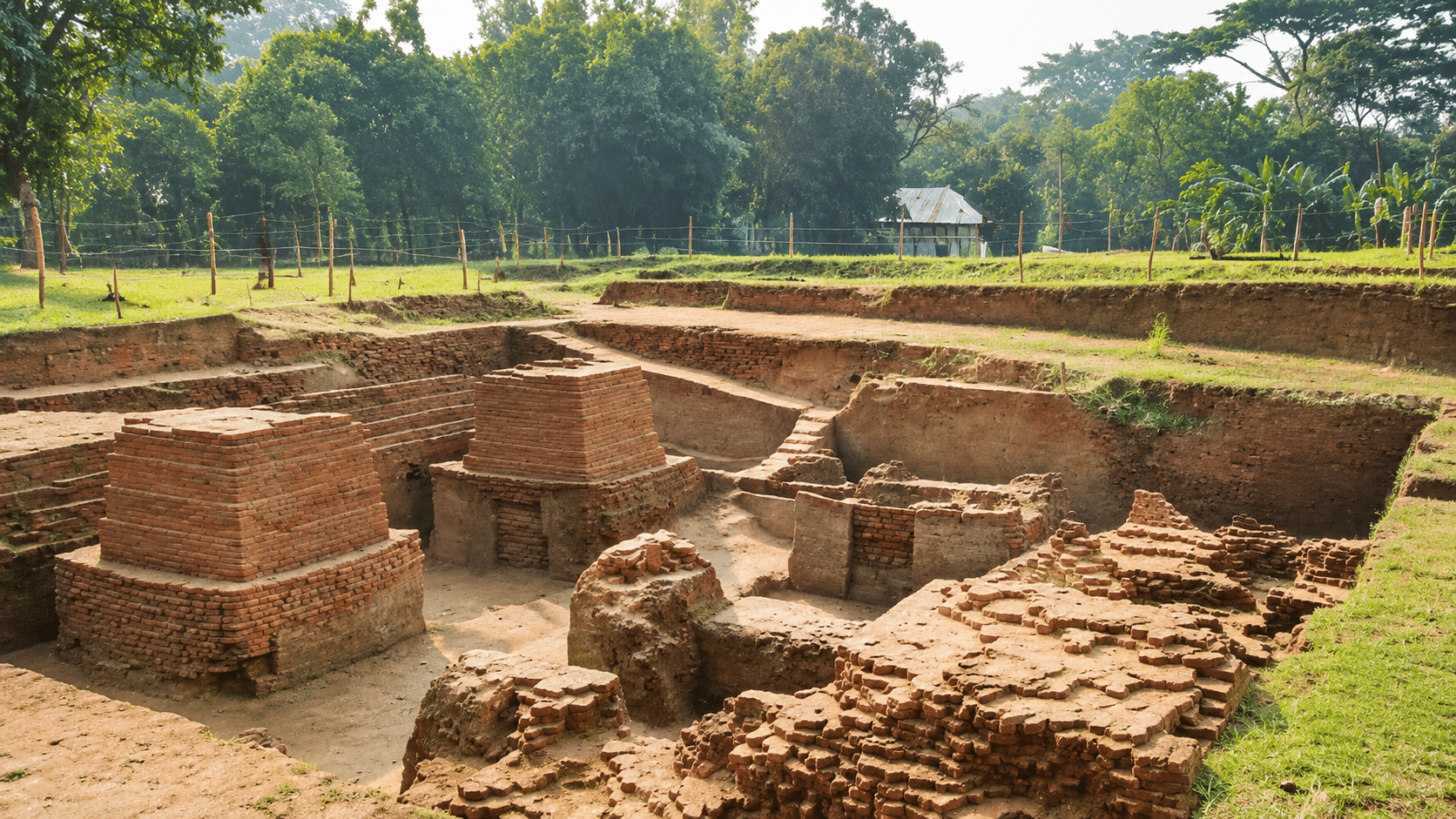
Nateshwar Buddhist Bihar is one of the most exciting archaeological sites in Bangladesh, and most people have never heard of it. Hidden under a village in Tongibari, Munshiganj, archaeologists have uncovered the remains of a Buddhist city more than a thousand years old, with stupas, brick roads and monastery rooms. If you like places where history is still coming out of the ground, Nateshwar Buddhist Bihar is a must-see.
What Is Nateshwar Buddhist Bihar?
Nateshwar Buddhist Bihar, also known as Nateshwar Deul, is a Buddhist archaeological site in Nateshwar village of Tongibari upazila. According to Wikipedia, it is the ruin of a Buddhist city with two settlement phases, one from about 780 to 950 CE and another from 950 to 1223 CE. These dates come from carbon testing of 26 charcoal samples in a laboratory in the United States.
That places Nateshwar Buddhist Bihar in the age when Bikrampur was a capital of Bengal under the Chandra, Varman and Sena dynasties.
How Nateshwar Buddhist Bihar Was Found
The story began in 2010, when archaeologists started surveys at nine locations across the Bikrampur region. One early find was the Bikrampur Vihara at Raghurampur. Digging at Nateshwar began in 2012 and 2013, and a team from the Hunan Provincial Institute of Cultural Relics and Archaeology in China joined in 2014. The Daily Star reported that five large excavations between December 2014 and January 2018 uncovered more than 5,000 square metres.
Historians had long guessed that the lost glory of Bikrampur lay somewhere in this soil. Nateshwar Buddhist Bihar showed that they were right.
What You Can See at Nateshwar Buddhist Bihar
- Octagonal stupas, whose eight-sided shape is unusual in Bangladesh
- Groups of four connected stupas, called chaturstupas, which are rare in the country
- A pyramid-shaped stupa found in 2019 and 2020, described as the largest complete one in Bangladesh
- Brick-paved roads, drains and an entrance walkway
- Rows of monastery rooms and the base of a prayer hall
By August 2020, sixteen stupas had been found at Nateshwar Buddhist Bihar. The builders also raised new structures on top of old ones, and archaeologists have identified at least five building periods at a depth of about seven metres.
Why Nateshwar Buddhist Bihar Matters
The site sits close to Bajrayogini, the birthplace of Atish Dipankar Srijnan. The pyramid stupa was built before he was born, so it is not his personal monument. Still, it shows the rich Buddhist world in which he grew up. Atish Dipankar himself described Bikrampur as a wealthy capital city with thousands of buildings and a gilded palace.
Experts have said that Nateshwar Buddhist Bihar has the potential to become a World Heritage site. Reports also mention government plans for an archaeological park, but no official listing has been made, so it is best to treat these as hopes and not facts.
Best Time to Visit Nateshwar Buddhist Bihar
November to February is the best time. The weather is dry and cool, and you can walk the grounds comfortably. Go in the morning, when the brick is soft in the light and the site is quiet. The site is open ground, so summer afternoons are hot and monsoon days can turn the paths muddy.
How to Reach Nateshwar Buddhist Bihar
Take a bus from Gulistan in Dhaka to Tongibari. From the Tongibari bus stand, hire a rickshaw or auto-rickshaw to Nateshwar village and ask for Nateshwar Deul. The Sonarang Twin Temples are in the same upazila, so a reserved auto-rickshaw for the day is a smart choice.
Tips for Visiting Nateshwar Buddhist Bihar
- Some excavated areas may be fenced off, so ask the caretaker what is open on your visit.
- Never climb on the stupas or walk on the fragile brick edges.
- Carry water, a hat and sunscreen, since shade is limited.
- Wear sturdy shoes, as the ground can be uneven.
- Visit the Bikrampur Museum at Bhagyakul to see finds from Nateshwar Buddhist Bihar up close.
Frequently Asked Questions
Where is Nateshwar Buddhist Bihar?
It is in Nateshwar village, Tongibari upazila, Munshiganj District.
How old is Nateshwar Buddhist Bihar?
Carbon dating places human settlement here from about 780 CE to 1223 CE.
Is Nateshwar Buddhist Bihar a World Heritage site?
Not yet. Experts believe it has the potential, but no official listing has been made.