
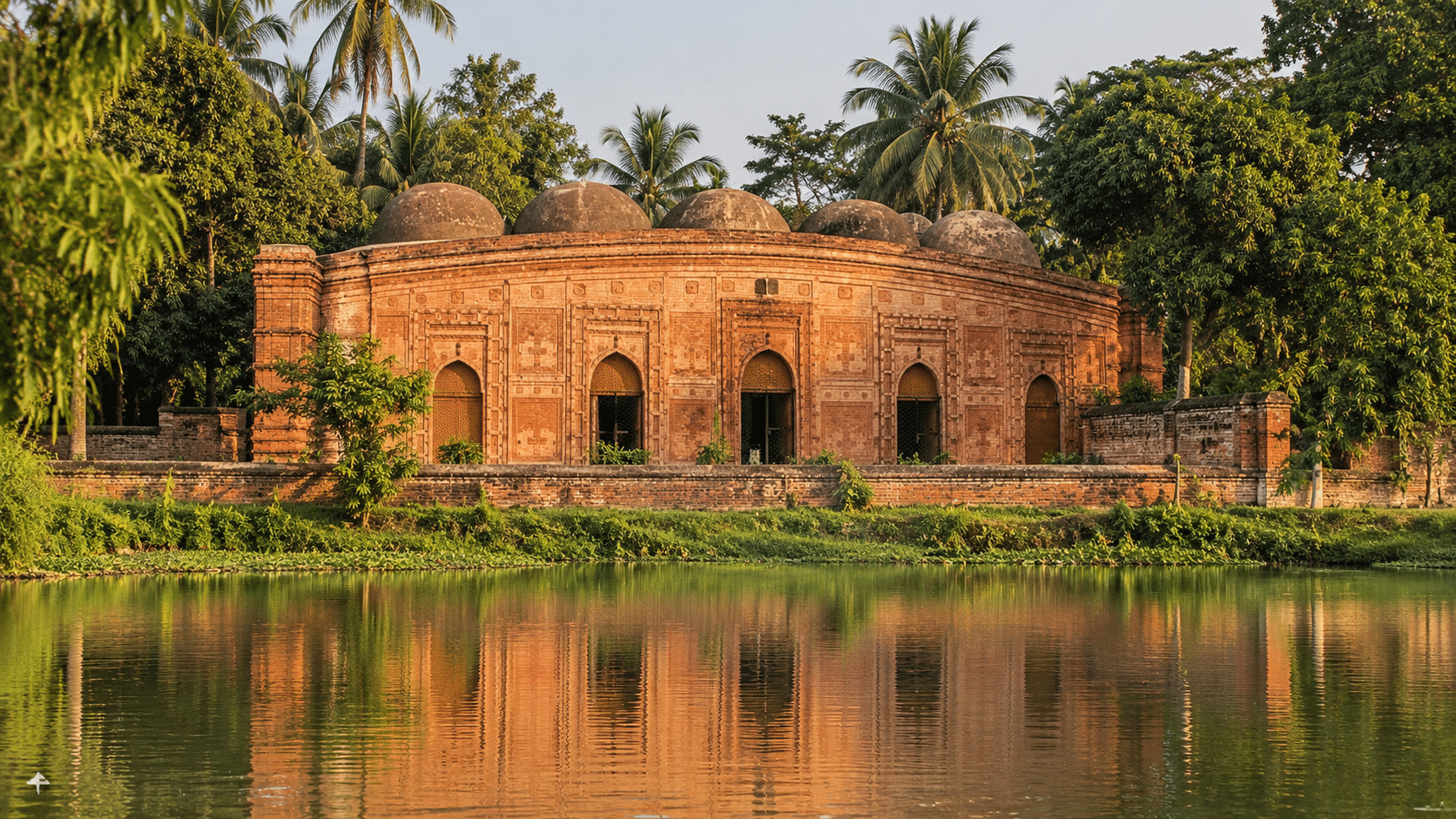
Most travellers race past Bhanga on the new expressway without knowing that a few kilometres away, beside a vast old pond, stands a mosque from the days of the Bengal Sultanate. The Pathrail Mosque, also called Majlis Aulia Mosque, is one of the oldest buildings in greater Faridpur. With its ten domes, terracotta traces and peaceful dighi, it is the perfect first stop on the Faridpur heritage trail if you are coming from Dhaka.
The Story Behind Pathrail Mosque
In Pathrail village of Bhanga upazila, a low brick wall encloses a mosque and a mazar on the western bank of a large tank. Local tradition links the complex to a saint named Majlis Abdullah Khan, widely known as Majlis Aulia, and that is where the mosque’s other name comes from. His grave, along with that of Fakir Solimuddin, lies just south of the mosque.
How Old Is It?
Here historians disagree. Some sources link Pathrail Mosque to the reign of Sultan Ghiyasuddin Azam Shah in the late 14th or early 15th century. Banglapedia, comparing its plan and decoration with Rajshahi’s Bagha Mosque, suggests the early 16th century during the Husain Shahi period. Either way, you are looking at a building around five hundred years old or more.
What to See at Pathrail Mosque
Ten Domes and Five Doors
The prayer hall is rectangular and was originally covered by ten equal domes, carried on arches rising from stone and brick pillars. The eastern facade has five arched doorways that line up with five mihrabs on the western wall. Octagonal towers mark the four outer corners, a classic Sultani feature.
Terracotta Traces
The walls of Pathrail Mosque were once richly decorated with terracotta, in the same tradition as the great Sultani mosques of Rajshahi and Gaur. Look carefully along the walls and around the doorways to find surviving floral and geometric patterns.
Pathrail Dighi
Beside the mosque lies Pathrail Dighi, a huge tank dug in the same period on more than 30 acres of land to provide water for the community and for worship. On a calm winter afternoon, the reflection of the old walls in the water is the best photo of the whole visit.
Visiting Etiquette
Pathrail Mosque is still an active place of prayer, not just a monument. Please keep these in mind:
- Dress modestly. Women should carry a scarf to cover their head.
- Avoid visiting during the five daily prayers, especially Jumu’ah on Friday.
- Remove your shoes before entering the prayer area.
- Ask before taking photos inside, and never photograph people at prayer.
- Keep quiet around the mazar and graves.
Plan Your Visit
An hour is enough to see the mosque, mazar and dighi at a relaxed pace. Coming from Dhaka on the expressway, stop at Pathrail Mosque first, then continue to Faridpur town. On another day, head west to Mathurapur Deul and Satoir Mosque to complete the Faridpur heritage trail.
Facilities nearby are basic, so carry water and use restrooms in Bhanga before you go.
Why It Matters
Bangladesh’s Sultani heritage is usually linked with Bagerhat and Gaur. Pathrail Mosque proves that the same building tradition reached deep into the Faridpur floodplain. It is quiet and authentic, and it rarely sees crowds.
Quick FAQ
Is there an entry fee for Pathrail Mosque?
No. It is a working mosque and free to visit outside prayer times.
Is Pathrail Mosque the same as Majlis Aulia Mosque?
Yes. Both names refer to the same mosque in Pathrail village, Bhanga, Faridpur.