
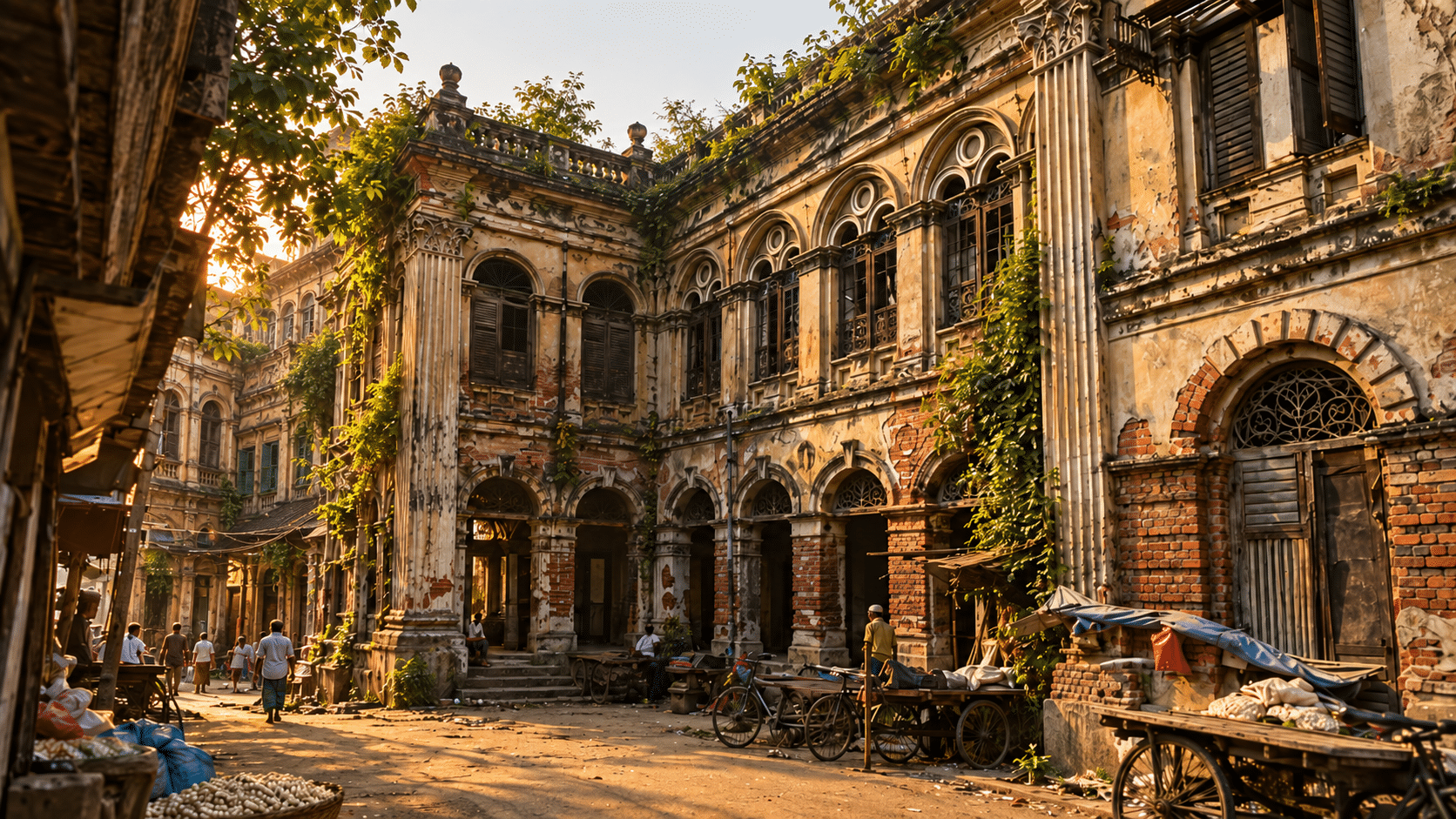
Ruplal House sits on the Buriganga riverbank in Farashganj, one of Old Dhaka’s grandest surviving mansions and, today, one of its most fragile. Built in 1825 by an Armenian businessman named Stephen Aratoon, it was originally called Aratoon House, a Renaissance-style riverside residence typical of the wealthy trading families who lined this stretch of the river. In 1840, two Hindu merchant brothers, Ruplal Das and Raghunath Das, bought the property, and it’s their name it carries today.
Under the Das brothers, the house became one of Old Dhaka’s premier social venues, hosting grand receptions for British officials and visiting dignitaries throughout the 19th century, part of the same social world that revolved around Ahsan Manzil a short distance downriver. The building’s Renaissance facade, tall columns, and riverside setting made it a natural stage for that kind of colonial-era entertaining.
That grandeur has faded considerably. Like much of Farashganj’s riverside heritage architecture, Ruplal House has suffered from decades of neglect, subdivision, and the general pressure of a dense, fast-changing Old Dhaka. Much of the building isn’t formally open to the public in the way a museum would be, and visitors should expect to appreciate it primarily from the outside, an exterior view of a once-grand mansion slowly losing its fight against time.
For visitors already exploring Shakhari Bazar or walking toward Sadarghat, Ruplal House is a worthwhile detour, less for a polished visitor experience than for the slightly melancholic sense of Old Dhaka’s colonial-era wealth, largely unrestored and increasingly rare.