
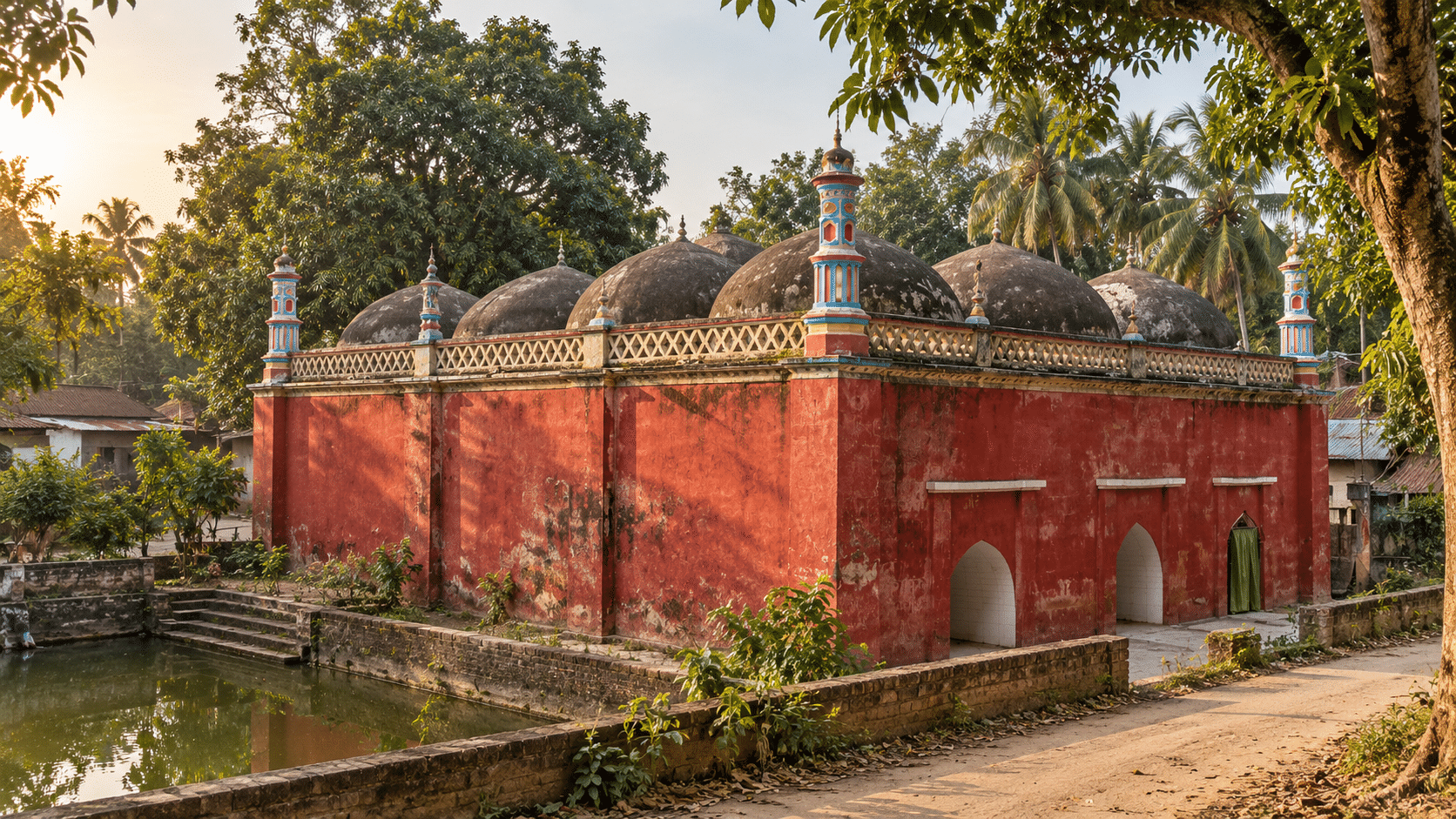
The Satoir Mosque in Boalmari looks like a modern village mosque at first glance, and that is exactly why so many visitors walk past its real story. Behind the red-painted walls is a nine-domed mosque that local tradition links to Sultan Alauddin Husain Shah, a building that was once swallowed by jungle and later pulled back into the light. If you enjoy legends more than polished monuments, the Satoir Mosque is one of the most interesting stops on the Faridpur heritage trail.
The Story of the Satoir Mosque
The Satoir Mosque stands in Satoir village in the northern part of Boalmari upazila, close to Ghoshpur Railway Station on the Bhatiapara to Madhukhali rail line. According to local legend, Sultan Alauddin Husain Shah built it in honour of his spiritual guide. Satoir was home to many saints in those days, which fits the story.
Later the mosque was abandoned and covered by forest. At the beginning of the 20th century it was found again, then repaired and renovated heavily. Some historians place its construction between 1493 and 1519, during the Husain Shahi period, while a few popular accounts link it to the Sher Shah era. The truth is still debated, which is part of the fun of visiting the Satoir Mosque.
What to See at the Satoir Mosque
Nine Domes and Four Stone Pillars
The mosque is square, about 17.8 metres on each side outside and 13.8 metres inside. Nine rounded domes sit on the walls and on four stone pillars inside, supported by twelve pilasters. Standing under the domes, you can feel how solid the old structure is, even though plaster now covers much of the brickwork.
The Well, the Grave and the Tank
Around the Satoir Mosque you will find three small details that are easy to miss. A well, believed to be from the same period, lies about 15 metres to the northwest. A grave sits on a stepped platform to the southeast, and a tank spreads out to the west. Together they show that the mosque was once part of a larger spiritual complex.
The Sunken Floor
Look at the entrance arches. They look small because the floor of the Satoir Mosque has sunk over the centuries, which quietly tells you how old the ground beneath you really is.
Myths Locals Still Tell
Ask around Satoir and you will hear stories that no history book records:
- The mosque was built in a single day by the order of Allah.
- Its four stone pillars sometimes laugh and cry, which many people explain as wind passing through the hall.
- A brick from the mosque kept in a house will keep insects away.
Treat these as folklore, not facts, but they are a big part of why the Satoir Mosque is still remembered across Faridpur.
Set Your Expectations
The Satoir Mosque has been plastered with sand and cement, painted red and extended with a tin-sheet section on the east side. If you come expecting bare Sultani brick and terracotta, like at Pathrail Mosque, you may feel let down. Come instead for the legend, the layout and the living village setting.
Visiting Etiquette
- The Satoir Mosque is an active place of worship. Dress modestly and avoid prayer times.
- Remove your shoes before entering and ask before taking photos inside.
- Respect the grave and mazar area, where some visitors make offerings and vows.
Plan Your Visit
Thirty to forty-five minutes is enough for the Satoir Mosque itself. Combine it with Mathurapur Deul in Madhukhali, which lies on the same western side of the district, and finish with Faridpur town. Roads can be rough after monsoon rain, so a private CNG or car is easiest.
Quick FAQ
Who built the Satoir Mosque?
Tradition credits Sultan Alauddin Husain Shah, though some accounts suggest his son Nusrat Shah or even the Sher Shah era. Its exact builder is not confirmed.
Is there an entry fee for the Satoir Mosque?
No. It is a working mosque and free to visit outside prayer times.
Is the Satoir Mosque worth visiting?
Yes, if you enjoy folklore and local history. It is more a living village landmark than an untouched ruin.