
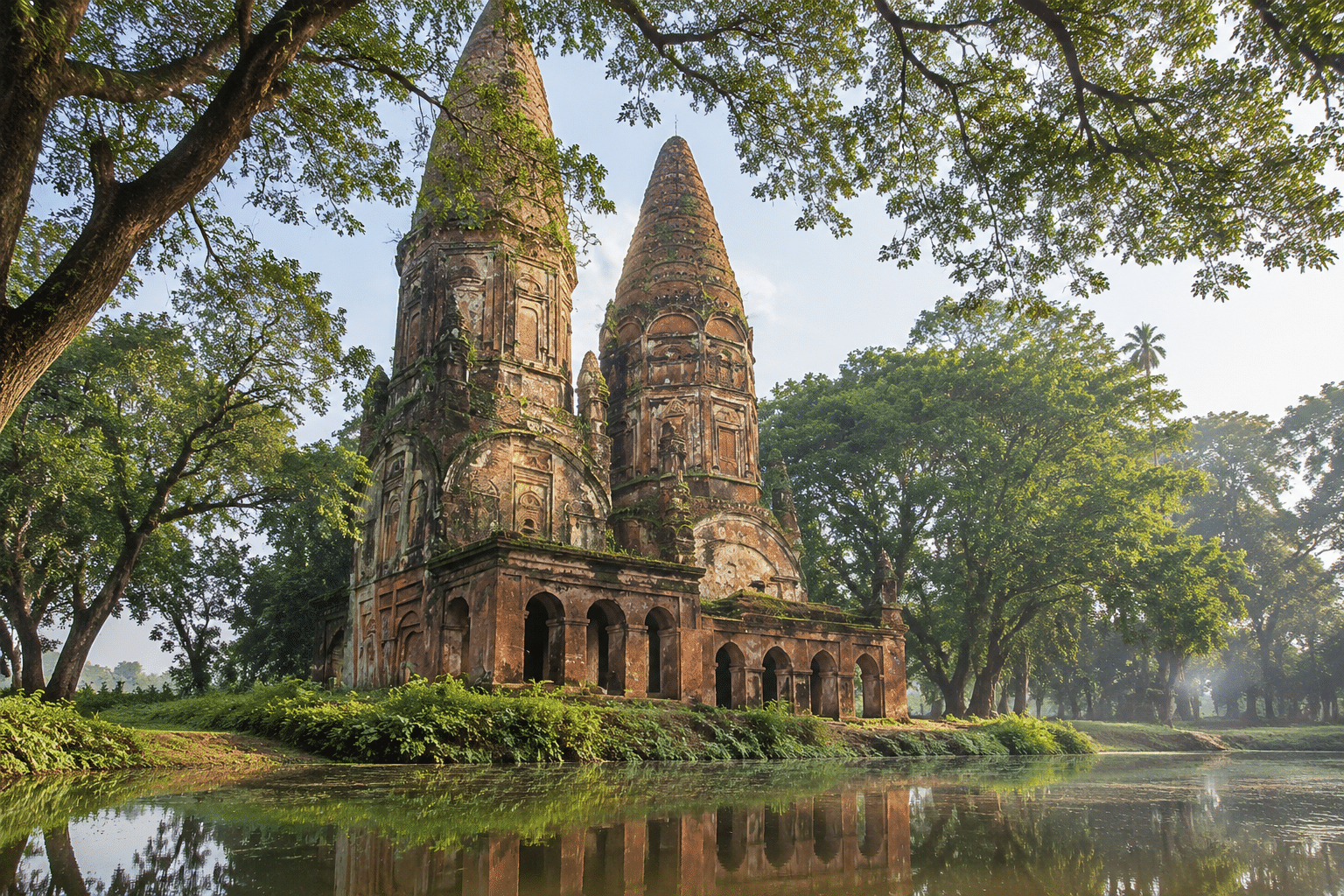
The Sonarang Twin Temples are two tall brick towers rising from a quiet village in Tongibari, Munshiganj. Standing side by side on one raised platform, with old plaster patterns on their walls and a still pond in front, the Sonarang Twin Temples look like a scene from a folk tale. They are one of the most photographed heritage sights in Bikrampur, and they are only a short trip from Dhaka.
What Are the Sonarang Twin Temples?
The Sonarang Twin Temples, also called Sonarang Jora Math, are two Hindu temples in Sonarang village of Tongibari upazila. According to Banglapedia, stone inscriptions show that a man named Rupchandra built the larger temple in 1843 and the smaller one in 1886. The larger, western temple is about 15 metres high over its square sanctum, and its tower rises higher above that.
Sources are not fully agreed about which temple is for Kali and which is for Shiva. Banglapedia describes the western one as a Kali temple and the eastern one as a Shiva temple, so it is worth checking the plaque on site.
The Look of the Sonarang Twin Temples
These are terracotta-style brick temples with tall pointed towers, called sikharas, built in the Bengal tradition. Look closely at the plaster and you will find fine patterns and figures. The Daily Star notes that one of the two towers is decorated with rows of snake heads on all sides, and locals joke that hidden treasure chambers inside are guarded by giant snakes.
- Two towers of different sizes on one shared masonry platform
- Ornate plaster work, with snake head patterns on one temple
- A large pond in front, which gives the temples a lovely reflection
- Green trees around the site that add a golden and green glow in the evening
The Condition of the Sonarang Twin Temples
The temples are not in perfect shape. The Daily Star reported in 2025 that plaster was peeling, cornices were wearing away, a side wall had broken and the tower’s top finial was missing. Local officials agreed the temples need proper conservation. Older reports also say regular worship no longer takes place here. Visiting respectfully, and telling others about the site, is one small way to help.
Best Time to Visit the Sonarang Twin Temples
November to February is best. The weather is dry, the village lanes are easy to walk, and the morning light is soft on the plaster. Late afternoon is also lovely, when the low sun lights the towers. In the rainy season the ground can be wet and muddy, so wear proper shoes.
How to Reach the Sonarang Twin Temples
Take a bus from Gulistan in Dhaka to Tongibari. From the Tongibari bus stand, a rickshaw or auto-rickshaw takes you to Sonarang village. Another route is to reach Muktarpur bridge first and then take an auto-rickshaw or shared CNG to the Tongibari bus stand, which usually takes 30 to 40 minutes. If you plan a full day, hire a reserved auto-rickshaw.
Combine the Sonarang Twin Temples with Other Stops
Tongibari has more heritage nearby. The Daily Star also mentions the Outshahi Math, an eight-faceted temple from the early nineteenth century that rises about 19 metres. Nateshwar Buddhist Bihar, a partly excavated ancient monastery site, is in the same upazila, so you can join them into one long day.
Tips for Visiting the Sonarang Twin Temples
- Do not climb on the temples or lean on the fragile plaster.
- Do not scratch, write on or remove anything from the walls.
- Carry water and mosquito repellent, especially in the monsoon.
- Ask nearby villagers for directions and show respect for the site.
Frequently Asked Questions
Where are the Sonarang Twin Temples?
They are in Sonarang village, Tongibari upazila, Munshiganj District.
When were the Sonarang Twin Temples built?
According to inscriptions cited by Banglapedia, the larger temple dates to 1843 and the smaller one to 1886.
Are the Sonarang Twin Temples Buddhist?
No. They are Hindu temples dedicated to Kali and Shiva.