
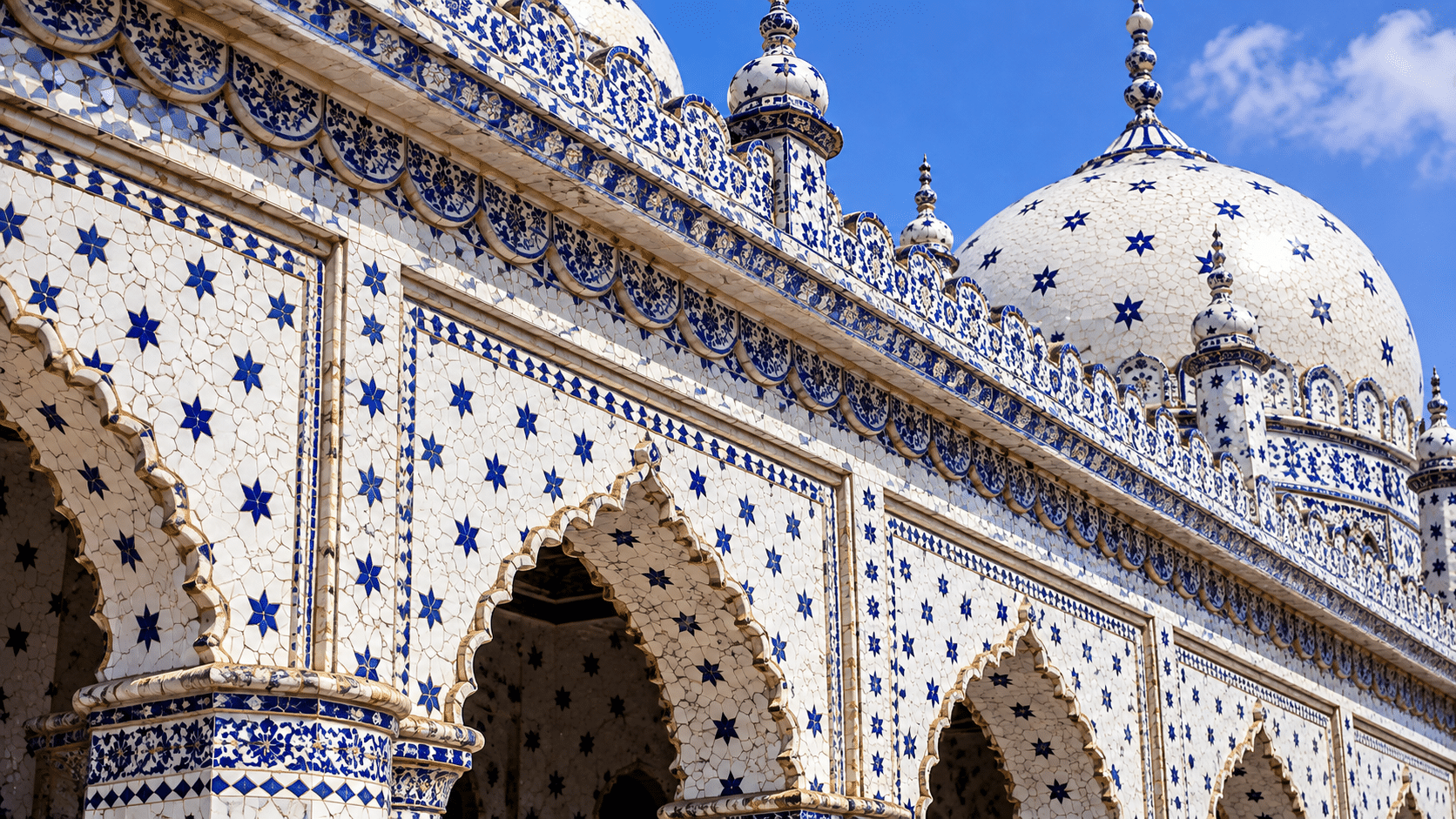
Star Mosque earns its name honestly, its every surface, inside and out, is covered in a mosaic technique called chinitikri, thousands of fragments of broken Chinese and Japanese porcelain arranged into blue star patterns that catch the light differently depending on the hour. It’s one of the most visually distinctive religious buildings in Bangladesh, and unlike Old Dhaka’s larger monuments, it’s compact enough to take in fully in under an hour.
The mosque began modestly. A local nobleman, Mirza Ghulam Pir, built it in the first half of the 19th century, and it carried his name for decades. Its transformation into the star-covered landmark known today came later, in 1926, when a businessman named Ali Jan Bepari funded a renovation that added the star motifs and porcelain mosaic work that define the building now. That renovation is really the reason the mosque is famous at all, a case of restoration becoming more celebrated than the original construction.
The mosque sits in Armanitola, a neighborhood name that itself points to Old Dhaka’s layered history, it references the Armenian merchant community that once traded here. Star Mosque remains an active place of worship, not a museum piece, which means visitors should expect limited access to the inner prayer hall during the five daily prayers and especially around Friday Jumma. The exterior courtyard and mosaic work, however, are visible and photographable throughout the day, and that’s honestly where most of the visual impact lives anyway.
Modest dress is expected, as at any working mosque, long sleeves and covered legs for men, a headscarf for women. It pairs naturally with a stop at Ahsan Manzil or the Armenian Church nearby, both an easy walk or short rickshaw ride away through Old Dhaka’s narrow lanes.