
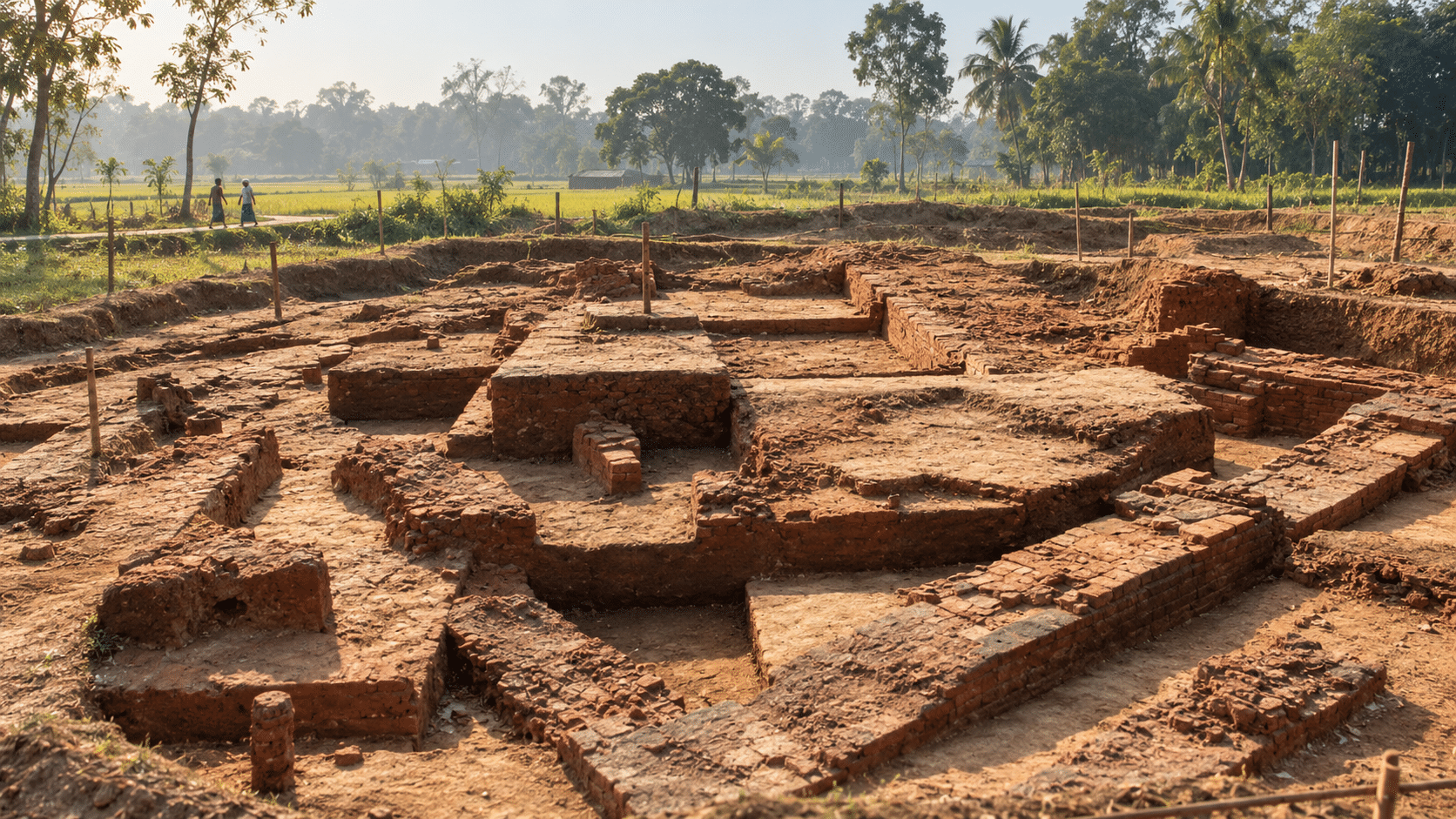
The Wari Bateshwar archaeological site is where Bangladesh’s deep past meets open fields and village paths. Found in Belabo upazila of Narsingdi, roughly 35 km north of Narsingdi town, the Wari Bateshwar archaeological site spreads across two neighbouring villages, Wari and Bateshwar. It is one of the oldest known urban sites in the country, and radiocarbon tests on pottery from Wari point to a settlement dating back to around 450 BCE.
What Is Inside the Wari Bateshwar Archaeological Site?
Excavation work that began in 2000 has revealed a fortified citadel of about 600 by 600 metres, circled by a moat roughly 30 metres wide. To the west and south-west, an earthen wall nearly 6 km long still runs across the landscape. Locals call it the Fort of the Uneven King.
Archaeologists have also marked dozens of smaller sites around the fort. These include brick-built houses and a paved road made with lime, surki and broken pottery. Together, they suggest a planned town with a busy trading life, not just a small village.
What You Can Actually See
Be ready for a quiet, open landscape. Much of the Wari Bateshwar archaeological site is farmland, with excavation trenches, exposed old bricks and soil mounds scattered between houses and fields. Traces of the old moat and walls are faint in many places, so a little imagination helps. Once a local guide points out where the fort stood, the whole area starts to make sense.
The Fort City Open-Air Museum
In February 2018, the research group Heritage Exploration opened the Wari Bateshwar Fort City Open-Air Museum in Wari village. It is described as the first museum of its kind in Bangladesh. Models, replicas, original finds, photographs and short explanations help you picture the ancient city. If you are short on time, start here, then walk out to the field areas of the Wari Bateshwar archaeological site.
The Pathan Family Collection
Long before experts arrived, local schoolteacher Hanif Pathan began collecting coins and beads at his home in Bateshwar. His family later kept this collection as a small museum and library, with iron tools, stone beads and silver coins among the items. Opening arrangements may change, so ask in Belabo or Bateshwar before you plan your visit around it.
Plan Your Wari Bateshwar Archaeological Site Visit
- Time needed: three to four hours if you include the open-air museum.
- Best months: November to February, when the ground is dry. Digging seasons usually fall in the cooler months.
- Wear: sturdy shoes, a hat and light cotton clothes. Paths can be muddy after rain.
- Carry: drinking water, cash for CNG and tea, and a power bank.
- Ask first: if an excavation is running, follow the team’s instructions and never step into a trench.
Visit the Wari Bateshwar Archaeological Site Responsibly
The Wari Bateshwar archaeological site is a protected heritage zone. Please do not pick up pottery pieces, beads or bricks, and say no to anyone selling so-called antiques. A broken fragment may look small, but for archaeologists, its exact position in the soil carries real information.
Make a Day of Belabo
Most visitors spend the morning at the Wari Bateshwar archaeological site and keep the afternoon for Belabo town.
Belabo has more to see around the site. The modern Belabo Bazar Central Jame Mosque is a stately building, and the medieval Maharanir Dighi is described as one of the largest reservoirs in eastern Dhaka Division. If you want the bigger story first, read our Wari Bateshwar heritage zone guide before you go.
Wari Bateshwar Archaeological Site FAQs
Is there an entry fee at the Wari Bateshwar archaeological site?
Travel listings report an open site with no regular ticket counter, but arrangements can change, so confirm locally.
How old is the Wari Bateshwar archaeological site?
Radiocarbon tests on pottery from Wari date the settlement to around 450 BCE, and some evidence points to earlier habitation.
How far is the Wari Bateshwar archaeological site from Dhaka?
It is about 75 km from Dhaka, and most travellers take a bus along the Dhaka-Sylhet highway and finish the trip by CNG.