

The Seven Domed Mosque, also called Sat Gambuj Mosque or Saat Gombuj Masjid, is a Mughal-era mosque and tomb complex in Mohammadpur, Dhaka. It was built around 1680, in the late 17th century, and tradition links it to the Mughal governor Shaista Khan. It gets its name from its seven domes: three large ones over the prayer hall and four on the corner towers. It stands near Banshbari Road in the Chand Mia Housing area and is looked after by the Department of Archaeology.
Mohammadpur is one of the busiest parts of Dhaka, packed with apartment blocks, shops and traffic. Turn into a narrow lane, and the noise suddenly softens. A red-and-cream mosque stands behind a green lawn, with its seven domes rising above the roofs. More than 300 years ago, a branch of the Buriganga River flowed beside it, and boats tied up at its steps. It is one of the quiet survivors of Mughal Dhaka.
The Seven Domed Mosque at a Glance
- Also known as: Sat Gambuj Mosque, Saat Gombuj Masjid, Satgumbad Mosque
- Location: Mohammadpur, Dhaka Division, near Banshbari Road
- Built: Around 1680 (the exact date is uncertain)
- Attributed to: Shaista Khan, or in some accounts his son Umid Khan
- Domes: Seven (three over the prayer hall, four over the corner towers)
- Also on site: A mausoleum known as the Unknown Tomb or Bibir Mazar
- Managed by: The Department of Archaeology, with local residents’ help
The Seven Domed Mosque in Dhaka: A Mughal Landmark
The Seven Domed Mosque is a unique piece of Mughal architecture in the capital. Banglapedia describes a mosque with seven domes, three over the prayer chamber and four over the corner towers, and that is how it earned the name Satgumbad. The four corner towers are hollow and two storeys high, and each is topped by a dome with a lotus finial. Together, they make the mosque different from most others in Dhaka.
Who Built the Seven Domed Mosque?
No inscription has survived, so the builder and the date are not certain. Archnet notes that the date of around 1680 is based on its style, which matches Shaista Khan’s other mosques. Wikipedia gives a construction period of about 1678 to 1684 and says the Seven Domed Mosque may have been built by Shaista Khan, who governed Bengal under the emperor Aurangzeb. Some local elders and writers say it was built by his son, Umid Khan, also around 1680, as The Daily Star reports.
The design is similar to two other Mughal mosques in Dhaka, the Lalbagh Fort Mosque (1678 to 1679) and the Khwaja Ambar Mosque in Karwan Bazar, which supports the idea that all three belong to the same period.
The 1814 Painting by Charles D’Oyly
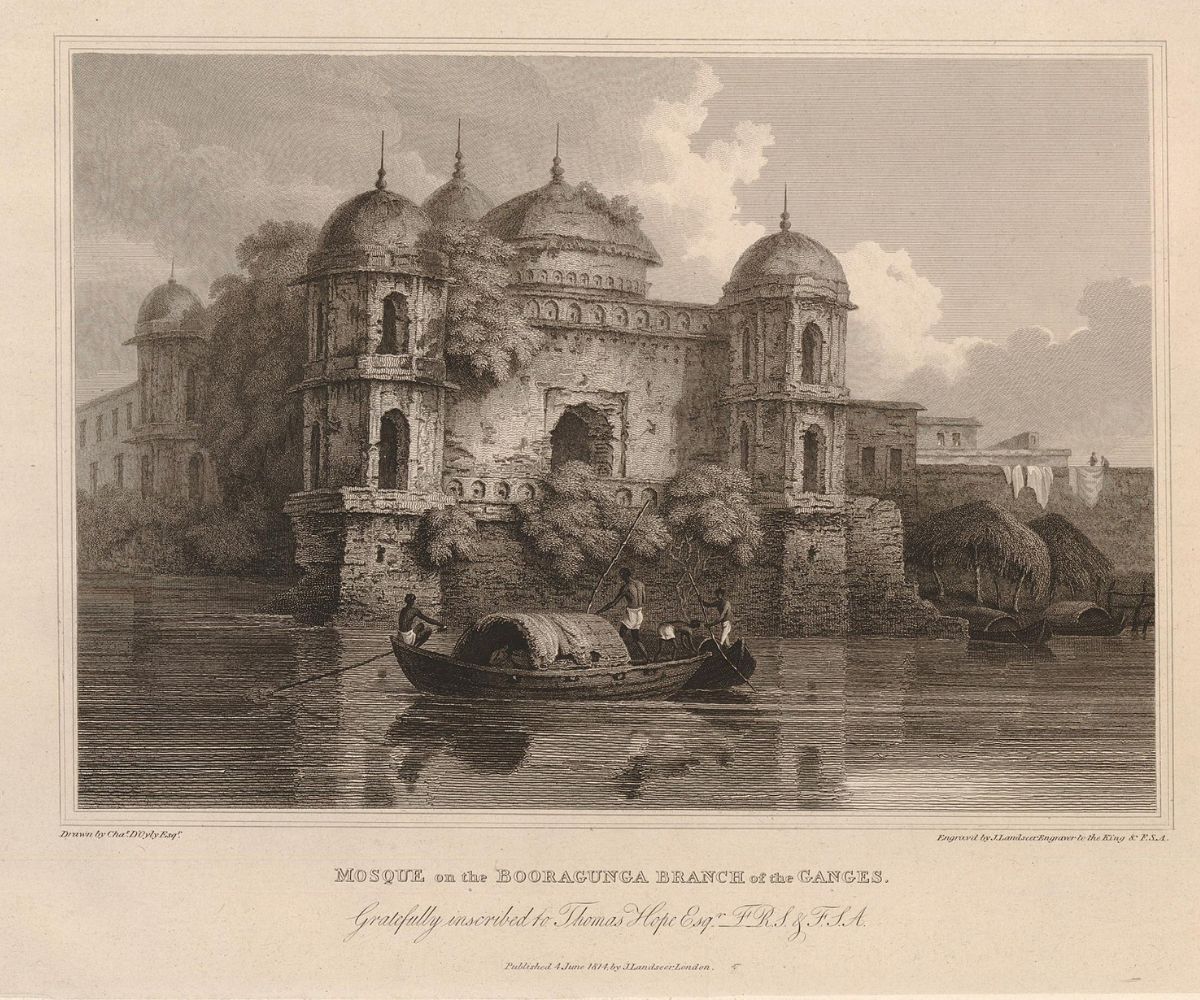
An 1814 artwork by Sir Charles D’Oyly, then the Collector of Dhaka, shows the mosque standing beside a branch of the Buriganga River. It was later engraved by John Landseer, and the title calls it a view of the “seven mosques” on the banks of the Buriganga. The picture shows boats and trading vessels near the mosque’s ghat, and it gives us a rare view of the Dhaka riverfront before the city grew around it. People coming by river in those days could pray on the steps of the mosque.
Then and Now: The Mosque and Its Surroundings
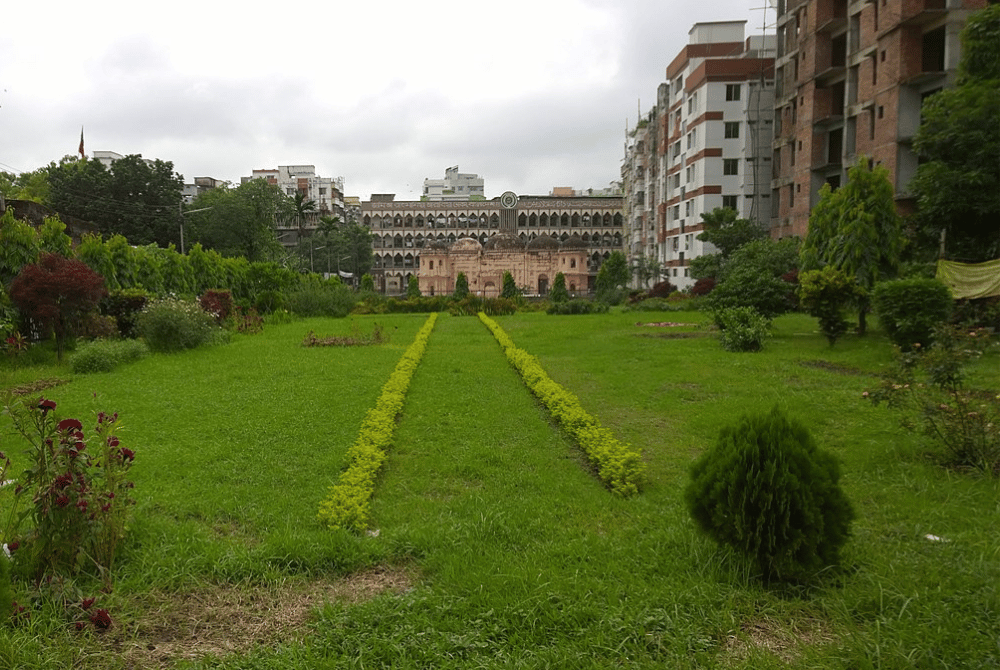
Much has changed since 1814. The river branch has been filled in, and tall buildings, shops and homes now surround the mosque. A large madrasa stands on the west side, built in 1986, according to local accounts. In front of the mosque, on the east side, there is still a green garden with trees and flowering plants, which gives worshippers a small break from the city.
Architecture of the Seven Domed Mosque
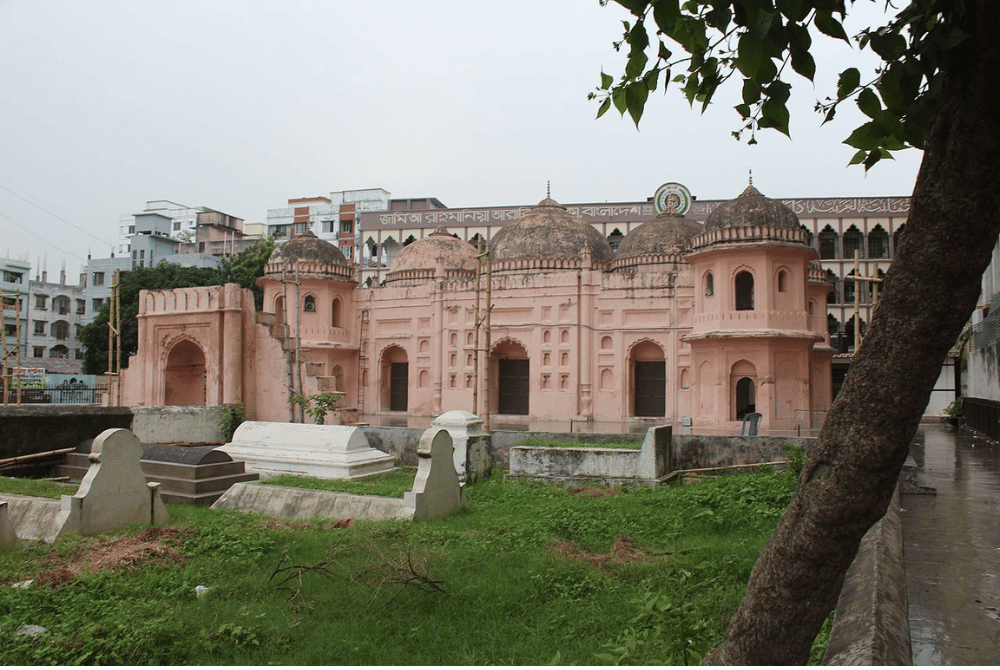
The Seven Domed Mosque is rectangular. Reported measurements put the inside of the prayer hall at about 14.33 meters long and 4.88 meters wide, and the outside at about 17.68 meters by 8.23 meters. Please treat these as approximate. Along the west wall, there are three mihrabs (prayer niches), and a raised pulpit stands beside the central one. Small mihrab-shaped designs on the front walls add to its look.
The prayer hall is entered through three arched openings on the east side, and the central one is the main door. There are arches on the north and south as well. On the west side, there are ablution areas, and local accounts mention a separate ablution block in the south-west corner and a quadrangular ablution area with a central water basin. Archnet describes the building as standing on a raised bank about 15 feet high, which once overlooked the river and a wide flood plain.
The Unknown Tomb (Bibir Mazar)
Near the mosque’s garden stands a small mausoleum that is known as the Unknown Tomb or Bibir Mazar (the tomb of the Bibi). It is octagonal inside and square outside. No inscription survives, so we cannot say for sure who is buried there. Some historians, including Syed Aulad Husain, think it may be the grave of one of Shaista Khan’s daughters. A small cemetery also lies at the north-east corner of the mosque compound.
Preservation and Use Today
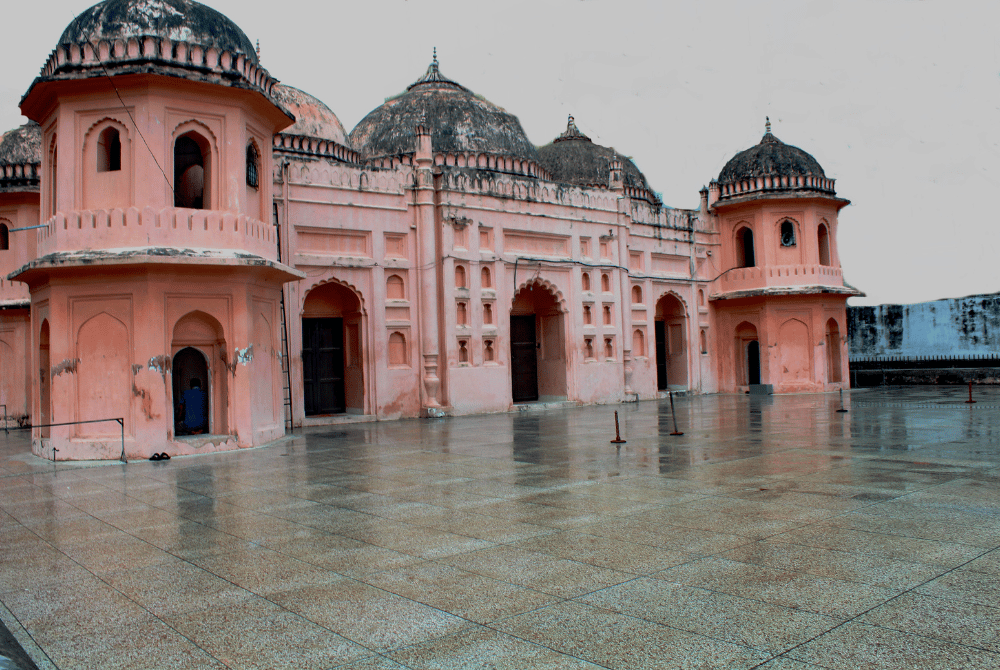
The Seven Domed Mosque and the Unknown Tomb are protected by the Department of Archaeology. According to The Independent, the mosque and the tomb were restored after a period of neglect. The Seven Domed Mosque is still an active mosque, and local residents help look after it. Local reports say about a hundred worshippers can pray in the central hall, although some parts of the building may be closed for safety, so please follow the instructions of the caretakers.
Visiting the Seven Domed Mosque
The Seven Domed Mosque is hidden among high-rise buildings, so it can be hard to find at first. Ask for the Sat Gambuj Mosque in Mohammadpur, and use a map app. Dress modestly, remove your shoes and avoid prayer times. Opening times and rules can change, so confirm them locally. For more mosques and Mughal sites, see our heritage mosques, the Sixty Dome Mosque in Bagerhat, Bagha Mosque in Rajshahi and the Chini Mosque in Saidpur. In Dhaka, you can also visit Gurdwara Nanak Shahi and try the lassi at Beauty Lassi. Browse our religious places and historical sites, and read our tips on local transport in the city.
Frequently Asked Questions About the Seven Domed Mosque
What is the Seven Domed Mosque?
The Seven Domed Mosque, or Sat Gambuj Mosque, is a Mughal-era mosque and tomb complex in Mohammadpur, Dhaka, built around 1680.
Why is it called the Seven Domed Mosque?
It has seven domes: three over the main prayer hall and four over the hollow corner towers.
Who built the Seven Domed Mosque?
It is traditionally attributed to Shaista Khan, the Mughal governor of Bengal, although some accounts say his son Umid Khan built it. No inscription survives, so the builder is not certain.
When was the Seven Domed Mosque built?
Around 1680, in the 17th century, based on its architectural style. Wikipedia gives a construction period of about 1678 to 1684.
Where is the Seven Domed Mosque located?
It is in Mohammadpur, Dhaka, near Banshbari Road in the Chand Mia Housing area.
What is the Unknown Tomb near the Seven Domed Mosque?
The Unknown Tomb, or Bibir Mazar, is an octagonal-inside mausoleum next to the mosque garden. Its occupant is unknown, although some historians think it may be a daughter of Shaista Khan.
Who painted the Seven Domed Mosque in 1814?
Sir Charles D’Oyly, then the Collector of Dhaka, made an 1814 artwork that shows the mosque beside the Buriganga River. It was engraved by John Landseer.
Final Thoughts on the Seven Domed Mosque
The Seven Domed Mosque has watched the river leave and the city arrive. Its seven domes, quiet garden and mysterious tomb make it one of the most rewarding stops for anyone interested in Mughal Dhaka. Take a few minutes to step off the busy road and look at it closely. For more ideas, explore our places to visit in Bangladesh, our Places to Visit stories and our travel experiences.