
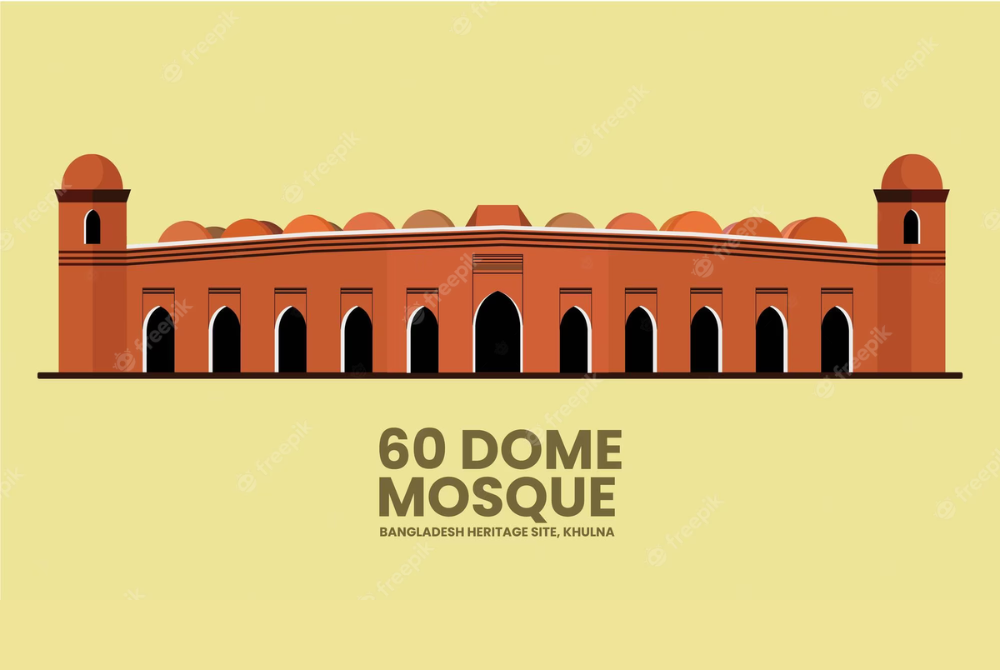
The Sixty Dome Mosque (ষাট গম্বুজ মসজিদ), locally known as Shat Gombuj Masjid, is a 15th-century mosque in Bagerhat, in Khulna Division, Bangladesh. Built by the saint-general Khan Jahan Ali, it is the largest Sultanate-era mosque in the country and the best-known part of the UNESCO World Heritage Site called the Mosque City of Bagerhat. Despite its name, it has 77 domes over the main hall and 60 pillars.
Step inside the Sixty Dome Mosque and the first thing you notice is not a dome at all. It is a forest of slender pillars, standing in neat rows and fading into soft shade. Outside, the heat of southern Bangladesh feels far away. This quiet brick giant was once a mosque, a school and a meeting hall for a frontier city in the mangroves, and it still holds the calm of that time.
The Sixty Dome Mosque at a Glance
- Local name: Shat Gombuj Masjid (ষাট গম্বুজ মসজিদ), also spelled Shait Gumbad Masjid
- Location: Bagerhat District, Khulna Division
- Builder: Khan Jahan Ali
- Built: 1442 to 1459, during the Bengal Sultanate
- Style: Tughlaq-influenced brick architecture
- Size: About 49 m by 33 m (160 ft by 108 ft)
- Domes and pillars: 77 domes over the main hall, 60 pillars
- UNESCO listing: 1985, as part of the Mosque City of Bagerhat
Exploring the Magnificence of the Sixty Dome Mosque in Bagerhat, Bangladesh
The Sixty Dome Mosque stands in the heart of the old Bagerhat settlement, in southern Bangladesh. It is part of the Mosque City of Bagerhat, a World Heritage Site that reflects the grandeur of the Bengal Sultanate period (1352 to 1576). In this guide, we look at the history, location and architecture of the Sixty Dome Mosque, and we clear up the puzzle of its name.
A Glimpse into the History of the Sixty Dome Mosque
In the 15th century, a devout Muslim leader named Khan Jahan Ali built a thriving settlement near the coast, at the edge of the Sundarbans mangrove forest. It was known as Khalifatabad, and it grew during the reign of Sultan Nasiruddin Mahmud Shah. Khan Jahan Ali filled the city with mosques, tanks and roads. Among them, the Sixty Dome Mosque became the most imposing and the largest.
Construction is commonly dated from 1442 to 1459, although the exact start is not certain, as Dhaka Tribune points out. Many scholars see it as the great congregational mosque of Khan Jahan Ali, built within his lifetime. It served as a place of worship, a madrasa (Islamic school) and an assembly hall. UNESCO listed the Mosque City of Bagerhat as a World Heritage Site in 1985.
Location of the Sixty Dome Mosque
The Sixty Dome Mosque is in Bagerhat District, in the Khulna Division of southern Bangladesh, a few kilometers from Bagerhat town. Bagerhat lies roughly 300 km southwest of Dhaka, and the exact road distance depends on your route. The Khan Jahan Ali mausoleum and the Nine Dome Mosque (Noy Gombuj Masjid) are nearby, so most visitors see them all in one trip. For more on this region, read our guide to Khulna District, and for more on getting there, see our tips on local transport.
Architectural Splendor of the Sixty Dome Mosque
The Sixty Dome Mosque is a fine example of Tughlaq-influenced architecture. It has very thick, slightly tapered brick walls, about 1.8 meters (6 feet) thick, and hollow, round corner towers that look like fortress bastions. A hut-shaped roofline, taken from local Bengali building styles, foreshadows trends that came later. Most sources give its size as about 160 feet by 108 feet (49 m by 33 m), while some surveys list 148 feet 6 inches by 101 feet 4 inches, as Archnet does.
The most striking feature is the roof. Seven rows of eleven squat domes make 77, and an extra dome sits on each corner, which brings the total to 81. Seven of the central domes are chauchala, a Bengal hut-shaped roof with four sloping sides.
The interior is a hall of aisles and bays. Slender columns lead up to arches that carry the roof. The mosque is well ventilated, with 11 arched doorways on the east side and 7 each on the north and south. Along the western wall, you can see a row of mihrabs (prayer niches), and the larger central one projects outward on the exterior. Together, these features show the refined beauty of 15th-century Bengal.
Sixty Domes or Sixty Columns?
The mosque is called the “Sixty Dome Mosque” locally, but it has 77 domes over the main hall, so the name does not match the count. One popular theory is that the real name was “Sixty Pillared Mosque”, since the roof rests on 60 pillars (Dhaka Tribune counts 55 stone and 5 brick). In that theory, the word “amud” (pillar in Arabic and Persian) slowly turned into “gombuj” (dome) in Bengali. It is a theory, not a proven fact, but it explains why a building with 77 domes carries the number sixty.
Planning a Visit to the Sixty Dome Mosque
Winter, from November to February, is usually the most comfortable time for walking around the site. Opening hours, entry fees and dress rules can change, so confirm them locally. Dress modestly, remove your shoes when asked and avoid visiting during prayer times. If you are interested in more heritage places, browse our heritage mosques, religious places and historical sites. You can also read about the ancient mosques of Jhenaidah District, or see another UNESCO site, Somapura Mahavihara.
Frequently Asked Questions About the Sixty Dome Mosque
What is the Sixty Dome Mosque?
The Sixty Dome Mosque, or Shat Gombuj Masjid, is a 15th-century mosque in Bagerhat, Bangladesh. It is part of the UNESCO World Heritage Site called the Mosque City of Bagerhat.
Who built the Sixty Dome Mosque?
Khan Jahan Ali, a saint and governor of the Sundarbans region, built the Sixty Dome Mosque during the Bengal Sultanate. Construction is commonly dated from 1442 to 1459.
Where is the Sixty Dome Mosque located?
The Sixty Dome Mosque is in Bagerhat District, Khulna Division, in southern Bangladesh, a few kilometers from Bagerhat town.
Why is it called the Sixty Dome Mosque?
It is named for the Bengali “Shat Gombuj”, meaning sixty domes, but it actually has 77 domes and 60 pillars. One theory says the name came from the sixty pillars, not the domes.
How many domes does the Sixty Dome Mosque have?
It has 77 domes over the main hall, in seven rows of eleven, plus four more on the corner towers, which makes 81.
Is the Sixty Dome Mosque a UNESCO World Heritage Site?
Yes. It is part of the Mosque City of Bagerhat, which UNESCO inscribed as a World Heritage Site in 1985.
What is the best time to visit the Sixty Dome Mosque?
Winter, from November to February, is usually the most comfortable season, with drier and cooler weather.
The Sixty Dome Mosque is a place for slow looking. Its thick brick walls, rows of low domes and quiet forest of pillars show how skilled builders could shape a city out of mud, brick and belief. If you love history, architecture or simply a peaceful corner of Bangladesh, put the Sixty Dome Mosque on your list. For more ideas, explore our places to visit in Bangladesh and travel experiences.