
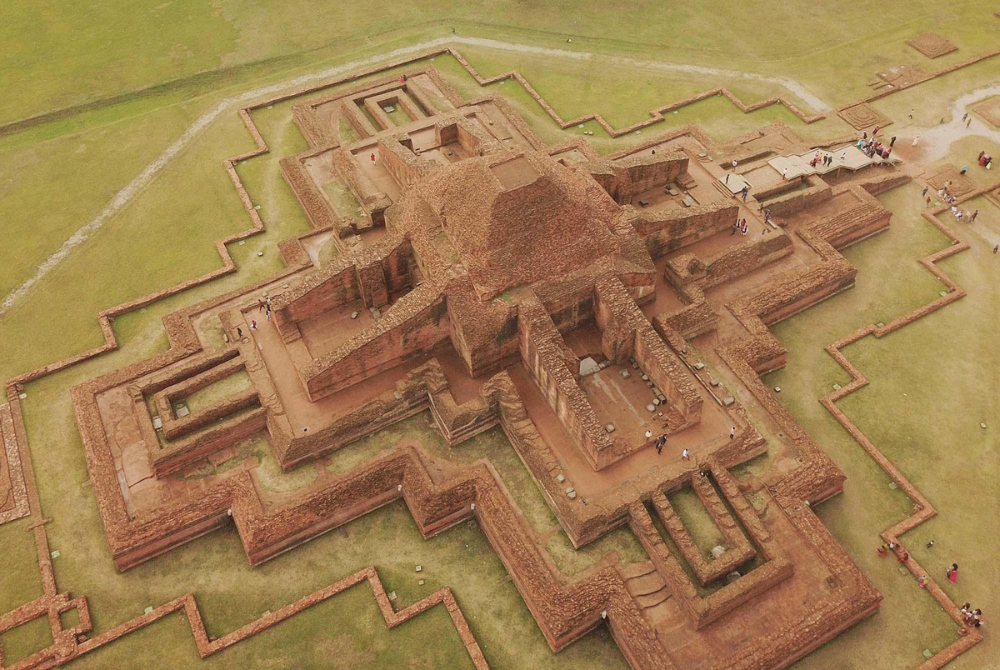
Somapura Mahavihara (সোমপুর মহাবিহার), also known as the Paharpur Buddhist Vihara (পাহাড়পুর বৌদ্ধ বিহার), is an ancient Buddhist monastery in Paharpur, Badalgachhi, Naogaon, Bangladesh. Built by the Pala king Dharmapala in the late 8th century, it is one of the best-known Buddhist monasteries in the Indian Subcontinent and has been a UNESCO World Heritage Site since 1985.
Walk in through the gate at Paharpur and you meet a wall of red-brown brick, and in the middle, a huge cross-shaped temple rising in terraces. More than 1,200 years ago, monks lived in the cells around this courtyard, scholars travelled long roads to study here, and ideas moved from here across the region. Somapura Mahavihara is more than a ruin. It is a window into the days when Bengal was a centre of learning.
Somapura Mahavihara at a Glance
- Also known as: Paharpur Buddhist Vihara
- Bengali name: সোমপুর মহাবিহার / পাহাড়পুর বৌদ্ধ বিহার
- Location: Paharpur, Badalgachhi, Naogaon, Rajshahi Division
- Built by: Dharmapala of the Pala dynasty (around 781 to 821 CE)
- UNESCO listing: 1985, as “Ruins of the Buddhist Vihara at Paharpur”
- Monk cells: 177
- Nearby: About 46.5 km north-west of Mahasthangarh
Somapura Mahavihara: An Overview (সোমপুর মহাবিহার)
Somapura Mahavihara is one of the most renowned Buddhist viharas, or monastic complexes, in the whole Indian Subcontinent. Its historical and cultural value earned it a place on the UNESCO World Heritage List in 1985. You can read the official record on the UNESCO World Heritage document for Paharpur.
The site is a proud example of the architecture of pre-Islamic Bangladesh. It belongs to the same era as other monasteries nearby, such as Halud Vihara and Sitakot Vihara, and together they show how widely Buddhism once flourished in northern Bengal.
Historical Context of Somapura Mahavihara
During the Pala period, several great mahaviharas (Buddhist universities) thrived in the eastern parts of the Indian Subcontinent, including Bengal and Magadha. They worked like a network under state support. The best-known were Vikramashila, Nalanda, Somapura, Odantapura and Jagaddala. Scholars moved freely between them.
This network produced great teachers. Atisa Dipankara, who later carried Buddhism to Tibet, came from this tradition, and his teacher Ratnakara Shanti served as a senior monk at Somapura. Around the same era, early Bengali began to take shape as a language.
Excavated clay seals show that Dharmapala built Somapura Mahavihara, and it was later repaired during the reign of Mahipala. In the 11th century, an army led by Jatvarma attacked Varendra and a part of the vihara was damaged by fire. Between the 9th and 12th centuries, many scholars and Tibetan monks visited. Under the Sena dynasty in the 12th century, the vihara slowly lost its importance as the political map of Bengal changed.
Evidence of a wider religious mix also turned up here. A copperplate dated 479 CE, found at Paharpur, records a gift to a Jain teacher’s monastery in the area.
Architecture of Somapura Mahavihara
Somapura Mahavihara is a vast, square Buddhist monastery. Depending on how the area is counted, it covers roughly 8.5 to 11 hectares. Around a central courtyard stand 177 monk cells, and inside the courtyard rise viharas, stupas, small chapels and a grand central temple with a cross-shaped plan. The temple’s design is unique, and experts still debate parts of it.
The site has also given up many treasures: terracotta plaques, stone sculptures, inscriptions, coins and pottery. They show traces of Buddhism, Jainism and Hinduism living side by side. It was an important centre of learning, and its style is said to have influenced Buddhist architecture as far as Myanmar, Java and Cambodia.
One big question remains: what did the top of the central temple look like? The upper part is gone, and scholars have suggested everything from a stupa to a temple-like spire. The most reliable record comes from archaeological studies, including the work of K. N. Dikshit, Prudence R. Myer and Mohammad Habib Reza, each of whom added to what we know about its design and possible reconstruction. For a wider background on monastic sites in Bengal, see the Banglapedia entry on Buddhist Viharas.
Planning a Visit to Somapura Mahavihara
Paharpur lies about 46.5 km north-west of Mahasthangarh, so many travellers see both heritage sites on one trip. Read our guide to Mahasthangarh in Bogura to plan the pair. Winter, from November to February, is the most comfortable season for walking around the open ruins. Timings and entry rules can change, so check with the site office before you go.
For more heritage trips, browse our archaeological sites in Bangladesh, historical sites and religious places. To follow the Buddhist story further, read about Cumilla District and its ancient Buddhist heritage, and check our tips on local transport.
Frequently Asked Questions About Somapura Mahavihara
What is Somapura Mahavihara?
Somapura Mahavihara is an ancient Buddhist monastery in Paharpur, Naogaon, Bangladesh. It was built by the Pala king Dharmapala and is a UNESCO World Heritage Site.
Is Somapura Mahavihara the same as Paharpur Buddhist Vihara?
Yes. Somapura Mahavihara and Paharpur Buddhist Vihara are two names for the same site. UNESCO lists it as “Ruins of the Buddhist Vihara at Paharpur”.
Who built Somapura Mahavihara?
The Pala king Dharmapala built it, around 781 to 821 CE. Clay seals found during excavation confirm this.
When did Somapura Mahavihara become a UNESCO World Heritage Site?
It was added to the UNESCO World Heritage List in 1985.
How many cells does Somapura Mahavihara have?
The monastery has 177 monk cells around its central courtyard, with a cross-shaped temple in the middle.
How far is Somapura Mahavihara from Mahasthangarh?
Paharpur is about 46.5 km north-west of Mahasthangarh, so the two sites are often visited together.
Final Thoughts on Somapura Mahavihara
Somapura Mahavihara reminds us that Bangladesh was once a hub of Buddhist learning, with scholars, monks and artists working side by side. Stand before its great central temple, count the rows of cells, and you will feel how big this world once was. Come with time and curiosity, and let the bricks tell their story. For more journeys like this, explore our places to visit in Bangladesh and travel experiences.