
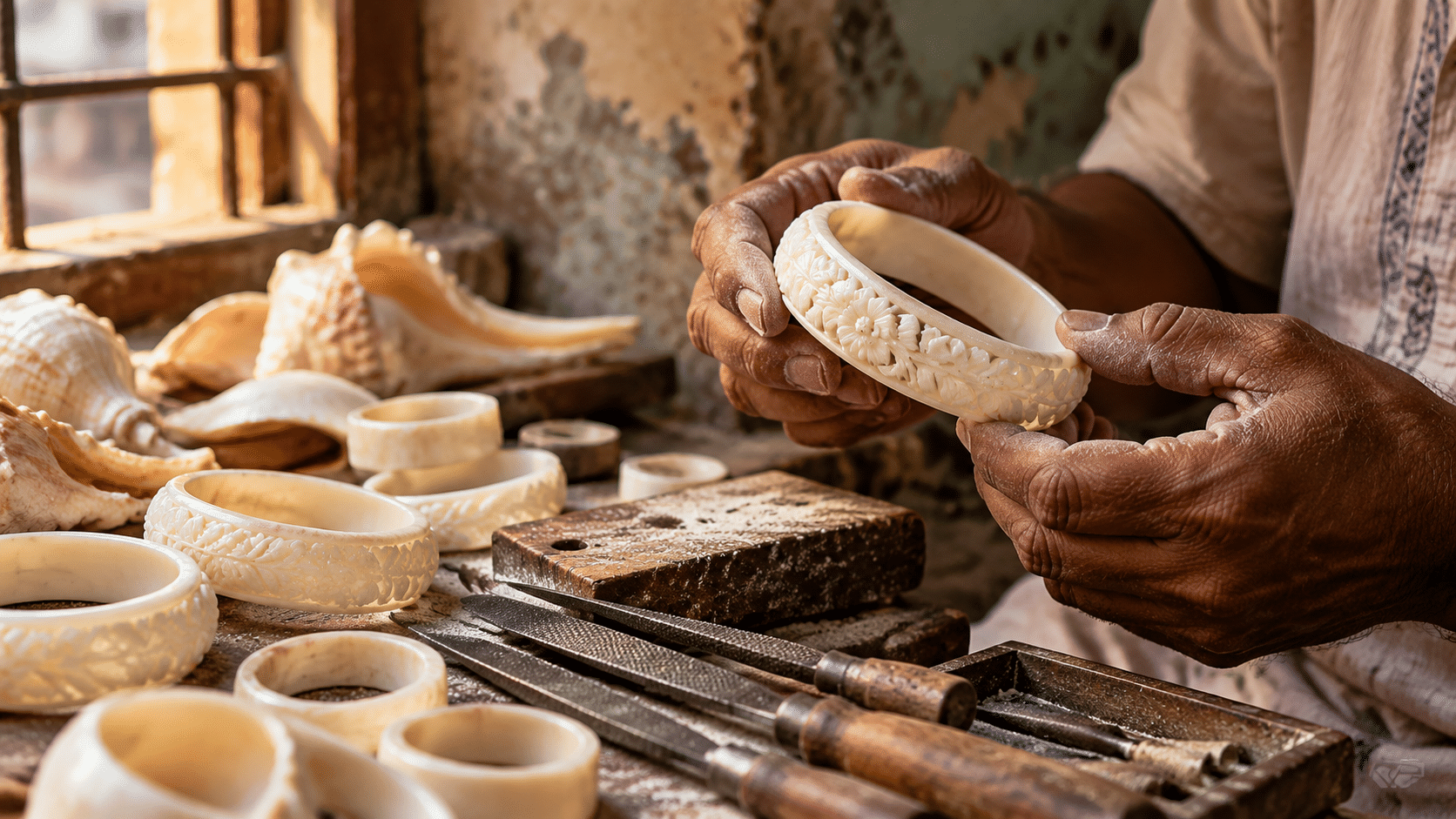
Conch shell bangles, called shankha or shakha in Bengali, are one of the oldest handmade objects still made and worn every day in Dhaka. Cut from the spiral shell of a sea snail and finished by hand, they are white, smooth and instantly recognisable. For married Hindu women across Bengal, conch shell bangles carry a meaning that no factory-made bangle can replace.
How conch shell bangles are made
A conch shell bangle is never cast or moulded. A whole shell is sliced into rings, and each ring is then filed, shaped and polished by hand until it fits a wrist. Some conch shell bangles stay plain and glossy. Others are carved with fine patterns, and the difference between a simple ring and a well-carved one is usually the hours of patient filing behind it. The shell is brittle, so every cut has to be right. One slip can crack a ring and waste the material.
More than jewellery
The bangle is the best-known product, but the same shell serves other purposes. Larger shells become the vadya shankha, blown like a trumpet at prayers and festivals, and the jal shankha, used to offer holy water to deities. In many Hindu homes the sound of the conch at dusk is a familiar marker of the evening ritual.
Why brides wear them
Traditionally, a bride receives her shakha from the older women of the family in the early hours of her wedding day. She wears it with a red bangle called the pola for as long as she is married. This is why demand for conch shell bangles rises around weddings and around Durga Puja, the biggest Hindu festival in Bangladesh.
Where the shells come from
Bangladesh does not source enough conch shells locally, so the trade has always depended on imports. Before 1947, shells reached Dhaka through Calcutta from South India and Sri Lanka. After Partition, that route closed and shells began arriving directly from Sri Lanka. Within Bangladesh, Noapara in Jessore is known as a trading centre for raw shells, where many are sliced by machine before reaching artisans. Because the raw material is imported and limited, every shell matters to a craftsman.
What to expect in a workshop
Most workshops on the lane are small, with a few artisans working at low benches, surrounded by rings, files and half-finished pieces. Watching a bangle take shape takes patience, so give yourself time. Ask before you take photographs, greet the artisan first, and keep in mind that this is a place of work and worship as much as a shopping street.
How to buy conch shell bangles
When you choose conch shell bangles, look for even thickness, a smooth inside surface and no hairline cracks. Try it on before you pay, because a rigid ring cannot stretch to fit. Ask where the shell came from and whether the carving was done by hand. Prices vary widely with size and detail, so compare a few shops before you buy. Visit in daylight when workshops are open, and be ready to bargain politely.
Caring for your conch shell bangles
Conch shell is hard but brittle. Keep your bangles away from sharp knocks, take them off before heavy work, and avoid harsh chemicals such as strong cleaners. A soft, dry cloth is enough to keep the surface glossy.
A craft that needs visitors
The Shakhari community, whose name comes from shakha itself, has made these bangles in Old Dhaka for generations. Their street is now a government-declared heritage site, yet the buildings and the trade are both fragile. Buying a bangle directly from a shop on the lane is one of the simplest ways for a visitor to support the craft. For the street itself, its history and its Durga Puja atmosphere, see our guide to Shakhari Bazar.
Another Dhaka craft worth seeking out is the hand-painted rickshaw art that colours the city’s streets.